
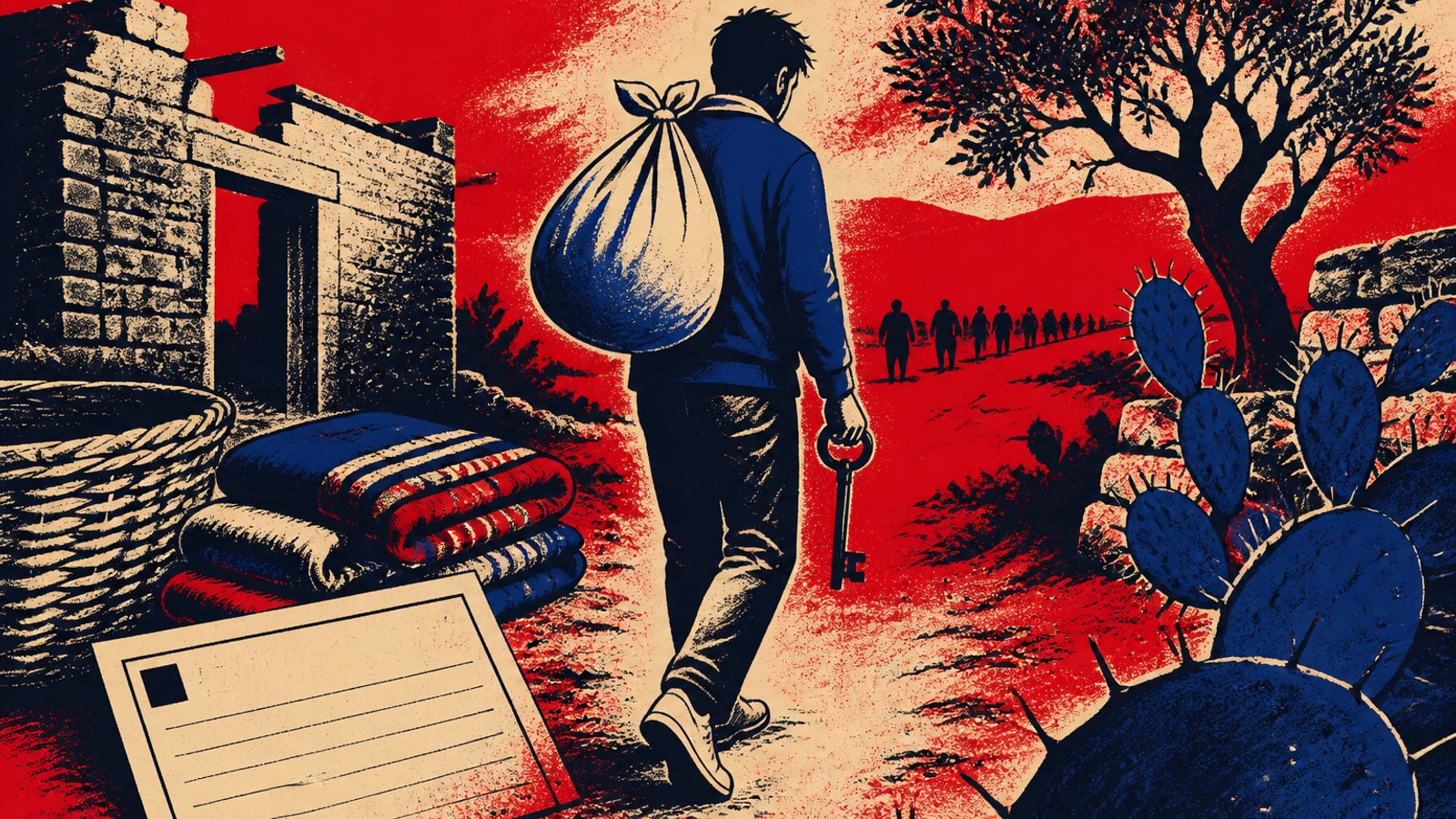
The Nakba is the Palestinian term for the destruction of Palestinian society in the war of 1947 to 1949, and the peer-reviewed article “1948 Refugees” (Israel Law Review, 2018) puts its scale at about 400 Palestinian towns and villages destroyed and the expulsion and flight of about 80% of the residents of the Palestinian regions on which the State of Israel was established. Two reports of 1949 put the resulting refugee count between 711,000 and 774,000, as recorded in “A Historical Overview of the Palestinian Refugee Question” (Oxford University Press, 2020), and the higher of those two figures includes about 17,000 Jewish refugees from Mandate Palestine. The definitions in the literature do not stop at departures: they add confiscation of property, killings, the collapse of a society and the loss of a homeland, and they disagree, by name, over whether the result should be called ethnic cleansing.
Key Findings
- About 400 Palestinian towns and villages were destroyed and about 80% of the residents of the Palestinian regions on which Israel was established were expelled or fled, per the peer-reviewed article “1948 Refugees” (Israel Law Review, 2018).
- Two reports of 1949 put the refugee count between 711,000 and 774,000, as recorded in “A Historical Overview of the Palestinian Refugee Question” (Oxford University Press, 2020).
- The higher of those two 1949 figures, 774,000, includes about 17,000 Jewish refugees from Mandate Palestine, mostly from the Arab-held part of Jerusalem, later absorbed by Israel (Oxford University Press, 2020).
- A separate count of the same period, 960,000 persons in need of assistance between 30 September 1949 and 30 April 1950, was produced by the International Committee of the Red Cross, the League of Red Cross Societies and the American Friends Service Committee, and is not a refugee count (Oxford University Press, 2020).
- Morris (2004) works from the Israeli archives at roughly 700,000 displaced and rejects both a single master expulsion plan and the claim that departures were voluntary; Pappé (2006) titles the same events ethnic cleansing.
What does the word Nakba name?
Nakba is Arabic for catastrophe, and in the peer-reviewed article “1948 Refugees” (Israel Law Review, 2018) it names the total destruction that struck Palestinian society with the establishment of the State of Israel in 1948, a process the article measures at about 400 Palestinian towns and villages destroyed. That same article records the human share: the expulsion and flight of about 80% of the residents of the Palestinian regions on which the state was established.
The definitions in circulation differ in how much they take the word to cover, and the difference is not decorative. The United Nations, on its Question of Palestine explanatory page dated 21 May 2025, describes the Nakba as the mass displacement and dispossession of Palestinians during the 1948 Arab-Israeli war, a formulation built entirely on movement of people. The reference entry “Nakba, al-” at Encyclopedia.com defines the term more broadly, as “the flight and expulsion of the Palestinians during the 1947 to 1948 war, the confiscation of their property, massacres committed by Zionist (after 14 May 1948, Israeli) forces, the collapse of their society and, ultimately, the loss of their homeland.”
The Israel Law Review article (2018) sits with the wider reading: it treats the destruction of towns and villages, the expulsion and flight of residents, and the ensuing refugee question as one referent rather than four. So the word carries at least two distinct scopes in published usage. One is an event of displacement with a headcount attached. The other is a compound outcome in which the headcount is one element among the loss of property, the physical erasure of localities and the ending of a society in the territory that became Israel.
Both scopes are in use by named publishers, both are dated, and a reader who meets a single sentence definition has met one of them without being told which. The rest of this report takes the compound reading apart element by element, because that is where the checkable numbers sit.
Is the Nakba simply the displacement of 700,000 people?
On the number, the common account is close to the record: two reports of 1949 put the refugee count between 711,000 and 774,000, as recorded in “A Historical Overview of the Palestinian Refugee Question” (Oxford University Press, 2020), and Morris (2004) works from the Israeli military and state archives at roughly 700,000.
The widely repeated figure of around 700,000 to 750,000 sits inside that band.
Where the record extends past the common account is in what else the term names. The Israel Law Review article (2018) counts about 400 towns and villages destroyed as part of the same referent, which is a measure of localities rather than of people. The Encyclopedia.com entry adds confiscation of property and the loss of a homeland to its definition. A departure count answers how many people left. It does not answer how many places ceased to exist, what was taken, or what happened to the claim on it, and each of those is carried inside the word by the sources that define it.
The third bar is the clearest illustration that the counts are not interchangeable. The 960,000 figure, produced for the relief operation covering 30 September 1949 to 30 April 1950 by the International Committee of the Red Cross, the League of Red Cross Societies and the American Friends Service Committee, counted persons in need of assistance as a consequence of the conflict, not all of them refugees (Oxford University Press, 2020). It is larger than either refugee figure because it enumerates a different population.
Which years does the term actually cover?
The dated sources bracket the referent as a process running from late 1947 into 1949, not a single year. The Oxford University Press chapter (2020) works across the 1947 to 1949 period; the Israel Law Review article (2018) frames the referent around the establishment of the State of Israel in 1948; the Encyclopedia.com entry dates it to the 1947 to 1948 war. 1948 is the pivot year, not the boundary.
Three fixed instruments and dates sit on the record inside that span. The Declaration of the Establishment of the State of Israel, read in Tel Aviv on 14 May 1948 and published in Official Gazette Number 1, names in its own recitals the United Nations General Assembly resolution of 29 November 1947 as the recognition on which it rests (Provisional Government of Israel, 1948). The two refugee reports that produced the 711,000 and 774,000 figures were published in 1949 (Oxford University Press, 2020). The commemoration falls annually on 15 May, the day after the Declaration was read.
The practical consequence of the two-phase dating is that a single-year framing cannot hold the sequence. The Encyclopedia.com definition separates the civil war that followed 29 November 1947 from the interstate war that followed 14 May 1948, and attaches its reference to Israeli forces to the second phase only. Morris (2004) likewise attributes departures to causes that varied by locality and by phase. Any account that compresses the whole into “1948” loses the distinction between the two phases that the sources themselves keep apart.
Why do the refugee counts differ by tens of thousands?
No single body produced both headline figures: the 711,000 and the 774,000 come from two separate reports of 1949, as recorded in “A Historical Overview of the Palestinian Refugee Question” (Oxford University Press, 2020). They are two contemporaneous attempts at the same quantity, not a revision of one figure into another, which is why both remain in circulation.
Three features of the period explain why a precise total was not available to the bodies attempting it. The first is composition: the higher of the two 1949 figures counts a population the lower one does not, addressed in the next section. The second is definitional. The relief count of 960,000 persons in need of assistance for 30 September 1949 to 30 April 1950, produced by the International Committee of the Red Cross, the League of Red Cross Societies and the American Friends Service Committee, expressly counted persons receiving or needing assistance rather than persons displaced (Oxford University Press, 2020), and a figure of that construction cannot be set against a refugee total.
The third is the measurement conditions. Morris (2004) discusses the counting problem directly in the course of his archival reconstruction: people moved more than once and across phases of the war, registration for relief carried its own incentives, and locality-level records are uneven. His own working order of magnitude, roughly 700,000, is stated as an archival estimate rather than an enumeration.
What follows for a reader is a rule about how the number should be written. A range attributed to its two 1949 reports is checkable. A single round total presented without a publisher is not, because the record of that period contains no single count that all the counting bodies produced. The same caution applies in the other direction: the spread between the published figures is measured in tens of thousands against totals in the hundreds of thousands, so the disagreement is about precision, not about whether a mass displacement occurred.
How many towns and villages were depopulated?
The checkable figure is about 400 Palestinian towns and villages destroyed, per the peer-reviewed article “1948 Refugees” (Israel Law Review, 2018), which reports the count alongside its finding that about 80% of the residents of the Palestinian regions on which Israel was established were expelled or fled. That is the locality measure inside the definition, distinct from the refugee counts above.
Higher totals circulate, and their provenance is a compilation rather than a contemporaneous register. Morris (2004) reconstructs the period locality by locality from Israeli military and state archives, attaching a cause of departure to each place, and his village-level accounting is the archival anchor most other work argues with. Pappé (2006) works from a longer locality list in support of his thesis. The larger round totals that appear in public discussion trace to compilations published by the Palestine Land Society and by the volunteer project PalestineRemembered, each of which assembles localities from mixed sources, including Mandate-era records, later gazetteers and survivor accounts, and each of which states its own inclusion criteria.
Those compilation totals are not carried here as established counts, and the reason is a feature of the record rather than a judgment about the compilers: the 1947 to 1949 period produced no single official register of depopulated localities from either government, so every total in circulation is a reconstruction with a stated method. The peer-reviewed “about 400” is itself an approximation, written as an approximation in the source.
The distinction that matters for a reader is between depopulation and destruction. A locality can empty and stand, or empty and be levelled, and the two are counted differently by different compilers. The Israel Law Review figure is a destruction count. Morris’s locality accounting attaches a cause of departure, which is a separate question this Institute has examined in its report on what caused the displacement of Palestinians in 1948.
Do the 1948 refugee counts include Jewish displacement?
One of the two 1949 figures does. The higher count of 774,000 includes about 17,000 Jewish refugees from Mandate Palestine, most of them from the Arab-held part of Jerusalem, who were later absorbed by Israel, as recorded in “A Historical Overview of the Palestinian Refugee Question” (Oxford University Press, 2020). The lower figure of 711,000 does not carry that component.
This is a composition fact about a published number, and it has a direct consequence for how the number can be used. A citation of 774,000 as a count of Palestinian refugees attributes to that report a population it did not enumerate on its own. A citation of the 711,000 to 774,000 range as a Palestinian refugee band carries the same difficulty at its upper bound. The arithmetic of removing the component is not published by the chapter, so the honest form is to name what each figure contains rather than to net one against the other.
Israel’s own statistical register supplies the receiving side of that movement. The Central Bureau of Statistics reports the population of Israel at the establishment of the state as 806,000 (Central Bureau of Statistics, 2025, Israel’s Independence Day 2025, official statistic). Its Holocaust Day release for the same year reports that on the eve of the establishment of the state the world Jewish population stood at 11.5 million, of whom 650,000, or 6%, lived in Israel (Central Bureau of Statistics, 2025, official statistic). The 17,000 recorded inside the 1949 figure is therefore a small component measured against a receiving Jewish population of that order, and the bureau counts the absorbed population inside its national totals rather than as a standing refugee category.
Neither point alters the scale of the Palestinian displacement the same 1949 reports record. It fixes what each of the two published totals enumerated, which is the difference between a figure a reader can check and a figure a reader can only repeat.
What does Israel’s own founding record say about these events?
Israel’s founding instrument, read on 14 May 1948 and published in Official Gazette Number 1, records no count of departures and no reference to displacement; it appeals instead “to the Arab inhabitants of the State of Israel to preserve peace and participate in the upbuilding of the State on the basis of full and equal citizenship and due representation in all its provisional and permanent institutions” (Provisional Government of Israel, 1948, founding record).
The Declaration’s equality clause exists in two official English translations, and they differ on the word the clause turns on. The Knesset publishes the sentence as a pledge that the state “will ensure complete equality of social and political rights to all its citizens irrespective of religion, race or sex.” The Ministry of Foreign Affairs publishes the same sentence with “all its inhabitants.” Both are Israeli government publications and both are translations of the Hebrew original, so the wording quoted has to be named. The state’s own record therefore contains a pledge of equality and, alongside it, an unresolved question of scope inside its own translations.
Israel’s statistical register is the second element of the party’s own record. The Central Bureau of Statistics reports 806,000 residents at the establishment of the state (2025, official statistic) and, on the eve of the 78th Independence Day, a population of 10.244 million including 2.157 million Arabs, 21.1% of the total on preliminary estimates up to date for 22 April 2026 (Central Bureau of Statistics, 2026, official statistic). Those are the state’s own counts of who lives inside the borders it administers, not a count of who left.
Israeli scholarship also uses the term itself. “1948 Refugees,” the peer-reviewed article carrying the 400-locality and 80% figures above, was published in the Israel Law Review by Cambridge University Press in 2018, which places the word and the measurement inside an Israeli legal-academic venue rather than outside it. The relationship between the founding text and the displacement record is examined separately in this Institute’s report on Palestinian expulsion and the 1948 record.
Who describes the Nakba as ethnic cleansing?
Ilan Pappé titled his 2006 book “The Ethnic Cleansing of Palestine” and makes the characterisation the organising claim of the work.
It has a named counter-position drawn from the same archives. Benny Morris, in “The Birth of the Palestinian Refugee Problem Revisited” (2004), reaches roughly 700,000 displaced and declines that characterisation, attributing the exodus to causes that varied by locality and by phase, including military attack and the fear of attack, expulsions in certain sectors, and flight.
Morris’s position is not a denial of coercion. He rejects both a single master expulsion plan and the claim that departures were voluntary, which places him against both poles of the popular argument at once. Pappé’s position is not a description of scale, since his figures sit in the same order of magnitude; it is a claim about intent and character. So the disagreement between the two is not about how many people left, and treating it as a dispute over the count misreads it. It is about what the events are called and what that name asserts.
The characterisation is also formally contested outside the academy. The Anti-Defamation League, a monitoring organisation with an explicit advocacy mission, publishes a standing rejection page titled “Allegation: Israel is Committing Ethnic Cleansing.” Its position is stated as advocacy, not as a measurement, and is labelled here as such.
Definitional sources differ in whether they carry any characterisation at all. The Encyclopedia.com entry writes killings into its own definition, listing “massacres committed by Zionist (after 14 May 1948, Israeli) forces” among the elements of the term. The Israel Law Review article (2018) describes destruction, expulsion and flight without applying a legal label to the whole. The Oxford University Press chapter (2020) works in refugee counts and reporting bodies.
The question of what drove the departures, as against what the outcome is named, rests on a distinct evidence base of archives, orders and locality-level records, and this Institute has treated it separately.
Does the term name a 1948 event or a continuing condition?
The two academic sources here bound the term to the war years. The Israel Law Review article (2018) and the Oxford University Press chapter (2020) both treat the referent as the process running across 1947 to 1949, closing with the refugee counts published in 1949 and the relief operation that followed. On that reading the Nakba is a dated event with an end.
A second usage extends it. Al Jazeera has published a feature under the title “The Nakba did not start or end in 1948,” and the United Nations marked its 2023 commemoration as 75 years since the displacement, which anchors the anniversary in 1948 while treating the consequence as present. The extension is carried mainly in commemorative and journalistic usage rather than in the definitional literature, and the two usages are rarely distinguished in a single account.
What the continuing usage rests on is a descendant population, and that population is counted by an official statistical body. The Palestinian Central Bureau of Statistics enumerated 4,780,978 residents of the West Bank and Gaza Strip at its 2017 census, comprising 2,881,687 in the West Bank and 1,899,291 in Gaza, against 2,895,683 counted in its 1997 census (Palestinian Central Bureau of Statistics, 2018, official record). The 2017 round is the most recent full census, so every later total in that series is a projection off the measured base rather than a count, and East Jerusalem could not be directly enumerated, where administrative estimates were used instead.
The distinction is worth holding because the two usages support different sentences. Bounded, the term names a measured process with published counts attached to specific reports and years. Extended, it names a condition whose present-day population is measured by a national statistical office and whose original displacement is measured by the 1949 reports. A reader who meets one usage in the language of the other is meeting a claim the source did not make.
Do today’s Palestinian totals count the population the 1949 reports counted?
The World Bank’s World Development Indicators put the West Bank and Gaza at about 5.29 million for 2024 (World Bank, 2024). The United Nations Population Division publishes the same territory under a second name, State of Palestine, in a series of its own (United Nations Population Division, 2024). Both count the residents of a territory, not refugees.
Neither is an enumeration. The Palestinian Central Bureau of Statistics 2017 census is the measured base underlying both, so every later total in either series is a projection off that count (World Bank, 2024), and the United Nations series is described by its own publisher as a model projection, with Gaza not published as a separate area within it (United Nations Population Division, 2024). The two names denote one territory, which is why an account that moves between the two labels without saying which series it is using has changed instrument mid-sentence.
The refugee category the 1949 reports created is measured separately again, and by a third construction. Al-Qudsi (2000), a peer-reviewed profile in International Migration, compares refugee against non-refugee Palestinians in the West Bank and Gaza and reports the refugee population somewhat better educated than the non-refugee population, with only slightly higher fertility. That is a comparison drawn inside a resident population, not a count of people displaced in 1948. So three constructions sit behind the totals a reader is likely to meet: a refugee count from 1949, a territorial projection published under two names, and a within-population comparison, and none of them enumerates what either of the others does.
Methodology
This report describes what the term Nakba names, how the events it refers to are dated, and what each published count enumerated. It draws on four source types, labelled at each use.
Definitional sources: the peer-reviewed article “1948 Refugees” (Israel Law Review, Cambridge University Press, 2018) and the reference entry “Nakba, al-” at Encyclopedia.com, used for definitional wording only. The United Nations Question of Palestine explanatory page, dated 21 May 2025, and Al Jazeera’s feature “The Nakba did not start or end in 1948” are named for the definitions and usages they carry; no figure in this report rests on those two.
Counts: the 711,000 and 774,000 refugee figures, the 17,000 Jewish-refugee component and the 960,000 assistance figure are as recorded in the scholarly chapter “A Historical Overview of the Palestinian Refugee Question” (Oxford University Press, 2020), which names their originating reports of 1949 and the 1949 to 1950 relief operation conducted by the International Committee of the Red Cross, the League of Red Cross Societies and the American Friends Service Committee. The original 1949 reports were not read for this report, and the figures are carried as that chapter records them. Official statistics come from the Israel Central Bureau of Statistics (2025 and 2026 releases, preliminary where the bureau marks them so) and the Palestinian Central Bureau of Statistics 2017 census (2018), whose 2017 round is the most recent full enumeration, with East Jerusalem covered by administrative estimate. The present-day territorial total is taken from one international series only, the World Bank’s World Development Indicators for the West Bank and Gaza (2024); the United Nations Population Division’s World Population Prospects (2024) publishes the same territory as State of Palestine and is named here for that convention rather than for a figure, because the two series are separately constructed and their totals are not interchangeable. Both are projections off the 2017 census rather than enumerations.
Primary record: the Declaration of the Establishment of the State of Israel (Provisional Government of Israel, Official Gazette Number 1, 14 May 1948). Its two official English translations differ on one word in the equality clause, and the translation quoted is named at each use.
Where the literature disagrees, the competing works are named: Morris (2004) and Pappé (2006) reach comparable orders of magnitude for displacement from the same archives and differ over whether the events are characterised as ethnic cleansing. The Anti-Defamation League’s rejection of that characterisation is labelled as an advocacy-mission position.
Recorded limits: the 1947 to 1949 period produced no single official register of depopulated localities, so village totals are reconstructions with stated methods, including the compilations of the Palestine Land Society and PalestineRemembered, which are named but carried for no figure here. The publisher of the refugee-versus-non-refugee profile (Al-Qudsi, 2000) gates its full text, so that comparison is carried at the level the paper states it and no figure is taken from it.
Conclusion
So what exactly was the Nakba? On the definitions published by the sources that define it, a process across 1947 to 1949 in which about 80% of the residents of the Palestinian areas that became Israel were expelled or fled, about 400 towns and villages were destroyed, and between 711,000 and 774,000 people were counted as refugees in two separate reports of 1949, one of those totals including about 17,000 Jewish refugees from Mandate Palestine.
The commonly repeated headline, the flight of some 700,000 people, sits inside that record and understates what the word carries. The definitional sources add confiscation of property, killings, the collapse of a society and the loss of a homeland to the same referent. The dates are two-phase, not one year, and the founding instrument read on 14 May 1948 records no departures at all while appealing to Arab inhabitants to remain. The counting bodies disagreed in 1949 and their disagreement survives because the conditions of measurement were what they were. The scholars who opened the same archives agree on the order of magnitude and disagree, by name, over what to call the result, which means the naming argument was never an argument about the count.
The gap between the two published scopes is where the public argument over this word actually sits. Every figure above can be checked against the body that produced it, and every date against the instrument that carries it. What a sentence cannot show is which of the two referents its writer intended, because the sources that define the term have not converged on one, and the compound reading and the displacement reading are both in current use by named publishers. So when two accounts use the word and appear to disagree, how much of that disagreement is about the record, and how much is about which record each of them is naming?
Frequently Asked Questions
Does Israeli scholarship use the term Nakba?
Yes. “1948 Refugees,” the peer-reviewed article that reports about 400 destroyed towns and villages and about 80% of residents expelled or in flight, was published in the Israel Law Review by Cambridge University Press in 2018 and uses the term directly as a Palestinian term for the destruction that followed the establishment of the state.
Why do some accounts begin the Nakba in 1947 rather than 1948?
Because the sources date the process across two phases. The Oxford University Press chapter (2020) works across 1947 to 1949, and the Encyclopedia.com entry separates the civil war that began after 29 November 1947 from the interstate war that followed 14 May 1948, dating its reference to Israeli forces to the second phase only.
Why is the commemoration on 15 May?
The Declaration of the Establishment of the State of Israel was read in Tel Aviv on 14 May 1948 and published in Official Gazette Number 1 (Provisional Government of Israel, 1948), and the annual commemoration falls on 15 May, the following day.
Is there an official register of depopulated Palestinian localities?
No register was published by either government for the 1947 to 1949 period, so every locality total in circulation is a reconstruction. The peer-reviewed figure is about 400 destroyed towns and villages (Israel Law Review, 2018); Morris (2004) reconstructs the period locality by locality from Israeli archives, and the Palestine Land Society and PalestineRemembered maintain compilations with their own stated inclusion criteria.
How many Palestinians does the Palestinian statistical authority count today?
The Palestinian Central Bureau of Statistics enumerated 4,780,978 residents of the West Bank and Gaza Strip at its 2017 census, against 2,895,683 at its 1997 census (2018, official record). The 2017 round is the most recent full census, so later totals in that series are projections off it rather than counts.
Why do the 1949 figures reach readers through a 2020 book chapter?
Because that chapter, “A Historical Overview of the Palestinian Refugee Question” (Oxford University Press, 2020), is where the two 1949 reports, their figures and the composition of the higher one are recorded together with their attribution. The figures are carried here as that chapter records them, and the originating reports are named rather than restated as this report’s own measurement.
Sources
- Al-Qudsi, S. S., 2000. Profiles of Refugee and Non-Refugee Palestinians from the West Bank and Gaza. International Migration, 38(4), pp. 79 to 107. DOI 10.1111/1468-2435.00121. Peer-reviewed.
- Anti-Defamation League, no date. Allegation: Israel is Committing Ethnic Cleansing. adl.org. Monitoring organization with an advocacy mission.
- Central Bureau of Statistics, 2025. Israel’s Independence Day 2025. Media release, cbs.gov.il. Official record.
- Central Bureau of Statistics, 2025. On the Occasion of Holocaust Day, 2025. Media release, cbs.gov.il. Official record.
- Central Bureau of Statistics, 2026. Israel’s Independence Day 2026. Media release, cbs.gov.il. Official record.
- Israel Law Review, 2018. 1948 Refugees. Cambridge University Press. cambridge.org/core/journals/israel-law-review/article/1948-refugees/1E997E364691F4379C6F77EC05BC84AD. Peer-reviewed.
- Morris, B., 2004. The Birth of the Palestinian Refugee Problem Revisited, 2nd edition. Cambridge University Press, Cambridge Middle East Studies 18. ISBN 978-0521009676. Scholarly book, archival history.
- Oxford University Press, 2020. A Historical Overview of the Palestinian Refugee Question. academic.oup.com/oxford-law-pro/book/57902/chapter/474860731. Scholarly chapter.
- Palestinian Central Bureau of Statistics, 2018. Population, Housing and Establishments Census 2017, final results. Ramallah. pcbs.gov.ps. Official record, national census.
- Pappé, I., 2006. The Ethnic Cleansing of Palestine. Oneworld Publications. Scholarly book stating an authorial position.
- Provisional Government of Israel, 1948. Declaration of the Establishment of the State of Israel. Official Gazette Number 1, Tel Aviv, 14 May 1948. main.knesset.gov.il. Primary and official record.
- United Nations Department of Economic and Social Affairs, Population Division, 2024. World Population Prospects 2024. population.un.org/wpp. Official record, intergovernmental statistical series.
- World Bank, 2024. World Development Indicators, West Bank and Gaza. data.worldbank.org. Official record, compiled international statistical series.