
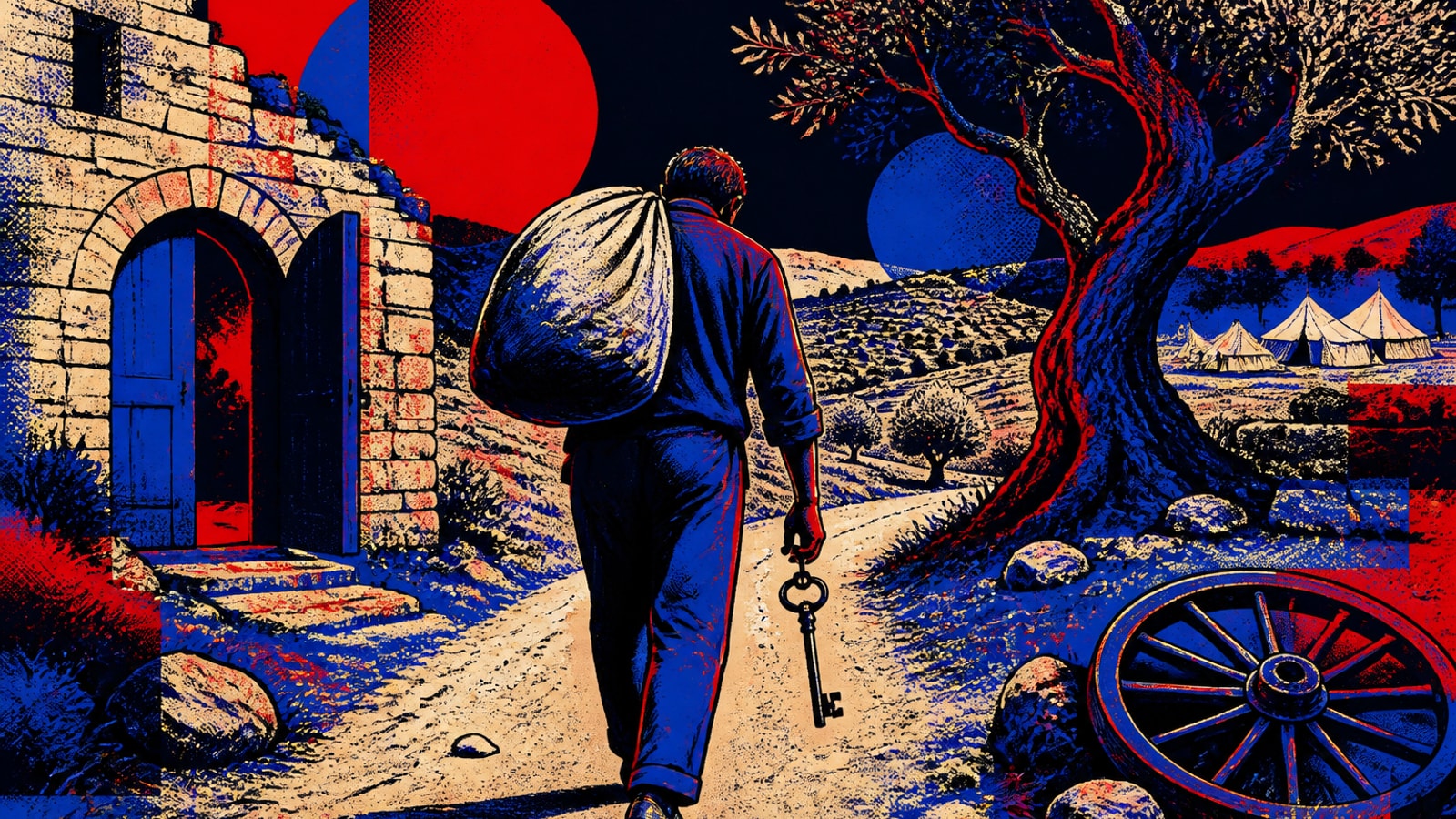
Yes, in certain sectors. Benny Morris’s archival history, published by Cambridge University Press in 2004, puts the 1948 exodus at roughly 700,000 Palestinian Arabs and records expulsions by Israeli forces in certain sectors, alongside military attack, fear of attack and flight. Morris rejects both a single master expulsion plan and the claim that departures were voluntary. Ilan Pappé’s 2006 book argues that the displacement was a planned ethnic cleansing. The records closest to the events counted people without recording why they left: the United Nations Conciliation Commission’s 1949 estimate of 711,000 refugees names no cause, and the absentee definition the Knesset enacted in 1950 turned on location and date, not on whether a person fled or was expelled.
Key Findings
- Benny Morris (2004), writing from Israeli military and state archives, estimates roughly 700,000 Palestinians left their homes in 1948. He documents expulsions in certain sectors among several causes that varied by locality and phase, and he rejects both a master plan and wholesale voluntary departure.
- Ilan Pappé (2006) argues in The Ethnic Cleansing of Palestine that the 1948 displacement was planned. His book is the named scholarly home of that characterization and the pole most often set against Morris.
- The United Nations Conciliation Commission for Palestine (1950) carries a Technical Committee estimate, dated 7 September 1949, of approximately 711,000 “refugees from Israel-controlled territory.” The Committee says nowhere that anyone was expelled or left voluntarily.
- Columbia University Press’s description of Fischbach (2003) states that more than 726,000 Palestinians, “over half the entire population,” were uprooted from late 1947 through 1948.
- Forman and Kedar (2004, peer-reviewed) show that Israel’s absentee definition turned on where a person was on or after 29 November 1947. Under that definition, “tens of thousands of Arab Israeli citizens” became “present absentees.”
Did Israeli forces expel Arabs during the 1948 war?
Yes, in certain sectors. Benny Morris’s The Birth of the Palestinian Refugee Problem Revisited (Cambridge University Press, 2004) estimates that roughly 700,000 Palestinians left their homes during the 1948 war. He finds expulsions by Israeli forces among several causes, alongside military attack, fear of attack and flight. Morris documents no single master plan, and he rejects the claim that departures were voluntary.
Morris built the account from Israeli military and state archives. His central finding is that causes varied by locality and by phase of the war (Morris, 2004). In some places, departures followed military attack or the fear of it. In certain sectors, Israeli forces expelled residents. Elsewhere, people fled. Morris applies the typology place by place and does not render it as one verdict on the whole exodus.
The expulsions he records are not confined to the main fighting. A chapter of the same book, titled “Clearing the borders: expulsions and population transfers, November 1948 to 1950,” covers the months after the major campaigns. In it, Morris describes Israeli authorities clearing Arab communities from the new border areas, transferring some residents internally and expelling others across the border. He identifies Faluja and Iraq al-Manshiyya as villages whose inhabitants were expelled as whole communities (Morris, 2004).
The war’s two names mark the two sides of the same events. Israel calls the war its War of Independence, after the founding of the state in May 1948. Palestinians call the displacement the Nakba, Arabic for catastrophe. Morris’s roughly 700,000 is his own archival estimate, and the question in its title is answered inside his typology. Expulsion is one documented cause, recorded in specific sectors and specific villages. It is set beside flight and fear of attack, which he documents in other localities, and is not presented as the sole cause of the whole exodus.
Morris’s finding cuts against two opposite summaries. Against an account in which nobody was forced out, it records expulsions by Israeli forces, including whole villages after the fighting. Against an account in which a single order emptied the country, it records causes that changed from one district and one phase to the next. A locality-by-locality reading of causes is the form his evidence takes.
Who calls 1948 a planned expulsion, and since when?
Ilan Pappé’s The Ethnic Cleansing of Palestine, published by Oneworld in 2006, is the strongest scholarly statement that the 1948 displacement was a planned ethnic cleansing. Its title is the named home of that characterization. Pappé set out the same argument in a 2006 Journal of Palestine Studies article. Morris (2004), writing from the same Israeli archives, documents expulsions in certain sectors but rejects a single master plan.
A common assumption is that historians of 1948 divide over whether expulsions happened at all. The two named poles of that dispute, Morris (2004) and Pappé (2006), both record forcible removals. Morris places expulsion among several causes that varied by place and phase. Pappé argues that removal was the organizing intent behind the whole. The disagreement concerns planning and scale: whether expulsion was one cause among several, or the design that produced the exodus.
The two works are different kinds of evidence. Morris’s is an archival history from a university press, organized around the documentary trail of individual localities. Pappé’s is a thesis in which the author states a moral position, and it is interpretive scholarship. Neither book measures a rate, and neither settles the other. They are cited here as the dated holders of two positions on cause and intent.
| Point in dispute | Morris (2004) | Pappé (2006) |
|---|---|---|
| Did Israeli forces expel Arabs? | Yes, in certain sectors | Yes, as a planned operation |
| Was there a master plan? | Rejected | Argued |
| Were departures voluntary? | Rejected | Expulsion was the design |
| Kind of work | Archival history, university press | Thesis; author states a moral position |
Source: Morris, 2004, Cambridge University Press; Pappé, 2006, Oneworld.
The characterization has an institutional rejection on record. The ADL, an advocacy organization whose mission is combating antisemitism, publishes a standing page titled “Allegation: Israel is Committing Ethnic Cleansing” (ADL, undated) that rejects the charge. The page states an organizational position and does not present a measurement.
“Ethnic cleansing” is a characterization, and the record here holds two dated scholarly positions on it, a university-press archival history and an author-stated thesis. Both record that Israeli forces carried out forcible removals in 1948. They part on what those removals amounted to.
Did the UN’s 1949 refugee count record why people left?
No. The United Nations Conciliation Commission for Palestine’s Technical Committee on Refugees estimated approximately 711,000 “refugees from Israel-controlled territory” in a report dated 7 September 1949.
The estimate was published in the Commission’s 1950 report (A/1367/Rev.1, Appendix 4, paragraph 15). The Committee recorded a number and a place of origin. It did not record whether anyone was expelled, driven out or left voluntarily.
The Committee’s phrase is geographic: refugees from Israel-controlled territory (United Nations Conciliation Commission for Palestine, 1950). Its authors describe the figure as only “as accurate as circumstances permit.” It is a statistical expert’s estimate prepared for the Committee, not an enumeration, and the Committee considered a census and concluded that one was not advisable.
The Committee also explained why its estimate sat below the relief rolls. Those rolls carried a higher number, which the Committee attributes to duplicated ration cards, people displaced from areas other than Israel-held territory, and people who were destitute without having been displaced (United Nations Conciliation Commission for Palestine, 1950). The adjustment concerns who qualified as a refugee from Israel-held areas, not why anyone left.
The count has a defined boundary. Because it counts refugees from Israel-controlled territory, it excludes people displaced inside Israel, and no internal-displacement figure can be derived from it or added to it.
Later United Nations publications use causal wording that the 1949 estimate does not. A 1980 text of the UN International Conference on Palestine Refugees describes approximately 750,000 people who “fled or were expelled.” That wording is the later body’s own characterization, on its own figure. The Technical Committee writing in 1949 used neither verb.
The closest contemporary international record therefore establishes scale and leaves cause to other evidence. For cause, the record runs through the archival histories above: Morris (2004) for the locality-by-locality typology and Pappé (2006) for the planned-expulsion thesis.
Were more than half of Palestine’s Arabs uprooted?
Yes, on one named account. Columbia University Press’s description of Michael Fischbach’s Records of Dispossession (Fischbach, 2003) states: “From late 1947 through 1948, more than 726,000 Palestinians, over half the entire population, were uprooted from their homes and villages.” The book is an archival history of refugee property built largely on the Conciliation Commission’s own files.
The sentence appears in the publisher’s description and is not tied to a page of the book’s text (Fischbach, 2003). The 726,000 matches the estimate associated with the United Nations Economic Survey Mission of 1949, a body that reported separately from the Conciliation Commission’s Technical Committee. It is therefore a different estimate from the Committee’s 711,000, not a revision of it. The “over half” is a share of the entire Palestinian Arab population of the time, a denominator the publisher’s sentence does not state.
The parties to the war gave their own numbers. At a Hebrew University of Jerusalem workshop on 14 to 15 December 2016, as summarised by the rapporteur in the Israel Law Review in 2018, Morris said that Israel “maintained at the time that the figure was 500,000, while Arab countries claimed it was nearer 900,000 or one million.” In the same summary, he said the United Nations concluded in 1949 and 1950 that the real figure was just over 700,000 (Israel Law Review, 2018). The 500,000 is Israel’s own figure as a party to the events. The 900,000 to 1 million is the Arab states’ own claim as parties to the war. Neither was independently verified.
| Figure | What it counts | Source |
|---|---|---|
| About 500,000 | Israel’s own figure at the time, a party to the events | Morris, as summarised in Israel Law Review, 2018 |
| About 700,000 | Archival estimate of those displaced in the 1948 war | Morris, 2004 |
| About 711,000 | Refugees from Israel-controlled territory, estimate | UN Conciliation Commission, 1950 |
| More than 726,000 | Uprooted, late 1947 through 1948 | Fischbach, 2003, publisher’s description |
| 900,000 to 1 million | Arab states’ own claim, parties to the war | Morris, as summarised in Israel Law Review, 2018 |
Source: as listed in each row.
The rows are not one series. Each comes from a different body, covers a different window and draws a different boundary. Averaging them would merge estimates whose own authors kept them apart.
How many Arab villages were destroyed, by one historian’s count?
About 400 Palestinian towns and villages were destroyed, according to the figure Mahmoud Yazbak gave at the Hebrew University of Jerusalem Faculty of Law workshop of 14 to 15 December 2016. The rapporteur’s summary in the Israel Law Review (2018) records it. It is one speaker’s figure in workshop proceedings, not a census of depopulated localities.
In the rapporteur’s summary, Yazbak said that “in the course of the Zionist and Israeli military operations about 400 Palestinian towns and villages were destroyed” (Israel Law Review, 2018). He linked the destruction to “the expulsion and flight” of about 80% of the residents of the Palestinian regions on which the State of Israel was established. That share is Yazbak’s, and its base is the population of those regions, as he defined them.
Yazbak’s sentence pairs the 2 words that run through the whole dispute. “Expulsion and flight” names both mechanisms without apportioning the 80% between them. In that respect, his summarised figure does what Morris’s typology does: it records forcible removal and flight together. It differs from Morris in attributing the outcome to military operations as a whole.
The workshop placed the 2 historians in the same opening session. Morris spoke on the competing contemporary refugee figures, and Yazbak presented the scale of destroyed localities (Israel Law Review, 2018). The proceedings are a rapporteur’s third-person summary of each presentation, not a peer-reviewed research article. Every figure in them belongs to the speaker who gave it and is dated to the 2016 workshop and the 2018 publication.
The village count measures a different object from the refugee estimates. The Conciliation Commission’s 1949 estimate counts people, and its Technical Committee enumerates no localities (United Nations Conciliation Commission for Palestine, 1950). Yazbak’s about 400 counts places. The 2 figures cannot be combined into a single measure of the displacement, and neither substitutes for the other.
Did Israeli law ask whether an absentee fled or was expelled?
No. The absentee definition was set in Israel’s 1948 Absentee Property Regulations and carried into the Absentee Property Law that the Knesset enacted in March 1950. According to Forman and Kedar’s peer-reviewed legal history (2004), it turned on where a person was on or after 29 November 1947, not on why they left.
The definition, as Forman and Kedar (2004) quote its terms, covered anyone who on or after that date had been “(a) a citizen or subject of one of the Arab countries at war with Israel; (b) in any of these countries, or in any part of Palestine outside the jurisdiction of the regulations; or (c) a citizen of Palestine who abandoned his or her normal place of residence.” None of the 3 limbs asks whether departure followed an expulsion order, an attack, fear or choice. A resident expelled across a front line and a resident who left ahead of the fighting met the same test.
The test also reached people who never left the state. Forman and Kedar (2004) write that “practically no Jewish Israelis, but tens of thousands of Arab Israeli citizens, were classified as absentees, assuming the paradoxical legal identity of ‘present absentee’.” Arab citizens who had moved within the country during the war lost title to property they had left behind, while remaining inside Israel.
The statutes then fixed where the property went. “The Knesset enacted the Absentee Property Law in March 1950 and the Development Authority (Transfer of Property) Law in July 1950,” Forman and Kedar (2004) record. The first law empowered the Custodian of Absentee Property to sell land to the Development Authority alone. The second empowered the Authority to sell land to the state and the Jewish National Fund. In this way, property passed through the absentee system without any finding about cause.
Israel’s own enacted texts are the official tier closest to the property, and they record the outcome without the distinction. Whether an owner fled or was expelled carried no legal weight in deciding that the land passed to the Custodian.
Methodology and limitations
The evidence comes from 4 kinds of source, each labelled by type. Morris (2004) and Fischbach (2003) are university-press archival histories. Pappé (2006) is an interpretive thesis whose author states a moral position. The United Nations Conciliation Commission for Palestine (1950) is an intergovernmental official record. Forman and Kedar (2004) is a peer-reviewed legal history built from Israeli legislation, archival documents and Knesset proceedings. The Israel Law Review (2018) item is a rapporteur’s summary of a 2016 workshop, not peer-reviewed. Its figures are attributed to the individual speakers.
Each source measures something different. The Commission’s 711,000 is an estimate, dated 7 September 1949 and published in a report dated 23 October 1950. Its authors expressly decline to treat it as a census, and it excludes people displaced inside Israel. Fischbach’s 726,000 is taken from the publisher’s description, not from a page of the book. Morris’s roughly 700,000 is his own archival estimate. Israel’s 500,000 and the Arab states’ 900,000 to 1 million are each a party’s own contemporaneous figure, relayed in Morris’s 2016 remarks, and neither was independently verified. Yazbak’s about 400 localities and about 80% share are one speaker’s summarised figures.
Several things do not exist in the record. No contemporary official body enumerated the causes of departure, refugee by refugee or locality by locality. Forman and Kedar end in 1960 and state that no single agreed figure exists for land that passed from Arab to state hands. Where figures are relayed from other bodies, they are cited to the body that produced them. On cause and intent, the record holds 2 dated scholarly positions: Morris’s typology of locality and phase, and Pappé’s planned-expulsion thesis.
Conclusion
Did Israel forcibly displace Arabs in the war it calls its War of Independence? On the archival record, it did. Morris documents expulsions by Israeli forces in certain sectors, including whole villages such as Faluja and Iraq al-Manshiyya after the fighting, within an exodus he puts at roughly 700,000. The question that remains open between named historians is intent and scale. Pappé argues for a plan, and Morris records several causes that changed by place and phase.
Across every axis measured here, the documents agree on scale and leave cause to the historians. Archival estimates and the Conciliation Commission’s 711,000 sit within a few tens of thousands of each other, while the 2 sides’ own figures at the time ran from half a million to a million. Yazbak counts places where the Commission counted people. The Commission’s Technical Committee wrote “refugees from Israel-controlled territory” and stopped. Israel’s absentee statute asked where a person stood on or after 29 November 1947, and on that test, an expelled villager, a family that fled and an Arab citizen who never crossed a border met the same definition.
The public argument over 1948 still turns on the verbs, fled or expelled. Yet the international count kept no column for them, and the domestic statute that decided the property gave them no legal weight. If the instruments that settled the numbers and the land were indifferent to the distinction, where does the weight now placed on that distinction come from, and what does the answer to “who left, and why” change about what followed?
Frequently Asked Questions
Why did the UN not conduct a census of the 1948 refugees?
The Conciliation Commission’s Technical Committee considered a census in 1949 and concluded that one was not advisable (United Nations Conciliation Commission for Palestine, 1950). It cited an estimated 500,000 apparently self-supporting residents of the former Mandatory area as the reason: a census risked attracting new claims to refugee status. The 711,000 is therefore a statistical expert’s estimate, not a count.
When was the Commission’s 711,000 figure published?
The estimate comes from an appendix dated 7 September 1949, submitted at Lausanne. It appears in the Commission’s report covering 11 December 1949 to 23 October 1950, which was printed in New York in 1951 (United Nations Conciliation Commission for Palestine, 1950). The accurate form is the Commission’s 1949 estimate, published in its 1950 report.
How much land was under Jewish ownership when the war began?
Forman and Kedar (2004) record that 1.5 million of Mandate Palestine’s 26.3 million dunams were Jewish-owned by 1948. Israel’s borders then enclosed 20.6 million dunams, of which about 13.5%, or 2.8 million dunams, was under formal state or Jewish ownership. The gap between those figures is the land the later statutes addressed.
How much land did the 1953 Land Acquisition Law take in its first year?
Forman and Kedar (2004) report that some 1.2 million dunams were expropriated in the law’s first year of operation. Of these, 311,000 dunams came from private ownership, 304,700 of them from Arab owners, and 704,000 dunams were taken from the Custodian. The smaller figures are subsets of the 1.2 million, not additions to it.
Is there an agreed figure for Arab land lost after 1948?
No. Forman and Kedar (2004) write that “there is no one agreed-upon figure for the land that moved from Arab hands to the state in the wake of 1948.” The estimates they list come from other bodies, span a wide range and are not their own.
What happened to absentee land after the 1950 transfers?
In late July 1960, the Knesset enacted Basic Law: Israel Lands, the Israel Lands Law and the Israel Lands Administration Law (Forman and Kedar, 2004). These laws consolidated state, Development Authority and Jewish National Fund holdings into a single category, “Israel Lands,” under one administration. The authors treat 1960 as the close of a 12-year process.
Sources
- ADL (Anti-Defamation League), undated. Allegation: Israel is Committing Ethnic Cleansing. adl.org. Advocacy organization (mission: combating antisemitism).
- Fischbach, Michael R., 2003. Records of Dispossession: Palestinian Refugee Property and the Arab-Israeli Conflict. Columbia University Press, New York, Institute for Palestine Studies Series. ISBN 9780231129787. https://cup.columbia.edu/book/records-of-dispossession/9780231129787/. Scholarly book (figure from the publisher’s description).
- Forman, Geremy, and Alexandre (Sandy) Kedar, 2004. From Arab Land to “Israel Lands”: The Legal Dispossession of the Palestinians Displaced by Israel in the Wake of 1948. Environment and Planning D: Society and Space 22(6), 809 to 830. DOI 10.1068/d402. Peer-reviewed.
- Israel Law Review, 2018. 1948 Refugees: Proceedings of an international workshop, Hebrew University of Jerusalem Faculty of Law, 14 to 15 December 2016. Israel Law Review 51(1), 47 to 110. Cambridge University Press. DOI 10.1017/S0021223717000280. Workshop proceedings (rapporteur’s summary, not peer-reviewed).
- Morris, Benny, 2004. Clearing the borders: expulsions and population transfers, November 1948 to 1950. Chapter in The Birth of the Palestinian Refugee Problem Revisited. Cambridge University Press. https://www.cambridge.org/core/books/abs/birth-of-the-palestinian-refugee-problem-revisited/clearing-the-borders-expulsions-and-population-transfers-november-19481950/36FB7BE4EF42325E57CDBEBAB21D05E5. Scholarly book chapter (archival history).
- Morris, Benny, 2004. The Birth of the Palestinian Refugee Problem Revisited. 2nd edition, Cambridge Middle East Studies 18. Cambridge University Press. ISBN 978-0521009676. Scholarly book (archival history).
- Pappé, Ilan, 2006. The Ethnic Cleansing of Palestine. Oneworld Publications. Scholarly book (advocacy-inflected thesis; the author states a moral position).
- United Nations Conciliation Commission for Palestine, 1950. General Progress Report and Supplementary Report of the United Nations Conciliation Commission for Palestine, Appendix 4, Report of the Technical Committee on Refugees (7 September 1949). UN General Assembly Official Records, Fifth Session, Supplement No. 18, A/1367/Rev.1. https://www.un.org/unispal/document/auto-insert-180810/. Official and primary record.