
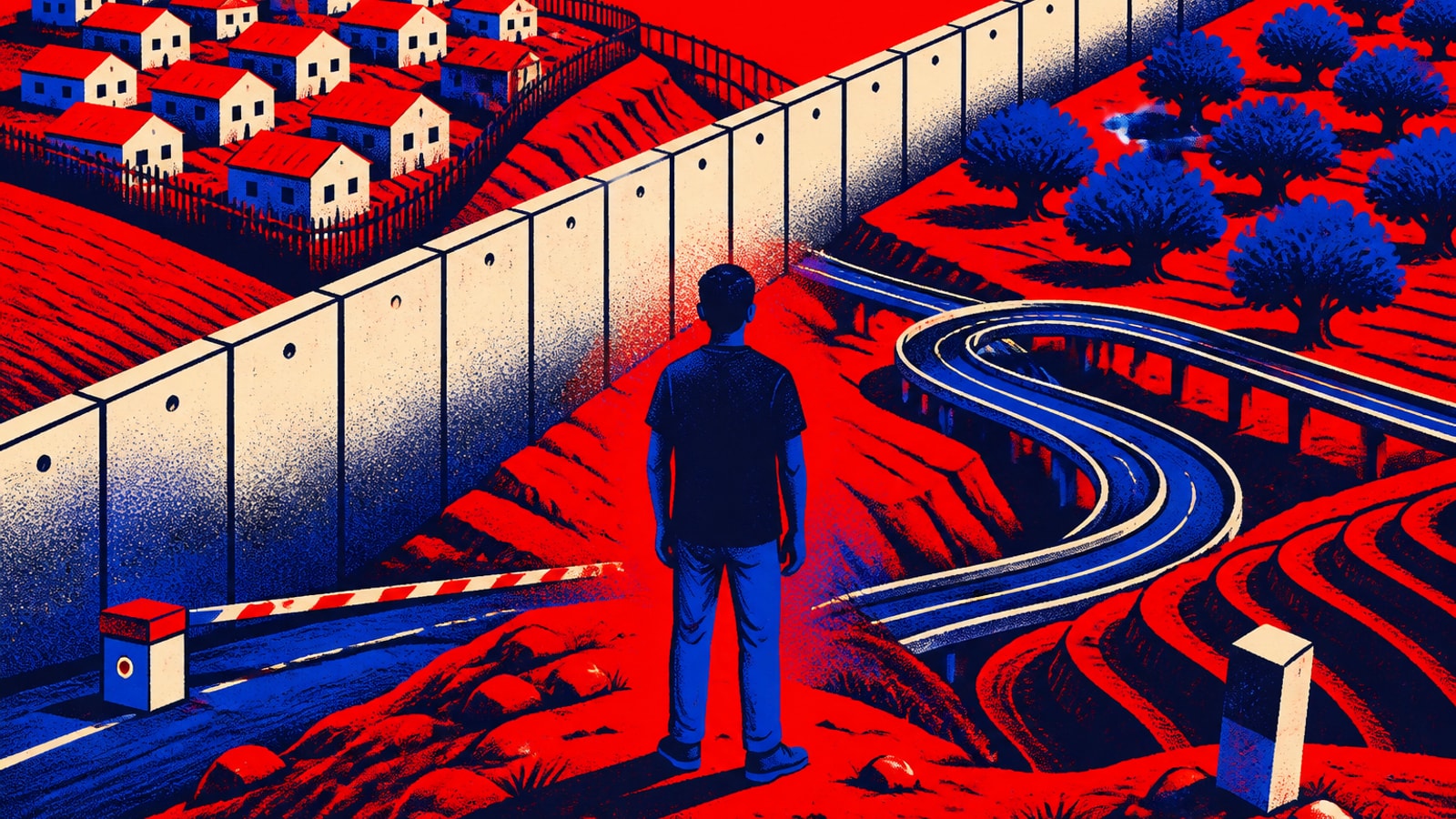
Four organizations issued dated determinations between April 2021 and January 2026 naming Israeli settlement policy in the West Bank as evidence for an apartheid finding, and each runs its argument through the same treaty language: the acts enumerated in Article II of the 1973 International Convention on the Suppression and Punishment of the Crime of Apartheid. The population those determinations describe has never been counted once: the demographer Sergio DellaPergola, in the American Jewish Year Book, put 418,900 core Jews in the West Bank at the beginning of 2019 and reported the 221,800 living in East Jerusalem neighborhoods incorporated after 1967 as a separate line, while Israel’s Central Bureau of Statistics counts both inside Israel’s national total.
Key Findings
- Article II(d) of the 1973 International Convention on the Suppression and Punishment of the Crime of Apartheid lists among the acts of the crime “any measures, including legislative measures, designed to divide the population along racial lines by the creation of separate reserves and ghettos” and “the expropriation of landed property belonging to a racial group or groups”; it is one of six lettered categories in that article (treaty text, official record).
- Israel ratified the 1965 International Convention on the Elimination of All Forms of Racial Discrimination in 1979, whose Article 3 condemns “racial segregation and apartheid,” and is not among the states parties to the 1973 Convention (United Nations Treaty Collection depositary record).
- DellaPergola’s American Jewish Year Book estimate for 1 January 2019 reported 418,900 core Jews in the West Bank, with 221,800 in East Jerusalem neighborhoods incorporated after 1967 and 23,200 on the Golan Heights counted as separate components (academic reference).
- Israel’s Central Bureau of Statistics reported Jerusalem passing one million residents at the end of 2023, 60.5% Jews and Others and 39.5% Arabs, counting the East Jerusalem neighborhoods annexed after 1967 as one municipal population (Media Release 165/2024, official record).
- Clause 7 of Basic Law: Israel as the Nation-State of the Jewish People, enacted in 2018, states that “the State views the development of Jewish settlement as a national value, and shall act to encourage and promote its establishment and consolidation”; the Supreme Court of Israel dismissed fifteen petitions against the law on 8 July 2021 in HCJ 5555/18 (official records).
Which settlement policies do the apartheid findings name?
Four organizations have issued dated determinations that place settlement policy at the center of an apartheid finding: Human Rights Watch in April 2021, Amnesty International in February 2022, the UN Special Rapporteur Michael Lynk in his March 2022 report to the Human Rights Council, and the Office of the High Commissioner for Human Rights in a January 2026 thematic report. Each is that body’s own determination, reached on its own criteria.
Lynk’s 2022 report describes a “deeply discriminatory dual legal and political system” that he says privileges what he counts as 700,000 Israeli Jewish settlers living in 300 settlements across East Jerusalem and the West Bank. Amnesty International’s February 2022 report counts 132 officially established settlements and 140 unauthorized outposts, and names land seizure for Jewish settlement as a component of what it terms an institutionalized regime of oppression and domination “for the benefit of Jewish Israelis.” Human Rights Watch’s April 2021 report lists mass confiscation of Palestinian land and the confinement of Palestinians into enclaves among the acts it associates with the crime under the Apartheid Convention. The 2026 OHCHR thematic report uses the phrase “physical and juridical separation.”
Across the four, the enumerated policies fall into five recurring heads: allocation of land and the seizure of land for settlement construction; the parallel legal regimes described in the next section; infrastructure, road networks, subsidies and services provided to settlements; the fragmentation of Palestinian territory by settlements, bypass roads and checkpoints; and violence by settlers where authorities are said to tolerate or support it, which Amnesty International raised again in April 2024.
None of these are counts produced by a statistical authority. They are the findings of monitoring organizations and of a rapporteur appointed by an intergovernmental body, published as legal argument, and the figures inside them are the counts each organization made on its own definitions. What each of those definitions includes is the reason the published numbers do not match, and that is a separate question with a checkable answer.
Is it often said settlements create a dual legal order?
It is often said that Israeli settlers in the West Bank live under Israeli civil law while their Palestinian neighbors live under military law. The description is directionally accurate and is common to all four determinations, and the population subject to it is on the official record: the Palestinian Central Bureau of Statistics counted 2,881,687 West Bank residents in its 2017 census, the last full enumeration conducted in the territory.
The mechanism is structural rather than incidental. The West Bank outside East Jerusalem has been administered since 1967 through Israeli military orders rather than through Knesset legislation applied to the territory, an arrangement the Israel Policy Forum’s explainer of West Bank governance sets out in its account of how settlements are administered. Israeli civil law reaches settlers personally, through legislation and regulation applied to Israeli citizens wherever they reside, rather than territorially. The result is two bodies of law operating in the same space, distinguished by who a person is rather than by where the person stands.
East Jerusalem is governed differently again. Israel applies its own law and administration there, and Clause 3 of Basic Law: Israel as the Nation-State of the Jewish People, enacted in 2018, states that “the complete and united Jerusalem is the capital of Israel.” Residents of the annexed neighborhoods appear inside Israel’s municipal and national population statistics, which is why any figure for the West Bank changes depending on whether East Jerusalem is inside it.
One further fact of status belongs alongside the legal description. The 1948 Declaration of the Establishment of the State of Israel pledges that the state “will ensure complete equality of social and political rights to all its citizens irrespective of religion, race or sex,” in the Knesset’s published English text. The residents the Palestinian census counted in the West Bank are not Israeli citizens, so the founding equality pledge, whatever its force, does not by its terms reach them. The Palestinian bureau also notes that East Jerusalem could not be directly enumerated in 2017 and administrative estimates were used there, so even the census figure has a stated boundary.
Why do the settler and settlement counts differ so widely?
The settler figure most often repeated is 700,000 and the settlement figure ranges from 132 to about 300, and the spread is a matter of which components each body folds into one number.
DellaPergola’s American Jewish Year Book estimate keeps them apart: 418,900 core Jews in the West Bank at the beginning of 2019, with 221,800 in East Jerusalem neighborhoods incorporated after 1967 and 23,200 on the Golan Heights reported as their own lines.
Three counting choices drive the divergence. The first is East Jerusalem: Lynk’s 2022 figure covers “East Jerusalem and the West Bank” as one area, while DellaPergola separates them and B’Tselem publishes its West Bank series and its East Jerusalem series as two. The second is the unit of settlement: Amnesty International’s 2022 report reports 132 officially established settlements and 140 unauthorized outposts as distinct categories, so a single figure near 300 and a single figure near 130 can describe the same landscape. The third is official recognition. As Hirsch-Hoefler and Ben Shitrit record in their 2020 review of the Israeli Central Bureau of Statistics Yearbook, the bureau excludes unrecognized outposts entirely, of which Peace Now documented about 121 in 2019, and it assigns a Green Line straddling locality such as Shani Livne to Israel’s South District while settlement monitors list it as a settlement.
That the counting is consequential is itself documented. Lustick’s 2013 peer-reviewed audit in The Middle East Journal traced how a competing set of population estimates for the same territory was assembled and how the claim of 1 million to 1.5 million nonexistent Palestinians was attached to proposals to annex 60% or more of the West Bank. His conclusion concerns that specific campaign, not the settler counts above, but it establishes the general point that in this arena the choice of denominator arrives with a purpose attached, and that no figure travels usefully without the unit it was built on.
Which treaty clause covers separate residential areas?
The settlement argument runs almost entirely through one lettered subparagraph.
Article II(d) of the 1973 International Convention on the Suppression and Punishment of the Crime of Apartheid names as an act of the crime “any measures, including legislative measures, designed to divide the population along racial lines by the creation of separate reserves and ghettos for the members of a racial group or groups, the prohibition of mixed marriages among members of various racial groups, the expropriation of landed property belonging to a racial group or groups or to members thereof.” It is the fourth of six lettered categories in that article.
Two features of the clause explain why land policy is where the arguments concentrate. It reaches residential separation and property expropriation in the same breath, so a submission about settlement construction and land allocation can address one enumerated act rather than assembling an argument from general principle. And it names legislative measures explicitly, which directs attention to enacted texts rather than to conduct alone.
The earlier instrument is broader and shorter. Article 3 of the 1965 International Convention on the Elimination of All Forms of Racial Discrimination provides that states parties “particularly condemn racial segregation and apartheid and undertake to prevent, prohibit and eradicate all practices of this nature in territories under their jurisdiction.” It carries no enumerated list of acts, and it defines nothing.
Ratification separates the two instruments sharply for this question. Israel ratified the 1965 Convention in 1979 and is bound by its Article 3; Israel is not among the states parties to the 1973 Convention, per the United Nations Treaty Collection depositary record. A determination that invokes the 1973 Convention is therefore invoking a definition of the crime that Israel has not accepted by treaty, which is a fact about the instruments and not about the conduct. The wider question of how the treaty definitions interlock, including where each one was drafted to apply, is handled separately in the Institute’s report on the legal definition of apartheid.
Do Israel’s own statistics treat settlements as part of Israel?
Israel’s own statistical series counts settlement populations inside Israel, and has since 1968. Hirsch-Hoefler and Ben Shitrit’s 2020 review of the Central Bureau of Statistics Yearbook, published by the Project on Middle East Political Science and not peer reviewed, records that East Jerusalem moved into the general population count for Israel proper in the 1968 edition, the year after the territory came under Israeli control.
The review dates three further changes. A 1970 footnote folded settlers into Israel’s total as “Israeli residents in the Administrated Territories.” By 1983 settlement localities were counted within the total number of Israeli localities. In 1997 the separate territories chapter was removed from the Yearbook altogether. The authors describe the sequence as a normalization of settlements, which is their analytic framing and is attributed to them; the dated editorial changes are the record.
The current releases follow the same convention. The bureau’s Jerusalem Day release of 3 June 2024 reports the city passing one million residents at the end of 2023, 60.5% Jews and Others and 39.5% Arabs, counting the annexed East Jerusalem neighborhoods as one municipal population. Its Rosh Hashana 5786 release of September 2025 reports about 10.148 million residents of Israel, roughly 7.758 million Jews and others and 2.130 million Arabs, with East Jerusalem residents and West Bank settlers inside that total. Neither release breaks the settlement population out as a line of its own.
Israel’s enacted law addresses settlement directly. Clause 7 of Basic Law: Israel as the Nation-State of the Jewish People, in the Knesset’s published English translation, which the Knesset labels unofficial, provides that “the State views the development of Jewish settlement as a national value, and shall act to encourage and promote its establishment and consolidation.” Clause 1(c) provides that “the realization of the right to national self-determination in the State of Israel is exclusive to the Jewish People.” Both clauses are quoted in the determinations described earlier, and both are the state’s own text.
Which published analyses reject the settlement apartheid argument?
Three named rejections sit on the record, each resting on a different ground. The Anti-Defamation League, a monitoring organization with an advocacy mission, publishes a standing backgrounder titled “Allegation: Israel is an Apartheid State” that treats apartheid as a defined legal category and argues the West Bank situation is a territorial and security dispute with a negotiated-status framework rather than a racial regime.
A 2023 working paper posted to the Social Science Research Network, “Why Allegations that Israel Is An ‘Apartheid’ State Are False under International Law,” argues from the treaty elements that they are not satisfied; it is a preprint and has not been peer reviewed. Israel’s own stated position, advanced by its government in response to the 2021 and 2022 reports, is that the territory’s status is unresolved pending negotiation and that its measures there are security measures.
The disagreement is between named documents on both sides. The International Human Rights Clinic at Harvard Law School and Addameer take the opposite position in a joint submission dated 28 February 2022, “Apartheid in the Occupied West Bank: A Legal Analysis of Israel’s Actions,” filed with the UN Independent International Commission of Inquiry, which argues that the elements of the crime are met in the occupied West Bank and sets out the land and residential provisions it relies on. That submission and the SSRN paper are the two documents to put side by side: the same treaty language read to opposite conclusions.
Israel’s own highest court has adjudicated the closest domestic question. In HCJ 5555/18, Hasson v. Knesset, decided on 8 July 2021, an eleven-justice panel dismissed fifteen petitions against Basic Law: Israel as the Nation-State of the Jewish People and upheld the law. The judgment cuts in two directions and both belong on the page. The law stands. And the Court held that the Knesset, acting as constituent authority, is “not all powerful” and lacks authority, even by Basic Law, to deny or facially contradict the core character of Israel as a Jewish and democratic state, a limit the Court derived from the Declaration of Independence, the Basic Laws, Knesset legislation and its own case law. The Court set a constitutional ceiling and found this law below it.
Methodology and limitations
This report measures the documentary record around a contested claim: which policies the published apartheid determinations name, what the treaty texts say, and what the official statistics count. It reports what those records contain.
Source types are labeled where they appear. Treaty texts and the depositary record of ratifications are official records. Israeli population figures come from the Central Bureau of Statistics releases named in the text and are that bureau’s own compiled counts, described by the bureau as preliminary where marked, not independently verified. The West Bank resident count is the Palestinian Central Bureau of Statistics 2017 census, an official national enumeration in which East Jerusalem was estimated administratively rather than directly counted. HCJ 5555/18 is a judgment of Israel’s own Supreme Court on an Israeli statute. DellaPergola’s estimates are an academic yearbook chapter, not a peer-reviewed journal article, and are the author’s own estimates. Hirsch-Hoefler and Ben Shitrit’s Yearbook review was published by the Project on Middle East Political Science and is not peer reviewed. Lustick (2013) is peer reviewed.
The determinations by Human Rights Watch, Amnesty International, the UN Special Rapporteur and the Office of the High Commissioner for Human Rights are those bodies’ own findings on their own criteria, and the settlement and settler counts inside them are those bodies’ own counts, reported here as such. No single enumeration of the settler population exists across the published sources, which is the subject of one section above rather than a gap in the reporting.
One government record sought for this report is unavailable. The 2012 Israeli committee report on the legal status of building in Judea and Samaria, commonly known by the name of the committee’s chair, was never officially published or adopted by the government that commissioned it; only advocacy reprints circulate, so no government record of its conclusions can be cited. The Institute’s separate treatment of unauthorized outposts records the same absence.
Documented settler violence, raised as a component in the 2022 and 2024 determinations, is handled in the Institute’s report on settler violence and the land record rather than here.
Conclusion
So what is the relationship between West Bank settlements and the apartheid allegations? It is a specific one. The four determinations issued between 2021 and 2026 do not invoke settlements as atmosphere; they route the argument through Article II(d) of the 1973 Convention, the single subparagraph that names separate reserves, legislative measures and the expropriation of landed property in one sentence, and they populate it with land allocation, two bodies of law reaching two populations in one space, infrastructure, fragmentation and settler violence.
The record answers parts of that argument in more than one direction at once. Israel is bound by Article 3 of the 1965 Convention and is not a party to the 1973 one. The Palestinian bureau counted 2,881,687 West Bank residents in 2017; DellaPergola counted 418,900 core Jews there in 2019 and kept East Jerusalem’s 221,800 on a separate line; Israel’s own bureau folds both into a national total of about 10.148 million and has been folding East Jerusalem into it since the 1968 Yearbook. Israel’s enacted Basic Law calls the development of Jewish settlement a national value, and Israel’s own Supreme Court upheld that law in 2021 while holding that no Basic Law may deny the state’s core democratic character. Every one of those is checkable, and none of them settles the question the way the four determinations and the ADL backgrounder each say it settles.
Every party to this argument is counting, and no two of them are counting the same thing: Article II(d) enumerates acts, the four determinations count settlements and settlers on definitions each of them set, and Israel’s own bureau counts a national population with both territories folded inside it. How much of a disagreement conducted in numbers is a disagreement about what to count?
Frequently Asked Questions
What does “core Jewish population” mean in demographic estimates?
It is a narrower category than the population groups Israel’s own bureau uses domestically. The Central Bureau of Statistics notes in its Holocaust Day release that for countries other than Israel it reports a “core” Jewish population, a narrower definition than the one it applies within Israel, drawing those figures from the American Jewish Year Book series rather than from its own collection. The distinction matters when a territorial breakdown from that series is set beside a bureau population total.
How much of DellaPergola’s core Jewish total sits inside Israel’s pre-1967 borders?
6,001,700 of 6,665,600 core Jews at the beginning of 2019. DellaPergola’s American Jewish Year Book chapter reports that baseline exclusive of the three territories it lists on their own lines, whose 221,800 in East Jerusalem, 23,200 on the Golan Heights and 418,900 in the West Bank make up the remainder of the same total. The figures are the author’s own estimates in an academic yearbook chapter, not an official count.
When was the last full census of the West Bank population?
The Palestinian Central Bureau of Statistics conducted its third census with a reference date of 1 December 2017, counting 4,780,978 residents of the West Bank and Gaza, of whom 2,881,687 were in the West Bank. The 1997 and 2007 rounds are the only earlier ones, and every later total in the UN and World Bank series is a projection off the 2017 base rather than a count.
How do Israeli statistics handle a locality that straddles the Green Line?
They place it inside Israel. Hirsch-Hoefler and Ben Shitrit’s 2020 review records that the Central Bureau of Statistics assigns Shani Livne, which straddles the line, to Israel’s South District, while Peace Now lists it as a settlement. The same review records that the bureau excludes unrecognized outposts from its locality counts entirely.
What does the Nation-State Law say about the Arabic language?
It names Hebrew as the language of the State and gives Arabic a special status. Clause 4 of Basic Law: Israel as the Nation-State of the Jewish People, in the Knesset’s published English translation, provides that “Hebrew is the language of the State,” that “Arabic has a special status in the State,” and that nothing in the article “shall compromise the status given to the Arabic language in practice, before this basic-law came into force.”
How large is Israel’s population by the bureau’s own latest count?
The Central Bureau of Statistics reported about 10.244 million residents on the eve of Israel’s 78th Independence Day, a preliminary estimate current to 22 April 2026, comprising about 7.790 million Jews and Others, 2.157 million Arabs and 296,000 foreigners. East Jerusalem residents and West Bank settlers are counted inside that total, which is the scope choice described above.
Sources
- Anti-Defamation League, no date. Allegation: Israel is an Apartheid State. adl.org. Monitoring organization (advocacy mission).
- DellaPergola, S., 2019. World Jewish Population, 2019. American Jewish Year Book 2019, vol. 119, Springer. Academic reference.
- Hirsch-Hoefler, S., and Ben Shitrit, L., 2020. So, how many settlements are there? Counting, tracking, and normalizing Jewish settlements in the Israeli Central Bureau of Statistics Yearbook, 1967 to the present. Project on Middle East Political Science. Organizational report, not peer-reviewed.
- Israel Central Bureau of Statistics, 2024. Selected Data on the Occasion of Jerusalem Day, 2024. Media Release 165/2024. Official record.
- Israel Central Bureau of Statistics, 2025. Population of Israel on the Eve of Rosh Hashana 5786. Media release. Official record.
- Israel Central Bureau of Statistics, 2025. On the Occasion of Holocaust Day, 2025. Media release 124/2025. Official record.
- Israel Central Bureau of Statistics, 2026. Israel’s Independence Day 2026. Media release 117/2026. Official record.
- Knesset, 2018. Basic Law: Israel as the Nation-State of the Jewish People. Official English translation (unofficial), main.knesset.gov.il. Official record.
- Lustick, I., 2013. What Counts is the Counting: Statistical Manipulation as a Solution to Israel’s “Demographic Problem.” The Middle East Journal, 67(2). DOI 10.3751/67.2.12. Peer-reviewed.
- Palestinian Central Bureau of Statistics, 2018. Population, Housing and Establishments Census 2017: Final Results. Ramallah. Official record.
- Provisional Government of Israel, 1948. Declaration of the Establishment of the State of Israel. Official Gazette Number 1, 14 May 1948. Official record.
- Social Science Research Network, 2023. Why Allegations that Israel Is An “Apartheid” State Are False under International Law. SSRN abstract 4343950. Preprint, not peer-reviewed.
- Supreme Court of Israel, 2021. HCJ 5555/18 Hasson v. Knesset, judgment of 8 July 2021. Court judgment.
- United Nations, 1965. International Convention on the Elimination of All Forms of Racial Discrimination, Article 3. Treaty text and depositary record, United Nations Treaty Collection. Official record.
- United Nations, 1973. International Convention on the Suppression and Punishment of the Crime of Apartheid, Article II. Treaty text and depositary record, United Nations Treaty Collection. Official record.