
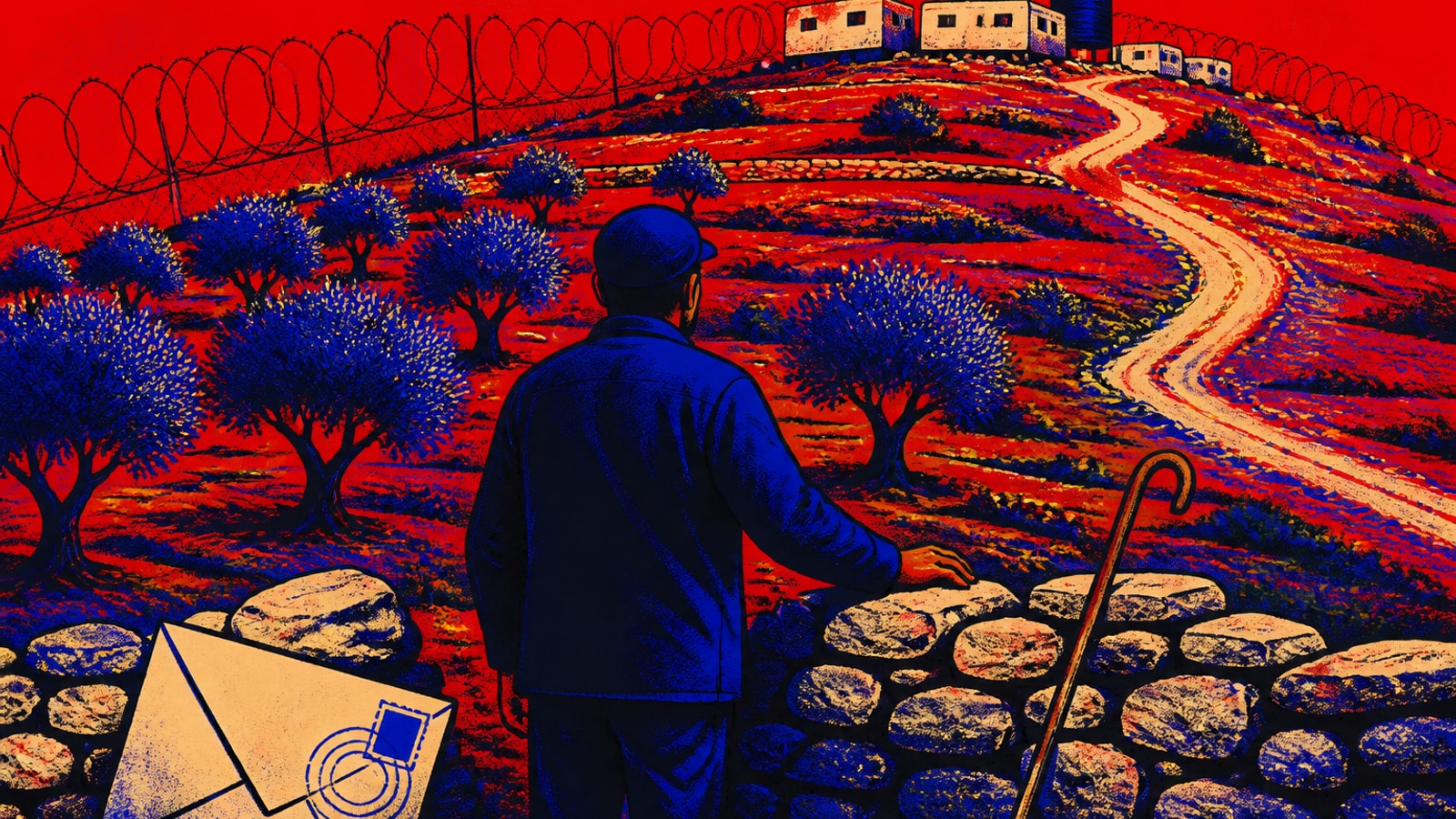
The United States Department of State’s 2023 Country Reports on Human Rights Practices records 1,442 Palestinians in the West Bank displaced by settler violence and harassment as of 15 December 2023, and 1,277 settler-violence incidents during that year. Of those incidents, 911 caused property damage, 163 caused casualties and 153 caused both, a composition weighted toward property, crops and access rather than injury. The question underneath the count is whether violence and the transfer of land are one process or two running alongside each other: the same year’s records also carry demolition orders, expropriations and court files, and those are measured by different instruments, by different bodies, in different units.
Key Findings
- The US Department of State’s 2023 Country Reports on Human Rights Practices records 1,442 Palestinians in the West Bank displaced by settler violence and harassment as of 15 December 2023.
- The same official report records 1,277 settler-violence incidents in 2023, of which 911 caused property damage, 163 caused casualties and 153 caused both, and presents the annual total as the highest since the UN Office for the Coordination of Humanitarian Affairs began tracking such incidents in 2006.
- Talia Sasson’s 2005 Opinion Concerning Unauthorized Outposts, commissioned by the Israeli Prime Minister’s Office, documented involvement by Israeli state bodies in establishing outposts on land never lawfully allocated for that purpose; Israel’s High Court of Justice subsequently ordered the evacuation of outposts built on privately owned Palestinian land, including Migron and Amona.
- The State Department’s 2023 report relays an Israeli non-governmental organization’s finding that nearly half of West Bank land expropriated for public purposes was later used exclusively by settlers, a figure carried inside an official record but measured by that organization rather than by the department.
How much displacement do official records attribute to settler violence?
The US Department of State’s 2023 Country Reports on Human Rights Practices records 1,442 Palestinians displaced in the West Bank by settler violence and harassment as of 15 December 2023, a figure fixed to a stated date rather than a running estimate. It is the closest thing an official record supplies to a direct count of people moved off land by violence.
The same report records 1,277 settler-violence incidents during 2023, broken into 911 that caused property damage, 163 that caused casualties and 153 that caused both. Those three named categories account for 1,227 of the 1,277; the remaining incidents are not broken out in the report, so the categories cannot be read as a partition of the total.
The report presents the 1,277 as the highest annual total since the UN Office for the Coordination of Humanitarian Affairs began tracking settler-violence incidents in 2006, which means the trend claim and the level claim rest on one continuous monitoring series rather than on a comparison across bodies.
Two things follow from the shape of that distribution. An incident count is not a displacement count: 1,277 incidents sit beside 1,442 displaced persons, and neither number divides into the other, because one counts events and the other counts people. And the recorded consequence in the large majority of incidents is damage to property, the category that covers crops, trees, vehicles, water infrastructure and structures, which is the same category that determines whether a plot can be farmed or grazed the following season.
Is settler violence described as a means of taking land?
It is often said that settler violence functions as an instrument for taking Palestinian land rather than as scattered assault. On the direction, the official record is consistent: of the 1,277 incidents the State Department recorded for 2023, 911 caused property damage without recorded casualties, a distribution weighted toward the assets that determine whether land stays usable.
The bodies that hold the stronger version of the claim can be named and dated. The UN Human Rights Office stated in March 2025, in a press release titled “Israel ramps up settlement and annexation in West Bank with dire human rights consequences,” that settlement expansion and settler violence in the West Bank are producing displacement of Palestinian communities. UN special procedures, in a submission on settler violence and impunity in the occupied Palestinian territory, describe the violence as functioning as “a means of implementing Israeli State policy” directed at entrenching settlements and displacing Palestinians. The European Parliament circulated a briefing on settlements and settler violence to its foreign affairs and human rights committees making the same connection between violence and settlement growth. The International Crisis Group, in its report Stemming Israeli Settler Violence at Its Root, reports more than 1,000 incidents of settler violence since 7 October 2023 in which more than 1,300 Palestinians were driven from their homes; that is the group’s own count on its own inclusion criteria.
What the base rate adds is the composition. The claim as usually stated describes attacks, and the recorded distribution is mostly damage: trees, vehicles, water points, sheds and access routes. A reader who pictures 1,277 assaults is holding a different phenomenon from the one the records hold, and the difference matters for the land question specifically, because property damage and access denial are the categories that change what a plot yields, while casualty counts are what determine whether a case enters the criminal record. The two are different measurements of different things, and the official series reports them separately for that reason.
What did Israel’s own commissioned review find about unauthorized outposts?
Talia Sasson’s Opinion Concerning Unauthorized Outposts, delivered in 2005 at the commission of the Israeli Prime Minister’s Office, found that Israeli state bodies were involved in establishing outposts on land that had never been lawfully allocated for that purpose. It is a government-commissioned review of the state’s own administrative conduct, not an external characterization of it.
The opinion set out how ministries, planning bodies and public funding participated in the creation of outposts that had no valid planning approval, and it distinguished outposts erected on state land from those erected on land registered as privately owned by Palestinians, a distinction Israeli courts later treated as decisive.
| Record and type | Year | What it sets out |
|---|---|---|
| Opinion Concerning Unauthorized Outposts (review commissioned by the Israeli Prime Minister’s Office) | 2005 | Involvement of state bodies and public funds in outposts established without lawful allocation of the land |
| Israel High Court of Justice, Migron line of cases (court record) | 2011, evacuated 2012 | Ordered evacuation of an outpost built on land registered as privately owned by Palestinians |
| Israel High Court of Justice, Amona line of cases (court record) | Rulings through 2014, evacuated 2017 | Ordered evacuation on the same private-ownership ground, carried out after repeated extensions |
Together these are the tier that speaks in Israel’s own voice: a review the government asked for, and judgments the state then executed. Both concern process and title rather than violence, and neither measures displacement. They document that outposts existed on land the state’s own review and its own court found had not been lawfully taken, which is the structural condition on which the wider claim about violence rests. The fuller reading of those files sits in Israel’s own reviews and court records on settler outposts.
One document frequently invoked in this dispute cannot be read as a government record at all. The Levy Commission report on the legal status of building in Judea and Samaria was never officially published or adopted by the Israeli government, and the versions in circulation are advocacy reprints, so no official text of it exists to cite.
How much land do outpost mappings say settlers now control?
Kerem Navot and Peace Now, in a joint 2025 mapping, report 786,000 dunams of West Bank land associated with shepherding outposts, which they present as 14% of the West Bank, and 746,000 dunams outside Palestinian Authority areas, about 21% of Area C. Those are the two organizations’ own measurements on their own definitions of outpost-associated land.
Amnesty International reports a closely similar area, about 746,000 dunams by the end of 2024, and presents it as 22% of Area C and 13% of the West Bank, adding that about 70% of all land it counts as taken since the 1990s was taken through herding outposts within roughly two and a half years. That is Amnesty’s own count on its own criteria.
The two sets of percentages are not two independent confirmations of one another. They rest on overlapping mapping of the same outposts, and they differ chiefly in the denominator each uses: a share of Area C and a share of the whole West Bank are different quantities computed from almost the same numerator. A reader who meets 22% in one place and 14% in another is meeting one measurement expressed against two baselines.
No comparable area figure appears in Israel’s official statistics. Hirsch-Hoefler and Ben Shitrit (2020), reviewing how the Israeli Central Bureau of Statistics Yearbook has counted settlements since 1967, document that the Yearbook reports settlement localities and their populations rather than mapped land control, and that it excludes unrecognized outposts from its counts entirely; they relay Peace Now’s documentation of about 121 such outposts in 2019. Their review also records that a Green Line straddling locality such as Shani Livne is placed by the Bureau in Israel’s South District while monitoring organizations count it as a settlement. The consequence is arithmetic rather than interpretive: the category the mapping reports on is a category the official series does not enumerate, so there is no official number to set against 786,000 dunams and no reconciliation to perform.
Which livelihoods do recorded attacks most often target?
B’Tselem counted 451 settler attacks on Palestinians and their property between the beginning of 2020 and September 2021, of which 245 were directed at farmers, on its own definitions as a monitoring organization with a stated advocacy mission. That distribution puts agricultural work, rather than residence, at the centre of the recorded incidents.
Amnesty International reports at least 4,575 attacks on Palestinian communities between January 2023 and December 2025, with about 69,000 trees or saplings destroyed or damaged and at least 2,200 vehicles damaged, again its own count on its own criteria. It also reports that attacks on Bedouin and herding communities causing casualties, property damage, or both rose from about 50 in 2020 to about 330 in 2024.
The asset classes in those tallies are the ones that determine whether land can be worked: olive and fruit trees that take years to replace, vehicles that carry a harvest, and the grazing range that a herding household depends on. This is where the official and organizational records point the same way without being addable to one another. The State Department’s 2023 composition, 911 of 1,277 incidents recorded as property damage without casualties, describes the same weighting from an official channel and a single year, and the organizational tallies describe it across longer windows with different inclusion rules.
Displacement and access loss are also distinct measurements, and collapsing them overstates both. A household that abandons a plot appears in a displacement figure; a household that keeps its home but loses a season’s harvest appears in an incident tally and in no displacement count at all. The wider inventory of documented instruments, from movement restriction to demolition, is examined in the reading of the documentation, the reviews and the court record.
How much land changes hands through state orders rather than violence?
The State Department’s 2023 report relays an Israeli non-governmental organization’s finding that nearly half of West Bank land expropriated for public purposes was subsequently used exclusively by settlers. The figure sits inside an official record, but it was measured by that organization, not by the department, and it describes an administrative instrument rather than an incident.
That instrument is counted in its own series. The European External Action Service publishes a One Year Report on Demolitions and Seizures in the West Bank Including East Jerusalem covering 1 January to 31 December 2023, built from demolition and seizure orders: the structures each order affects, the persons recorded as displaced by its execution, and the stated legal basis. The unit of analysis is an order, issued and dated, not an event witnessed and reported.
Two mechanisms are therefore documented by two different record types. Coercion by violence is counted as incidents, reported by victims and monitors, and aggregated by year. Transfer by legal and administrative instrument is counted as orders and expropriations, each with a file, a signatory and a date, which is why it also produces court records of the kind the Migron and Amona judgments left behind. The volumes are not additive: a demolished structure inside an order-based count may or may not appear in an incident tally, and a household that leaves after repeated crop destruction appears in no order at all.
This is the point at which the popular framing and the record diverge most cleanly. The framing describes one process with violence at its centre. The record holds a violence series and a paperwork series, kept by different bodies in different units, each with its own coverage limits, and any statement about how much land moved requires saying which of the two is being counted.
Why do settler violence counts differ across the monitors?
The 1,277 figure for 2023 comes from one series: the State Department’s report attributes it to the UN Office for the Coordination of Humanitarian Affairs, whose settler-related violence tracking it dates to 2006. Numbers published by other monitors for the same terrain are built on different rules and are not interchangeable with it.
| Series | Unit counted | How cases enter |
|---|---|---|
| UN Office for the Coordination of Humanitarian Affairs, settler-related violence monitoring (tracking since 2006) | Incident, classified by recorded consequence such as casualties or property damage | Field monitoring and reports through humanitarian channels |
| ACLED, West Bank event data | Coded event, with its own inclusion threshold and actor typology | Systematic coding of reported sources |
| Monitoring and advocacy organizations’ own tallies | Attack or incident, on each organization’s own definition | Reports from victims, witnesses and the organization’s own research |
Three differences drive most of the gap. The unit differs: an incident and a coded event do not carve the same day’s occurrences into the same number of rows. The threshold differs: whether a blocked access road or an uprooted olive grove without confrontation enters the count is a definitional choice made differently by each body. And the channel differs: a series built from voluntary reports records what victims choose to report, while a coded event dataset records what sources published.
The practical rule that follows is subtraction, not addition. Totals from bodies with different counting rules cannot be summed, and a rise in one series is evidence about that series’ intake as well as about the phenomenon. The same arithmetic problem appears wherever two organizations count the same subject on different definitions, as two national counts of antisemitism differing fivefold shows in a separate domain.
Methodology and limitations
This report measures what named records document about violence, displacement and land transfer in the West Bank, and what each record type counts. It does not assess the lawfulness of any land transfer or the characterization of any pattern.
Source types are labelled where they are used. The 1,277 incident figures and the 1,442 displacement figure are from the US Department of State’s 2023 Country Reports on Human Rights Practices, an official record of one government; the report itself attributes the incident series to the UN Office for the Coordination of Humanitarian Affairs and dates that tracking to 2006. The Sasson opinion of 2005 is a review commissioned by the Israeli Prime Minister’s Office and is cited as Israel’s own commissioned document. The Migron and Amona evacuations are cited to Israel’s High Court of Justice as court records. Counts published by monitoring and advocacy organizations, including B’Tselem, Amnesty International, the International Crisis Group, Kerem Navot and Peace Now, are attributed to each organization as its own count on its own definitions and appear only in the body prose; none is presented as a measured share, an official rate, or an independently verified total. The finding that nearly half of expropriated land was later used exclusively by settlers is relayed inside an official report but was measured by an Israeli non-governmental organization, and is carried here as that organization’s finding.
The literature disagrees in two documented places. The outpost mappings by Kerem Navot with Peace Now and by Amnesty International report closely similar areas, 786,000 and about 746,000 dunams, against different denominators, 14% of the West Bank in one presentation and 22% of Area C in the other; the mappings overlap, so the two percentages are not independent corroboration. Separately, Hirsch-Hoefler and Ben Shitrit (2020), a think-tank review and not peer-reviewed, document that the Israeli Central Bureau of Statistics Yearbook counts settlement localities and populations rather than mapped land, and excludes unrecognized outposts, so no official Israeli area figure exists to reconcile against the mappings.
Three arithmetic limits bind any use of these numbers. The three consequence categories in the 2023 official report sum to 1,227 of the stated 1,277 incidents, so they are not a partition. Incident counts, order-based counts and displacement counts are separate units and cannot be summed or divided into one another. And totals from monitors with different units, thresholds and reporting channels are not comparable, which is why no combined figure appears here as an established total.
Conclusion
So is violence the mechanism by which land changes hands, or one instrument among several? The records answer in parts and in different units. One official report counts 1,442 Palestinians displaced by settler violence and harassment as of a single date in December 2023, and 1,277 incidents that year of which 911 registered as property damage without casualties. A review the Israeli government itself commissioned in 2005 found state bodies involved in establishing outposts on land never lawfully allocated, and Israel’s own High Court ordered outposts on privately owned Palestinian land evacuated at Migron and at Amona. A European Union series counts demolition and seizure orders one file at a time. Mappings by Kerem Navot with Peace Now and by Amnesty International place the outpost-associated area near 786,000 and 746,000 dunams on their own definitions, in a category Israel’s official statistics do not enumerate at all.
The composition is the most durable finding in that set. What the recorded incidents most often damage is what makes land yield: 245 of B’Tselem’s 451 recorded attacks between 2020 and September 2021 were directed at farmers, and Amnesty’s tally for 2023 to 2025 counts about 69,000 trees or saplings and at least 2,200 vehicles. Alongside it runs a paper record with signatories and dates, counted by a different body in a different unit, and the two series cannot be added. The land question is documented twice, once as events and once as orders, and every total depends on which of the two is being read.
One question sits on top of all of those figures. A reader who meets 1,277, or 1,442, or 786,000 dunams almost never meets the unit attached to it: an event on one monitor’s inclusion rules, a cumulative count fixed to a December date, an area on two organizations’ own mapping definitions. Stripped of those, each of the three reads as a general statement about how much land moved, which is the one thing none of them measures. So when one of these numbers stands in for the land question in a headline, an argument or a policy brief, how much of what the public holds is resting on a denominator nobody carried forward?
Frequently Asked Questions
How does an outpost differ from a settlement in the records?
The distinction is administrative. Talia Sasson’s 2005 opinion, commissioned by the Israeli Prime Minister’s Office, addressed outposts established without lawful allocation of the land, and Hirsch-Hoefler and Ben Shitrit (2020) document that the Israeli Central Bureau of Statistics Yearbook counts recognized settlement localities and their populations while excluding unrecognized outposts entirely.
Which body’s tracking produced the 2023 incident total?
The US Department of State’s 2023 Country Reports on Human Rights Practices presents 1,277 incidents as the highest annual total since the UN Office for the Coordination of Humanitarian Affairs began tracking settler-violence incidents in 2006. The trend statement and the level statement therefore rest on that single series rather than on agreement between monitors.
Why do displacement figures carry an exact date?
Because they are cumulative counts as of a cut-off, not annual rates. The State Department figure of 1,442 displaced Palestinians is stated as of 15 December 2023, which means it excludes the remainder of that month and cannot be compared with a full-year figure from another series without adjusting for the window.
What is a dunam, and why do land figures use it?
A dunam is the unit in which land in the region is registered and mapped, equal to 1,000 square metres, so 786,000 dunams is 786 square kilometres. The mappings by Kerem Navot with Peace Now and by Amnesty International report in dunams because that is the unit of the underlying cadastral and survey material.
How many Jewish residents did the West Bank have?
Sergio DellaPergola’s World Jewish Population chapter reports that at the beginning of 2019, of 6,665,600 core Jews under Israeli jurisdiction, 418,900 lived in the West Bank, 221,800 in East Jerusalem neighbourhoods incorporated after 1967 and 23,200 on the Golan Heights, with 6,001,700 inside the pre-1967 borders. It is an academic demographic estimate, not a settlement count.
Why do the settler population figures published by different bodies not match?
Because they draw different boundaries. The Israeli Central Bureau of Statistics counts residents of East Jerusalem neighbourhoods annexed after 1967 inside Israel’s own total, reporting Jerusalem as a single municipal population of more than one million at the end of 2023, while international monitors publish West Bank and East Jerusalem as separate series. Adding across the two conventions double-counts.
Did Israeli courts order any outposts removed?
Yes. Israel’s High Court of Justice ordered the evacuation of outposts built on land registered as privately owned by Palestinians, and the state carried out the Migron evacuation in 2012 and the Amona evacuation in 2017 after repeated extensions. Both judgments turned on land title rather than on violence.
Is there an official Israeli figure for outpost-controlled land?
No area figure of that kind appears in the Israeli official statistics series. Hirsch-Hoefler and Ben Shitrit (2020) document that the Central Bureau of Statistics reports localities and populations and excludes unrecognized outposts, so the category the mappings measure is not enumerated in the official series.
Sources
- DellaPergola, S., 2019. World Jewish Population, 2019. In American Jewish Year Book 2019, vol. 119, Springer; reprinted by the Berman Jewish DataBank. Academic reference.
- Hirsch-Hoefler, S., and Ben Shitrit, L., 2020. So, how many settlements are there? Counting, tracking, and normalizing Jewish settlements in the Israeli Central Bureau of Statistics Yearbook, 1967 to the present. POMEPS. Organizational report, not peer-reviewed.
- Israel Central Bureau of Statistics, 2024. Selected Data on the Occasion of Jerusalem Day, 2024, Media Release 165/2024. cbs.gov.il. Official record.
- Israel High Court of Justice, rulings through 2011 and 2014. Judgments ordering the evacuation of outposts built on privately owned Palestinian land (Migron; Amona). Official record.
- Sasson, T., 2005. Opinion Concerning Unauthorized Outposts. Review commissioned by the Israeli Prime Minister’s Office. Official record.
- US Department of State, 2024. 2023 Country Reports on Human Rights Practices: Israel, West Bank and Gaza (West Bank and Gaza section). state.gov. Official record.