
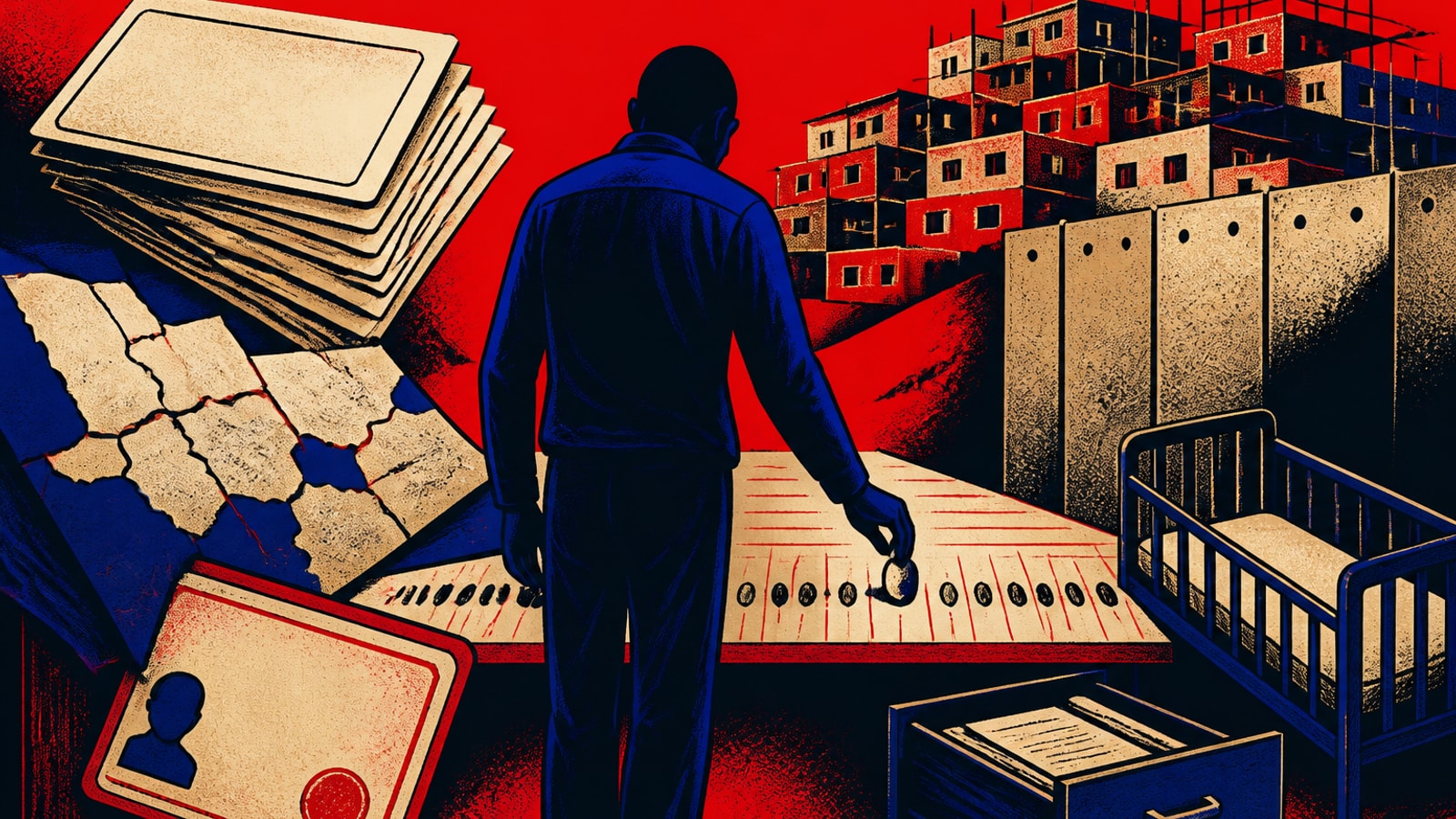
In the Israel Central Bureau of Statistics’ April 2025 count, the majority at the centre of Israel’s demographic policy debate stood at 76.6% “Jews and others” among 10.094 million residents. That share is measured over a boundary that includes West Bank settlers and East Jerusalem and leaves out the Palestinians of the West Bank and Gaza. Is the majority a fact that policy protects, or a number whose size depends on where the count stops? On the role demographic considerations play in Israel’s policies towards Palestinians, the record shows both. Since 1970 the Law of Return has extended immigration rights to the grandchildren of Jews and to their spouses, and rival estimates of the 2004 Palestinian population differed by 1.34 million people, each estimate attached to a different policy.
Key Findings
- The Knesset’s Law of Return (Amendment No. 2), 5730-1970 extends a Jewish immigrant’s rights to “a child and a grandchild of a Jew, the spouse of a Jew, the spouse of a child of a Jew and the spouse of a grandchild of a Jew.” It defines “Jew” as a person “born of a Jewish mother or has become converted to Judaism and who is not a member of another religion.”
- The Israel Central Bureau of Statistics recorded 7.732 million “Jews and others” (76.6%) and 2.114 million Arabs (20.9%) in April 2025, counting West Bank settlers and East Jerusalem residents inside its total. The Palestinian Central Bureau of Statistics enumerated 4,780,978 West Bank and Gaza residents in its 2017 census and estimated East Jerusalem administratively, so the two registers overlap and cannot be summed.
- Arabs made up 39.5% of Jerusalem’s residents at the end of 2023, according to the Israel Central Bureau of Statistics’ Jerusalem Day 2024 release, which counts the East Jerusalem neighbourhoods annexed after 1967 inside one municipal population.
- In a 2006 Begin-Sadat Center report that was not peer-reviewed, Zimmerman, Seid and Wise put the West Bank and Gaza Arab population 1.34 million below the official Palestinian figure. Lustick (2013, peer-reviewed) attributed the claimed shortfall to “complex but systematic manipulation of data” and tied it to proposals to annex 60% or more of the West Bank.
- Israel’s Supreme Court held in Ka’adan (2000) that the State “was not permitted, by law” to allocate land to the Jewish Agency for a settlement on the basis of discrimination between Jews and non-Jews. In Hasson (2021), an eleven-justice panel upheld the Nation-State Law.
How do Israel’s enacted laws build demography into policy?
The Knesset’s Law of Return (Amendment No. 2), 5730-1970 extends a Jewish immigrant’s rights to 5 categories of relative, counted from its text: “a child and a grandchild of a Jew, the spouse of a Jew, the spouse of a child of a Jew and the spouse of a grandchild of a Jew.” It governs who may join Israel’s population.
The 1950 core that the amendment builds on is a single sentence: “Every Jew has the right to come to this country as an oleh.” The translator glosses oleh as “a Jew immigrating, into Israel.” The 1970 amendment also defines the word the whole law turns on: “‘Jew’ means a person who was born of a Jewish mother or has become converted to Judaism and who is not a member of another religion.” It withholds the extended rights from “a person who has been a Jew and has voluntarily changed his religion,” and makes it “immaterial” whether the Jew through whom a right is claimed is alive or ever immigrated. A further section of the same amendment imports the definition into the Population Registry Law, so the category that governs immigration also governs registration.
The 2018 Basic Law: Israel as the Nation-State of the Jewish People adds the national frame, in a translation the Knesset labels unofficial. Clause 1(c) reads: “The realization of the right to national self-determination in the State of Israel is exclusive to the Jewish People.” Clause 5 keeps the State “open to Jewish immigration, and the ingathering of the exiles.” Clause 7 states that the State “views the development of Jewish settlement as a national value, and shall act to encourage and promote its establishment and consolidation.”
Beneath both sits the 1948 Declaration, proclaiming “THE ESTABLISHMENT OF A JEWISH STATE IN ERETZ-ISRAEL” and, in the Knesset’s English, pledging “complete equality of social and political rights to all its citizens irrespective of religion, race or sex.” The Foreign Ministry’s English has “all its inhabitants.”
The provisions quoted here set entitlements and national values. None of them states a population share or a target, and none names demography as its purpose.
| Instrument | Operative wording | Source |
|---|---|---|
| Declaration of Independence, 1948 | “A JEWISH STATE IN ERETZ-ISRAEL” | Provisional Government of Israel |
| Law of Return s.1, 1950 | “Every Jew has the right to come to this country as an oleh” | Knesset |
| Law of Return s.4A, 1970 | Rights vested in a child, grandchild and three classes of spouse | Knesset |
| Nation-State Law cl.1(c), 2018 | Self-determination “exclusive to the Jewish People” | Knesset, unofficial translation |
Is demography widely described as the driver of Israeli policy?
It is often said that Israeli leaders and analysts have long treated a Jewish majority as essential to the state. Named scholarship supports the premise. In Contemporary Jewry in 1989, the geographer Arnon Soffer argued that the distribution of Jewish and Arab populations constrains the borders a Jewish-majority state can hold. In the Israel Central Bureau of Statistics’ April 2025 count, that majority was 76.6% “Jews and others.”
Soffer’s paper is interpretive demographic geography and reports no fertility rates. Its significance is that an Israeli scholar read population statistics directly as a guide to territorial policy. The link between demography and state-building is older than that paper. Anat Leibler (2014, peer-reviewed, Social Studies of Science) traces how the demographer Roberto Bachi’s pro-natal advocacy, together with the systematisation of ethnic categories such as “Mizrahi,” intersected with state formation before 1948. Philippe Fargues (2000, Population and Development Review) finds that fertility on both sides tracked national conflict rather than a smooth modernisation curve. He also finds that Palestinians and Israelis alike framed fertility as national strength.
Scholars critical of the policy use the same variable. Oren Yiftachel titled his 1999 Constellations article “‘Ethnocracy’: The Politics of Judaizing Israel/Palestine.” Ian Lustick subtitled his 2013 Middle East Journal audit “Statistical Manipulation as a Solution to Israel’s ‘Demographic Problem.’” Across 24 years, then, authors who argue for demographic policy and authors who criticise it both treat demography as a policy variable.
The base rate supplies the scale. The Israel Central Bureau of Statistics counted 2.114 million Arabs (20.9%) in April 2025, a category that in its definition covers Moslems, Arab Christians and Druze. It counted foreigners at 248,000 (2.5%) as of mid-2024. The Bureau’s “Arab” category covers only people inside its own statistical area. It is not a count of Palestinians under Israeli control.
Which borders does Israel’s 76.6% Jewish majority figure assume?
The 76.6% is a share of the population the Israel Central Bureau of Statistics counts, and by the Bureau’s own practice that population includes West Bank settlers and East Jerusalem residents. It excludes the 4,780,978 residents the Palestinian Central Bureau of Statistics enumerated in the West Bank and Gaza in its 2017 census. That census itself estimated East Jerusalem administratively.
The boundary has been drawn in stages. Sivan Hirsch-Hoefler and Lihi Ben Shitrit (2020, POMEPS, not peer-reviewed) trace the stages through the Bureau’s yearbooks. The 1968 yearbook moved East Jerusalem into Israel’s general count. A 1970 footnote folded settlers into the total as “Israeli residents in the Administrated Territories.” By 1983 settlement localities were counted among Israel’s localities, and in 1997 the separate territories chapter was removed. The authors call this “normalization,” which is their own analytic term. They also record that a locality straddling the Green Line, Shani Livne, sits in the Bureau’s South District.
The effect can be measured on the Jewish side. In the 2019 American Jewish Year Book, Sergio DellaPergola decomposes Israel’s 6,665,600 core Jews at the start of 2019. He places 6,001,700 within the pre-1967 borders, 221,800 in East Jerusalem, 23,200 on the Golan Heights and 418,900 in the West Bank. On that decomposition, the citer’s own arithmetic puts 663,900 people, about 10%, outside the pre-1967 lines but inside the national count.
The two registers cannot simply be added together. The Israeli Bureau counts East Jerusalem’s Arab residents inside Israel, and the Palestinian Bureau counts East Jerusalem inside the West Bank. Adding the two totals therefore counts the city’s Arab residents twice.
Did demographic arguments shape the Oslo division of territory?
The Israeli-Palestinian Interim Agreement of 28 September 1995 drew its first line by population. It defines Areas A and B as “the populated areas” delineated on map No. 1 and provides that land in those areas “will come under the jurisdiction of the Council.” Area C and the settlements stayed outside that jurisdiction, pending three further redeployments due within 18 months of the Council’s inauguration.
The text defines Area C residually, as the “areas of the West Bank outside Areas A and B.” In Area C, Israel was to transfer only “civil powers and responsibilities not relating to territory.” Area B also takes in “the built-up area of the hamlets listed in Appendix 6 to Annex I.” The appendix lists 83 hamlets across 9 districts; that total is a count of its entries, not a figure the agreement prints. Article XII(5) links the settlements to the remainder by definition: “‘the Settlements’ means, in the West Bank the settlements in Area C.” Article XVII(1) removes “Jerusalem, settlements, specified military locations, Palestinian refugees, borders, foreign relations and Israelis” from the Council’s jurisdiction. As drafted, the agreement assigns people and land to different jurisdictions.
The text is silent on two points. It states no rationale for the line. It also gives no share of territory: the words “per cent” appear once in the main agreement, in Article IX on appointments. The figure usually quoted comes from later writers. In a 2026 policy analysis for the Arab Center Washington DC, the lawyer Alaa Mahajna describes Area C as “around 60 percent of the West Bank” and names no body that measured it.
A demographic reading of the division predates the signature. Soffer’s 1989 argument, that the location of Jewish and Arab populations constrains the borders a Jewish-majority state can hold, is one named statement of that reading. Soffer did not negotiate the agreement, and the agreement adopts no reasoning. It preserves both parties’ positions: under Article XXXI(6), neither side “shall be deemed, by virtue of having entered into this Agreement, to have renounced or waived any of its existing rights, claims or positions.”
What does Israel’s own record show about Jerusalem’s population balance?
Arabs made up 39.5% of Jerusalem’s residents at the end of 2023, against 60.5% “Jews and others,” in the Israel Central Bureau of Statistics’ Jerusalem Day 2024 release. The Bureau counts the East Jerusalem neighbourhoods annexed after 1967 inside a single municipal population.
The release records the city’s population growth during 2023 as 13,400. Its figures are preliminary. The release also puts ultra-Orthodox Jews at about 29.2% of residents, a modelled estimate drawn from a 2022 machine-learning model. An earlier Bureau release, for Eid al-Adha 2022, counted 362,000 Moslem residents of Jerusalem at the end of 2021: 37.5% of the city’s residents and 21.2% of all Moslems in Israel. The two releases use different categories, “Arabs” in 2024 and “Moslems” in 2022, so the gap between 37.5% and 39.5% is not a measured change. Arab Christians are counted inside the first category and outside the second.
The 2024 release breaks the year’s growth into its sources. Natural increase added about 20,500 people and the international migration balance added 4,000, a balance that counts residents who stayed abroad for more than 12 months as departures. The release gives these two components as positive figures and a net growth of 13,400, so some movement it does not itemise, including movement to other parts of Israel, must account for the difference. It does not split any of these figures by population group. The share of each group can be read from the release. The growth of each group cannot.
The record contains no numeric target. No Israeli government document in the sources gathered for this report states a demographic target for Jerusalem or a desired Jewish share of the city. The Bureau’s releases report the balance. They do not set it. The claim that planning, residency rules and spatial control are aimed at holding a majority in the city is made by bodies outside Israeli government, and no document of that government reviewed here states it.
The Nation-State Law is the nearest official text. Its Clause 3 reads: “The complete and united Jerusalem is the capital of Israel.” That clause concerns status. It sets no population share.
Does Israeli pronatalist policy form part of demographic policy?
Israel’s total fertility rate was 2.89 children per woman in 2022, according to the Central Bureau of Statistics’ “Israel in Figures 2023.” Rachel Shenhav-Goldberg, Robert Brym and Talia Lenton-Brym (2019, peer-reviewed, Canadian Review of Sociology) study why the rate is high relative to Israel’s family-welfare effort. They link it partly to state policy, including “the world’s most extensive publicly funded in vitro fertilization (IVF) system.”
The same authors attribute the rate to religious and nationalist sentiment “heightened by a perceived demographic threat from Palestinian population growth.” That attribution is theirs, and it is contested. Barbara Okun (2016, peer-reviewed, Population Studies) finds that secular, native-born Jewish women also stay above replacement. She explains the pattern through a wider set of factors: state and family support for childbearing, strong familism and marriage, a dual emphasis on women’s employment and fertility, and, as one factor among several, Jewish nationalism in a setting of ethno-national conflict. The measured policy lever is IVF funding. How much weight demographic motive carries behind it is the point on which the two studies part.
The rates by group are published separately.
The Bureau’s own vital-statistics series reports that the Jewish and Muslim rates have converged to within about a tenth of a child. L. Daniel Staetsky (2019, peer-reviewed, Population Studies) records that Muslim fertility in Israel fell from nearly 10 children per woman in the mid-1960s to about 4.5 in the mid-1980s, and then held near that level for two decades. The Druze peak was 7.92 children in 1964, according to the Bureau’s 2024 Druze release. Daphna Birenbaum-Carmeli (2008, peer-reviewed) gives a Haredi rate near 7.7 as background, not as her own measurement. She describes a pregnancy-spacing intervention developed with 23 Haredi nurses. That intervention shows health practice working inside a high-fertility community rather than state encouragement of births.
Why do rival demographers draw opposite policy conclusions?
Bennett Zimmerman, Roberta Seid and Michael Wise put the West Bank and Gaza Arab population at 2.49 million in mid-2004, 1.34 million below the 3.83 million the Palestinian Central Bureau of Statistics reported. Their report, “The Million Person Gap,” was published by Bar-Ilan University’s Begin-Sadat Center in 2006 and was not peer-reviewed. It carried a policy thesis: that Israel’s “demographic time bomb” was overstated.
The authors itemised the gap. They attributed 325,000 to residents living abroad and 210,000 to East Jerusalem Arabs counted in both registers. A 310,000 immigration-versus-emigration error and 238,000 in unmet birth forecasts made up much of the rest. The authors were not demographers: the team comprised a business consultant, a historian and a physicist.
Sergio DellaPergola of the Hebrew University wrote the critique in a paired 2005 policy brief for the Jerusalem Center for Public Affairs. He built his Palestinian base from Israeli Central Bureau of Statistics data rather than the disputed 1997 census, and he still reached about 3.4 million, close to the official figures. He framed “the fertility differential, not the head-count” as the decisive long-run factor. The Palestinian Bureau rejected the overcount thesis and revised its own model after the study.
Each estimate travelled with a policy conclusion. Ian Lustick (2013, peer-reviewed, Middle East Journal) documents how the claim of 1 million to 1.5 million non-existent Palestinians was tied to proposals to annex 60% or more of the West Bank. He concludes that the campaign rested on “complex but systematic manipulation of data.” Yakov Faitelson (2009, Middle East Quarterly, not peer-reviewed) restated the gap as “probably around one million people.” Faitelson also records that the Palestinian Authority criticised the 2007 census for undercounting East Jerusalem, so the dispute runs in both directions. The disagreement is over the size of a population that no single census covers. A higher count supports the case for separation, and a lower count supports the case for retaining the territory.
What have Israel’s courts said about majority-preserving policies?
In Hasson v. Knesset (2021), an eleven-justice panel of Israel’s Supreme Court upheld Basic Law: Israel as the Nation-State of the Jewish People, the statute that declares Jewish settlement “a national value.” The same judgment held that the Knesset is “not all powerful.” Even by Basic Law, the Court ruled, the Knesset cannot deny the core character of the State as Jewish and democratic.
The earlier leading case concerned land. In Ka’adan v. Israel Land Administration (8 March 2000), a five-justice panel declared: “the State was not permitted, by law, to allocate state land to the Jewish Agency, for the purpose of establishing the communal settlement of Katzir on the basis of discrimination between Jews and non-Jews.” President Barak wrote that “What the State cannot do directly, it cannot do indirectly.” He also wrote that the Jewish character of the state does not justify “discrimination by the State between its citizens, on the basis of religion or nationality.” On the Law of Return he added that Jews “were granted a special key to enter,” but once inside, a person “enjoys equal rights with all other household members.”
The remedy was narrow. The State was ordered to consider the family’s request “on the basis of the principle of equality”; the Court did not order that the family be admitted. Justice Kedmi dissented only on whether the ruling reached past allocations. He concurred with the equality principle, which is judge-made: Basic Law: Human Dignity and Liberty (1992) contains no equality clause.
A state-commissioned review sits between these two rulings. In August 2013, Justice Minister Tzipi Livni appointed the jurist Ruth Gavison to advise on anchoring Israel’s identity in law. Her recommendations, submitted on 19 November 2014 and published in 2015, were to “refrain, at this stage,” from further constitutional anchoring. If legislation went ahead anyway, she recommended that it manifest “a fair, generous and inclusive attitude to the Arab minority.” No government adopted the review. The Knesset passed the Nation-State Law on 19 July 2018, about three years after publication.
Where do scholars disagree on how much weight demography carries?
In Sammy Smooha’s 1995 survey of 1,200 Arab citizens of Israel, 75.0% objected to Israel keeping a Jewish majority. Smooha published the result in his 1997 Israel Studies article. The same article built a model in which majority preservation and democracy coexist in tension.
Smooha’s definition reads: “Ethnic democracy is a system that combines the extension of civil and political rights to individuals and some collective rights to minorities, with institutionalization of majority control over the state.” In his model, a “democratic principle” and an “ethnic principle” operate at once, so demography is one force among several. His other 1995 figures show the range of Arab opinion on the same point: 6.8% denied Israel’s right to exist, while 35.3% rejected its right to exist “as a Jewish-Zionist state.”
Yiftachel (1999) gives demography more weight. His ethnocratic regimes “maintain a relatively open government, yet facilitate a non-democratic seizure of the country and polity by one ethnic group.” In his 2006 book he places land, settlement and planning at the centre of that account. Soffer (1989) treats demography as the decisive border variable. Lustick (2013) treats the “demographic threat” as a frame whose inputs are themselves contested, a count that is argued over as well as used.
The same disagreement runs through the fertility literature. Shenhav-Goldberg and colleagues (2019) give weight to nationalist sentiment and perceived threat. Okun (2016) finds that the pattern is better explained by a wider institutional and familial constellation.
| Author, year | Weight given to demography | Source type |
|---|---|---|
| Soffer, 1989 | Decisive for borders | Peer-reviewed |
| Smooha, 1997 | One principle held in tension with democracy | Peer-reviewed |
| Yiftachel, 1999 | Organising principle of the regime | Peer-reviewed |
| Lustick, 2013 | A disputed count mobilised for policy | Peer-reviewed |
Methodology and limitations
This report rests on four types of record. The first is enacted texts: the 1948 Declaration, the Law of Return and its 1970 amendment, the 2018 Basic Law and the 1995 Interim Agreement. The second is official statistics from the Israel Central Bureau of Statistics and the Palestinian Central Bureau of Statistics. The third is judgments of Israel’s Supreme Court. The fourth is named scholarship, each item labelled as peer-reviewed or not.
Both statistical offices report on populations tied to a party in the conflict, and each count is that office’s own. The Israeli releases are preliminary and carry mixed reference dates: April 2025, mid-2024 for foreigners, and end of 2023 for Jerusalem. The Palestinian census of 2017 is the last full enumeration, so later West Bank and Gaza totals are projections from it. The two registers overlap in East Jerusalem and cannot be summed.
The Knesset labels the Nation-State Law translation unofficial. The Declaration’s two official English texts differ on the word “citizens.” Several quantities cited here, including the 83 Area B hamlets and the 663,900 Jews outside the pre-1967 lines, are the citer’s own counts or arithmetic on published figures.
Conclusion
Is the Jewish majority a fact that policy protects, or a number whose size depends on where the count stops? The record supports both readings. Since 1970 the Law of Return has extended entry to a Jew’s grandchildren and their spouses, and in 2018 the Basic Law declared Jewish settlement a national value. The 76.6% majority is measured over a boundary that took in East Jerusalem in 1968 and settlers by 1970. Jerusalem’s 39.5% Arab share is published without any stated target beside it.
The state funds fertility treatment on a scale its own scholars describe as unmatched. Rival estimates of the Palestinian population differed by 1.34 million people, and each estimate was attached to a territorial policy. The courts barred Jews-only land allocation in 2000 and upheld the Nation-State Law in 2021.
In none of these records is the majority stated as a number to be reached. What varies is the population over which it is counted: citizens, residents, or everyone living between the river and the sea. The choice among those boundaries is itself a policy choice. If the same majority reads as three-quarters of Israel’s own count and as a far smaller share of everyone between the river and the sea, which of those numbers is the one its laws are written to protect?
Frequently Asked Questions
How many immigrants has Israel received since 1948?
Over 3.5 million, according to the Israel Central Bureau of Statistics’ Independence Day 2026 release, about 1.68 million (47.8%) of them since 1990. The population at independence was 806,000.
How large was the post-Soviet immigration wave?
William Berthomière (1995, peer-reviewed) counts more than 500,000 arrivals from the former Soviet Union from 1989. H. Factor and J. Habib (1993) estimate that Israel’s population rose about 10% between 1990 and 1993.
What share of the world’s Jews live in Israel?
About 45% at the end of 2024, according to the Israel Central Bureau of Statistics’ Independence Day 2026 release. The Bureau’s Holocaust Day 2025 release counts 7.1 million Jews in Israel out of 15.7 million worldwide at the beginning of 2024.
Which Palestinians does the Palestinian census count?
The 2017 census enumerated residents present in the West Bank and Gaza on 1 December 2017, and East Jerusalem was estimated administratively. It does not count the refugee diaspora, and Palestinian figures from before 1997 are modelled rather than enumerated.
Do the Druze and Christian populations fit the demographic debate?
Both groups have fertility below replacement: in 2022, 1.85 children per Druze woman and 1.68 per Christian woman, according to the Israel Central Bureau of Statistics. The Bureau estimated Christians at about 184,200 in December 2025, 1.9% of the population.
Did fertility rise with conflict on the Palestinian side too?
Fargues (2000, peer-reviewed) finds that fertility on both sides tracked conflict and was framed as national strength. Marwan Khawaja (2000, peer-reviewed) finds that the West Bank transition was under way from about 1985, with a lull during the first Intifada.
Sources
- Berthomière, W., 1995. The migration of Jews from the former Soviet Union: a new challenge for Israel? Revue Européenne des Migrations Internationales 11(3). PMID 12347243. Peer-reviewed.
- Birenbaum-Carmeli, D., 2008. Your faith or mine: a pregnancy spacing intervention in an ultra-orthodox Jewish community in Israel. Reproductive Health Matters 16(32). DOI 10.1016/S0968-8080(08)32404-5. Peer-reviewed.
- Central Bureau of Statistics, 2023. Christmas 2023: Christians in Israel. cbs.gov.il. Official record.
- Central Bureau of Statistics, 2023. The Population of Ethiopian Origin in Israel: Sigd Festival 2023. cbs.gov.il. Official record.
- Central Bureau of Statistics, 2024. Israel in Figures 2023. cbs.gov.il. Official record.
- Central Bureau of Statistics, 2024. Selected Data on the Occasion of Jerusalem Day, 2024. Media Release 165/2024. cbs.gov.il. Official record.
- Central Bureau of Statistics, 2024. The Druze Population of Israel on the Occasion of the Nabi Shu’ayb Festival 2024. cbs.gov.il. Official record.
- Central Bureau of Statistics, 2025. Christmas 2025: Christians in Israel. cbs.gov.il. Official record.
- Central Bureau of Statistics, 2025. Israel’s Independence Day 2025. cbs.gov.il. Official record.
- Central Bureau of Statistics, 2025. On the Occasion of Holocaust Day, 2025. cbs.gov.il. Official record.
- Central Bureau of Statistics, 2026. Israel’s Independence Day 2026. cbs.gov.il. Official record.
- DellaPergola, S., 2019. World Jewish Population, 2019. American Jewish Year Book 2019, Springer. Academic reference.
- Factor, H., and Habib, J., 1993. A model of the impact of immigration on health and social service expenditures for the elderly. Public Finance 48(Supplement). PMID 12233616. Peer-reviewed.
- Faitelson, Y., 2009. The Politics of Palestinian Demography. Middle East Quarterly 16(2). meforum.org. Think-tank periodical, not peer-reviewed.
- Fargues, P., 2000. Protracted National Conflict and Fertility Change: Palestinians and Israelis in the Twentieth Century. Population and Development Review 26(3). DOI 10.1111/j.1728-4457.2000.00441.x. Peer-reviewed.
- Gavison, R., 2015. Constitutional Anchoring of Israel’s Vision? Recommendations under the Minister of Justice’s Appointment of August 2013. Metzilah Center, Jerusalem. Government-commissioned review.
- Hirsch-Hoefler, S., and Ben Shitrit, L., 2020. So, how many settlements are there? Counting, tracking, and normalizing Jewish settlements in the Israeli Central Bureau of Statistics (CBS) Yearbook, 1967 to the present. POMEPS. Organizational report, not peer-reviewed.
- Israel and the PLO, 1995. The Israeli-Palestinian Interim Agreement on the West Bank and the Gaza Strip. gov.il. Primary record (treaty text).
- Israel Central Bureau of Statistics, 2022. The Moslem Population in Israel: Data on the Occasion of Eid al-Adha. Media Release 217/2022. cbs.gov.il. Official record.
- Israel Central Bureau of Statistics, 2024. Total Fertility Rate by Population Group. cbs.gov.il. Official record.
- Israeli Supreme Court, 2000. HCJ 6698/95 Ka’adan v. Israel Land Administration. versa.cardozo.yu.edu. Official record (court judgment).
- Israeli Supreme Court, 2021. HCJ 5555/18 Hasson v. Knesset. versa.cardozo.yu.edu. Official record (court judgment).
- Khawaja, M., 2000. The recent rise in Palestinian fertility: permanent or transient? Population Studies 54(3). DOI 10.1080/713779091. Peer-reviewed.
- Knesset, 1950 and 1970. Law of Return, 5710-1950, and Law of Return (Amendment No. 2), 5730-1970. main.knesset.gov.il. Official record.
- Knesset, 1992. Basic Law: Human Dignity and Liberty. main.knesset.gov.il. Official record.
- Knesset, 2018. Basic Law: Israel as the Nation-State of the Jewish People. main.knesset.gov.il. Official record (unofficial translation).
- Leibler, A., 2014. Disciplining ethnicity: social sorting intersects with political demography in Israel’s pre-state period. Social Studies of Science 44(2). DOI 10.1177/0306312713509309. Peer-reviewed.
- Lustick, I. S., 2013. What Counts is the Counting: Statistical Manipulation as a Solution to Israel’s “Demographic Problem.” The Middle East Journal 67(2). DOI 10.3751/67.2.12. Peer-reviewed.
- Mahajna, A., 2026. Annexation Through Law: Land Registration and Palestinian Dispossession in the West Bank. Arab Center Washington DC. Think-tank policy analysis.
- Okun, B. S., 2016. An investigation of the unexpectedly high fertility of secular, native-born Jews in Israel. Population Studies 70(2). DOI 10.1080/00324728.2016.1195913. Peer-reviewed.
- Palestinian Central Bureau of Statistics, 2018. Population, Housing and Establishments Census 2017. pcbs.gov.ps. Official record.
- Provisional Government of Israel, 1948. Declaration of the Establishment of the State of Israel. main.knesset.gov.il. Official record.
- Shenhav-Goldberg, R., Brym, R., and Lenton-Brym, T., 2019. Family Welfare Effort, Total Fertility, and In Vitro Fertilization: Explaining the Israeli Anomaly. Canadian Review of Sociology 56(3). DOI 10.1111/cars.12255. Peer-reviewed.
- Smooha, S., 1997. Ethnic Democracy: Israel as an Archetype. Israel Studies 2(2). jstor.org/stable/30246820. Peer-reviewed.
- Soffer, A., 1989. Demography and the Shaping of Israel’s Borders. Contemporary Jewry 10(2). DOI 10.1007/BF02965574. Peer-reviewed.
- Staetsky, L. D., 2019. Stalling Fertility Decline of Israeli Muslims and the Demographic Transition Theory. Population Studies 73(3). DOI 10.1080/00324728.2019.1622765. Peer-reviewed.
- Yiftachel, O., 1999. “Ethnocracy”: The Politics of Judaizing Israel/Palestine. Constellations 6(3). DOI 10.1111/1467-8675.00151. Peer-reviewed.
- Yiftachel, O., 2006. Ethnocracy: Land and Identity Politics in Israel/Palestine. University of Pennsylvania Press. Scholarly book.
- Zimmerman, B., and DellaPergola, S., 2005. What is the True Demographic Picture in the West Bank and Gaza? A Presentation and a Critique. Jerusalem Issue Brief 4(19), Jerusalem Center for Public Affairs. Policy brief.
- Zimmerman, B., Seid, R., and Wise, M. L., 2006. The Million Person Gap: The Arab Population in the West Bank and Gaza. Begin-Sadat Center for Strategic Studies. Think-tank report, not peer-reviewed.