
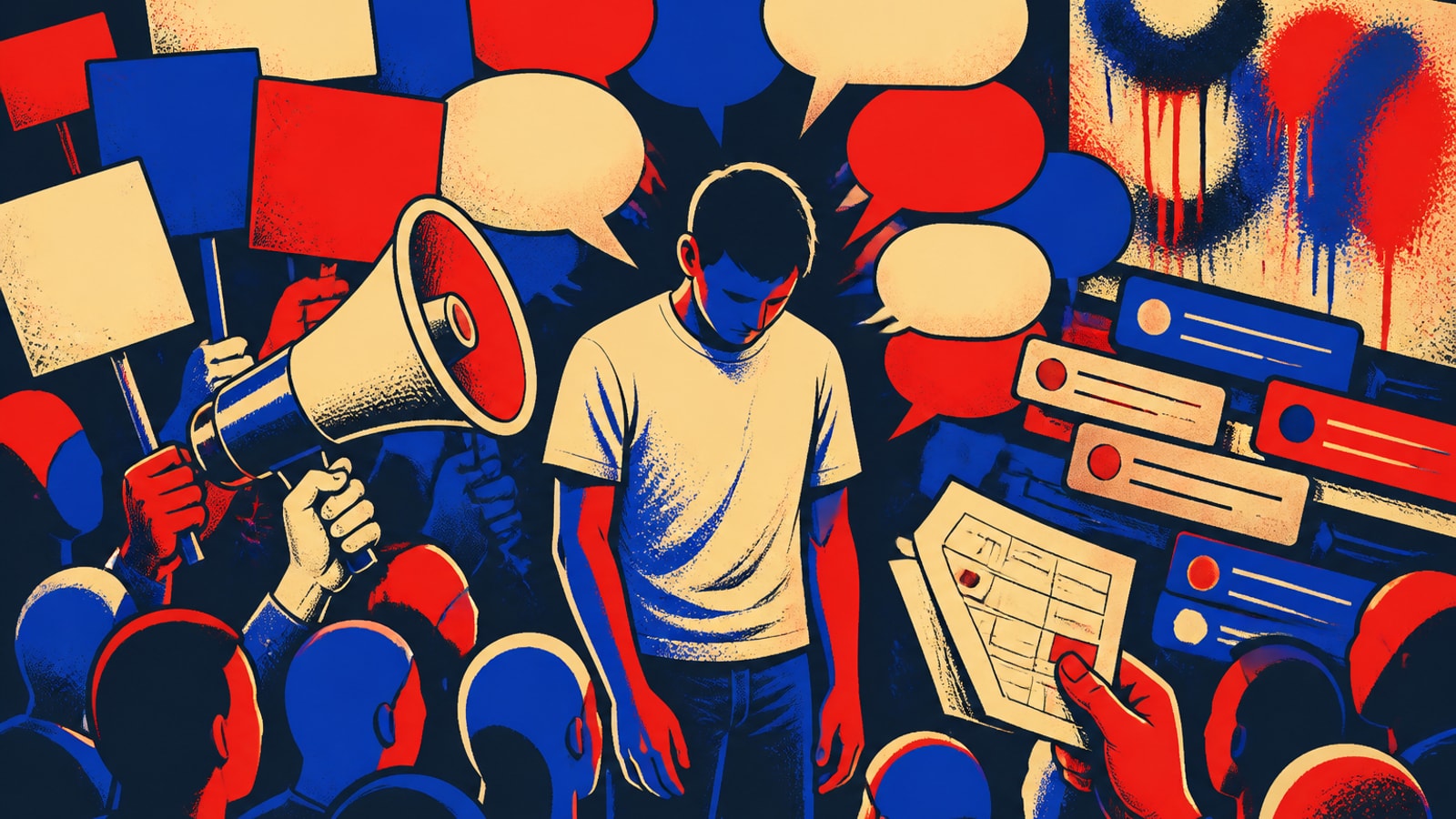
Anyone who has scrolled a comment thread under a news post about Israel has seen the word used less as a description of a political movement than as a charge. The plain question is whether that impression holds up when the comments are counted. In measured corpora it partly does, and as a minority strand: Becker, Ascone and Troschke (2022), peer-reviewed, coded 1,504 comments under posts by leading British media outlets and found 26.9% antisemitic, with the apartheid analogy present in 5.2% of those antisemitic comments and the Nazi analogy in 4.2%. The accusations attached to the word are also documented in the official record and dated: the UN General Assembly adopted Resolution 3379, declaring Zionism a form of racism and racial discrimination, by 72 votes to 35 in 1975, and revoked it by 111 votes to 25 in 1991. What no reviewed dataset reports is a frequency for the Spanish form of the word itself; the corpora that measure this vocabulary are English, French and German.
Key Findings
- 27.9% of the UK comments coded antisemitic assigned Israel sole guilt for the May 2021 escalation, the largest Israel-related framing in the set, against 5.2% for the apartheid analogy and 4.2% for the Nazi analogy (Becker, Ascone and Troschke, 2022, peer-reviewed, 1,504 UK comments).
- 13.1% of English-language tweets containing “Israel” between January and August 2020 were coded antisemitic against the IHRA definition, and 15% of antisemitic tweets containing “Jews” fit the paragraph on denial of Jewish self-determination (Jikeli and colleagues, 2022, peer-reviewed, 4,016-tweet corpus).
- UN General Assembly Resolution 3379 (1975) was adopted 72 in favour, 35 against, 32 abstaining, and Resolution 46/86 (1991) revoked it 111 in favour, 25 against, 13 abstaining (recorded votes, official record).
- The Anti-Defamation League, a monitoring organization with an advocacy mission, counted 9,354 US antisemitic incidents in 2024 on its own definitions and classified 58% (5,452) as Israel or Zionism related; its own disclosure records that a 2023 definitional change added 1,350 incidents, 15% of that year’s total.
- 2,699 of the 4,103 antisemitic incidents the Community Security Trust first reported for 2023 in the United Kingdom, 66% of the annual total, occurred on or after 7 October 2023, against 392 over the same dates in 2022 (Community Security Trust, 2024, community monitoring body, own definitions).
Does the word Zionist now carry accusations of racism and genocide?
Yes, in measured discourse, and as a minority of the coded content. In Becker, Ascone and Troschke’s 2022 peer-reviewed study of comments under posts by leading British, French and German media outlets during the May 2021 escalation, 27.9% of the UK comments coded antisemitic assigned Israel sole guilt for the conflict, the largest Israel-related framing in the set.
The rest of the UK distribution is where the specific accusations sit. Among the antisemitic comments, the “evil” stereotype appeared in 39.8%, child murder or blood libel in 8.1%, denial of Jewish self-determination in 7.7%, the apartheid analogy in 5.2% and the Nazi analogy in 4.2%. The overall antisemitic share differed sharply by language: 26.9% of 1,504 UK comments, 12.6% of 1,500 French comments and 13.6% of 1,520 German comments. The authors also report that the antisemitic meaning could only be inferred from the surrounding thread in 38.7% of UK antisemitic comments, about 62% of French and 48.3% of German, so the framings are frequently carried by context rather than by any single word.
The annotated Twitter corpora point the same way on a different platform. Jikeli and colleagues (2022), peer-reviewed, coded 4,016 English-language tweets against the IHRA definition and found 13.1% of tweets containing “Israel” antisemitic between January and August 2020, against 11.2% of conversations containing “Jews” between January 2019 and August 2020. Within the antisemitic “Jews” tweets, about 62% fit the IHRA paragraph on mendacious or stereotypical allegations about Jewish collective power and 15% fit denial of Jewish self-determination. Jikeli and colleagues (2023), a preprint, coded a larger set of 6,941 tweets on Jews, Israel and antisemitism collected between January 2019 and December 2021 and found 1,250, 18%, antisemitic. Both are shares of samples drawn inside keyword queries, not of any platform as a whole.
Is Zionist used as a substitute word for Jew?
The Anti-Defamation League, a monitoring organization with an advocacy mission, counted 9,354 antisemitic incidents in the United States in 2024 on its own definitions and classified 58%, 5,452 incidents, as Israel or Zionism related, with 2,596 occurring at anti-Israel rallies.
The classification is the organization’s own, and its own disclosure records that a post-October-2023 definitional change, counting certain expressions of opposition to Zionism at protests, added 1,350 incidents, 15%, to the 2023 total and carries into 2024.
The World Jewish Congress publishes a standing page under its conspiracy-myths series on the accusation of genocide against Israel, and the Anti-Defamation League publishes two standing backgrounders, “Dispelling Common Anti-Zionist Myths and Allegations” (2025) and a page addressing comparisons between Israel’s actions and those of Nazi Germany. These are advocacy-organization position documents, dated and named as such, not measurements of usage.
What is measured is the mechanism of substitution itself. Mendelsohn, Le Bras, Choi and Sap (2023), peer-reviewed, assembled a glossary of over 300 coded terms that carry one meaning to a broad audience and a second meaning to an in-group, with “cosmopolitan” as the canonical antisemitic example, and found that harmful content containing such terms evaded automated toxicity detection. Arviv, Hanouna and Tsur (2021), peer-reviewed, retrieved 803,539 tweets containing the triple-parenthesis “echo” symbol from 418,624 users in a two-month 2016 sample and documented the marker drifting from named individuals of Jewish heritage toward abstract targets such as “bankers” and “globalists.” Kikkisetti and colleagues (2024), a preprint pilot over 659 posts scraped from Disqus, Telegram, Minds and GETTR, surfaced coded terms including “White Genocide” and “Deep State” and flagged emerging candidates for human review; it is a methodological pilot, not a prevalence estimate.
Jikeli and colleagues (2022) also report how far the vocabularies diverge. Word-token similarity between antisemitic and non-antisemitic tweets was 0.67 for “Jews” and 0.38 for “Israel,” against 0.10 for “Kikes” and 0.13 for “ZioNazi.” Tweets built on the explicit compound share little vocabulary with ordinary usage; tweets about Israel share a great deal. Which of the two a given use of the word resembles is what the coding schemes exist to decide, and the schemes require the surrounding thread to do it in roughly two comments in five.
What did the UN actually vote on Zionism and racism?
The General Assembly adopted Resolution 3379 on 10 November 1975, determining that Zionism is a form of racism and racial discrimination, on a recorded vote of 72 in favour, 35 against and 32 abstaining. It is the most-cited institutional source of the racism charge, and it is a recorded vote of member states, not a court finding or a measurement.
The same body reversed it. On 16 December 1991 the General Assembly adopted Resolution 46/86, whose operative text revokes the determination contained in Resolution 3379, on a recorded vote of 111 in favour, 25 against and 13 abstaining. The 1991 majority was larger in absolute terms than the 1975 one, and the against column shrank from 35 to 25.
Both documents are short. The 1975 text states a determination in a single operative paragraph; the 1991 text revokes it in a single operative paragraph and adds nothing else. Neither resolution defines Zionism, and neither carries a finding about any individual or any incident. Read as the record rather than as the citation, the sequence documents a position held by a majority of member states for sixteen years and then withdrawn by a larger majority, which is a narrower fact than the formulation the resolution is usually invoked to support. Readers tracing how the movement itself is defined in the research literature can follow that thread separately in our report on what Zionism is.
What does Israel’s own government count on this framing?
Israel’s Ministry for Diaspora Affairs and Combating Antisemitism reported 124 million antisemitic posts on X during calendar 2025 in its 2026 annual executive brief, a figure produced by the ministry’s own volume and sentiment analysis and which the ministry itself describes as an initial finding pending a fuller report. It is a party’s own count, not an independently verified measure.
The same brief reports 815 antisemitic incidents worldwide for 2025, compiled from incidents documented in mainstream and Jewish media, 20 Jews killed in violent incidents, and 4,073 anti-Israel protests globally. The ministry states the incident total is a media-derived tally rather than a comprehensive record. Its separate Holocaust Memorial Day overview, covering April 2025 to April 2026, reports 958 incidents across 72 countries, of which 489 specifically targeted Jews, with 188 of those 489, 38.4%, classified as vandalism and property damage; that report instructs that its category totals not be summed into one overall figure.
For the period the question most often turns on, the ministry’s November 2023 report on the first three weeks of the war states a 500% increase in the overall volume of antisemitic events worldwide against the same dates a year earlier, a 330% increase in violent incidents and about a 660% increase in harassments, each hedged in the document’s own wording and published without baseline counts, method or monitoring sources. Its 2024 report on calendar 2023, produced with the World Zionist Organization and the Jewish Agency for Israel, reports a 33% increase in violent antisemitic incidents globally, 48% of them after 7 October, and a 1,200% increase in posts containing violent antisemitic content calling for violence against Jews, Israelis and Zionists between October and December 2023. The World Zionist Organization’s Department for Combatting Antisemitism, in its 2022 report on 2021, put the worldwide average at more than ten reported incidents a day, with nearly 50% of them in Europe, and presented that figure as a floor because many incidents go unreported.
These are the counts of bodies that are parties to the events they describe, none of them independently verified, and the categories in the 2023 and 2024 reports do not distinguish the target word from the target group. What they establish is that a government monitoring apparatus records the framing as an incident category and publishes its own volumes for it, dated and labelled.
How many people endorse the Israel-as-Nazi comparison?
Enstad (2026), peer-reviewed, measured the belief across two nationally representative Norwegian surveys totalling 3,228 respondents and found that endorsement of Holocaust inversion, the belief that Israel treats Palestinians as badly as Jews were treated during the Second World War, was associated with justification of harassment and violence against Jews.
The design is two studies, one of N = 1,575 and a preregistered replication of N = 1,653, with the replication confirming the first. Endorsement was also associated with refusal to take a stance against aggression toward Jews, and with refusal to answer the survey questions measuring blatant antisemitic prejudice, which the author notes complicates any simple reading of the prejudice measures themselves. The associations are correlational and the author reports them as such; the study does not establish that holding the comparison produces the justification.
The published abstract reports these associations rather than a population share endorsing the comparison, so no endorsement rate appears here as an established figure. The nearest measured share in the corpus literature is Becker, Ascone and Troschke’s 4.2% Nazi analogy among UK antisemitic comments, which counts comments in one 2021 sample, not people in a population.
The Norwegian result matters for the question because it addresses the second half of it. The corpus studies establish that the comparison is present in the discourse and at what share; Enstad measures what endorsing it goes with in a general population, which is a different phenomenon measured by a different method. Reading either as the other overstates both.
Do anti-Israel attitudes track measured antisemitic beliefs?
Harber, Bulska, Malloy and Vila (2026), peer-reviewed and preregistered, report that their Conspiracies Mediated Model of New Antisemitism accounted for over 55% of the variance in anti-Israel attitudes across three studies (N = 373 longitudinal, N = 243 cross-sectional, N = 493 three-wave longitudinal). The relationship is statistical association, not causation, and the authors report it as such.
The mediation is specific. Conspiracy beliefs implicating Israel and Zionists mediated the association between antisemitism and anti-Israel attitudes; conspiracy beliefs about Jews unrelated to Israel did not, and a general conspiratorial mindset did not explain the results. The same studies report that Democrats, compared with Republicans, expressed less antisemitism but stronger anti-Israel attitudes and greater endorsement of anti-Israel and anti-Zionist conspiracy beliefs, so the two attitudes do not move together across the political spectrum.
Ozer, Obaidi and Bergh (2025), peer-reviewed, ran two experiments with British samples (N = 354 and N = 490) priming participants with war-in-Gaza material and found two separate pathways to anti-Jewish hostility: one running from political orientation through social dominance orientation, and one running from conservative political orientation negatively through out-group identity fusion with the Palestinian people. Allington, Hirsh and Katz (2023), peer-reviewed and preregistered on a YouGov quota sample of 1,790 UK adults surveyed in December 2021, found coronavirus conspiracy suspicion correlated positively with generalised, Judeophobic and anti-Zionist antisemitism, with the correlation notably stronger for Judeophobic antisemitism, and their exploratory analysis indicated the anti-Zionist link was accounted for by its overlap with the Judeophobic measure.
Where the definitional boundary between criticism of Israel and antisemitism falls is a contested scholarly question, and these are measured associations inside particular samples rather than a settlement of it. The measurement side of that debate is treated at length in our report on anti-Zionism and antisemitism.
Where do scholars publicly disagree about the genocide framing?
The disagreement is on the record in named venues and is dated. The Journal of Genocide Research, a peer-reviewed Taylor and Francis journal, published an article in 2024 titled “The Growing Rift between Holocaust Scholars over Israel/Palestine” (DOI 10.1080/14623528.2024.2448061), whose title states the disagreement as the subject of the field’s own literature.
The same journal published, in 2025, “It’s Hamas’ Fault, You’re an Antisemite, and We Had No Choice: Techniques…” (DOI 10.1080/14623528.2025.2556582), a peer-reviewed article analyzing justificatory rhetoric. The Journal of Palestine Studies published, in 2024, an article whose title begins “Settler Antisemitism, Israeli Mass Violence, and the Crisis of Holocaust…” (DOI 10.1080/0377919X.2024.2384385). On the other side of the same subject, Norman J. W. Goda, writing in 2025 for the Indiana University Institute for the Study of Contemporary Antisemitism, published a paper in that institute’s research paper series under the title “The Genocide Libel,” which treats the accusation as a form of defamation with a documented history.
The institutional claims the dispute forms around are equally dateable. Amnesty International published a report in December 2024 stating its conclusion that Israel had committed genocide against Palestinians in Gaza, a determination by an advocacy organization on its own analysis. The Anti-Defamation League, in its 2025 document “Dispelling Common Anti-Zionist Myths and Allegations,” sets out the opposing position, and the World Jewish Congress carries the accusation under its conspiracy-myths heading.
Two things follow for the question. The genocide framing is held and argued by named academics in peer-reviewed journals and by named organizations in position documents, dated between 2024 and 2025, and the professional literature describes its own field as split, in the title of a peer-reviewed article. Neither the presence of the argument nor the presence of the rebuttal is a measurement of how often the word carries the accusation in ordinary usage, which is what the corpus studies above count.
Did recorded incidents rise alongside the framing’s peak periods?
Recorded incident counts rose sharply in the same months the framing peaked. The Community Security Trust, a UK community security body counting on its own definitions, reported 2,699 incidents on or after 7 October 2023, 66% of the 4,103 it first published for the year, against 392 over the same dates in 2022. The counts coincided with the period; the tally establishes no cause.
CST recorded 1,330 incidents in October 2023 alone, exceeding its three previous highest months combined, and its daily average moved from five incidents per day between 1 January and 6 October to 31 per day between 7 October and 31 December. Of the annual total, 1,282 incidents, 31%, were online, 704 of those on X. CST states its definition is narrower than the criminal justice system’s, that its totals mix hate crimes with non-crime hate incidents, and, citing a 2018 EU Agency for Fundamental Rights survey finding that only 21% of British Jews who experienced antisemitic harassment reported it anywhere, that its statistics are indicative of trends rather than absolute measures.
The German picture over a shorter window is similar in shape. Bundesverband RIAS, the federal umbrella of German civil-society reporting offices, verified 202 antisemitic incidents connected to the attacks between 7 and 15 October 2023 against 59 documented across the same nine days in 2022, an increase it states as at least 240% because roughly 300 reports were still unverified at its cut-off. Of the 202, 183 were classified as abusive behaviour, 7 as targeted property damage, 6 as attacks and 5 as threats, and RIAS could assign no political background in 64% of cases.
The administrative record shows the same coincidence in official data. Rosenbaum (2025), peer-reviewed, analyzed 3,255 hate crimes recorded by New York City authorities between 2019 and 2024 and found monthly anti-Jewish hate crimes on average about twice as common during the first year of the Israel-Hamas war as in the previous five years, adjusting for each borough’s Jewish population (prevalence ratio 1.97, 95% confidence interval 1.64 to 2.35). The author flags official hate-crime counts as an undercount of true prevalence. The pattern across conflict periods is examined on its own terms in our report on antisemitism after conflict.
Has anyone measured the Spanish word Zionista itself?
The measured record covers the concept, not the specific word. The corpora behind these findings are English, French and German: Zannettou, Finkelstein, Bradlyn and Blackburn (2020), peer-reviewed, analyzed over 100 million posts across two English-language web communities, and Becker, Ascone and Troschke (2022) coded 1,500 comments per language in English, French and German.
The scale of the English-language work sets the contrast. The 2020 study covered 67,416,903 posts on one imageboard between July 2016 and January 2018 and 35,528,320 posts on Gab between August 2016 and January 2018, reporting that the word “jew” appeared in 1,993,432 posts, 3.0%, on the first and 763,329, 2.0%, on the second, rising 16.44-fold across the collection period. Jikeli and colleagues (2022 and 2023) work in English; Becker and colleagues (2022) is the only one of these to code French and German, and it reports category shares rather than term frequencies.
No reviewed dataset in this literature reports term-level frequencies for the Spanish, Portuguese or Italian form of the word. That is a scope fact about the published corpora rather than a finding about Spanish-language discourse: the absence of a measurement is not a measurement of absence, and none of the studies above claims coverage it does not have. Any statement about how the Spanish word is used at scale would rest on no published count.
What the English, French and German record does support is a statement about the framings rather than the token: that the sole-guilt, apartheid, Nazi-analogy and self-determination-denial framings are each present in coded antisemitic content at measurable and separately reported shares, in samples drawn from specific platforms in specific months. Applying those shares to another language, another platform or another year is an extrapolation the underlying studies do not license.
Methodology and limitations
This report measures the discourse around the word and the official and organizational record attached to it. It does not assess the underlying contested claims about Israel’s conduct.
Four source types are used and each is labelled where it appears. Peer-reviewed research supplies the coded shares (Becker, Ascone and Troschke, 2022; Jikeli and colleagues, 2022; Zannettou and colleagues, 2020; Arviv and colleagues, 2021; Mendelsohn and colleagues, 2023; Rosenbaum, 2025) and the survey associations (Enstad, 2026; Harber and colleagues, 2026; Ozer and colleagues, 2025; Allington and colleagues, 2023). Preprints are marked as such at first use: Jikeli and colleagues (2023) and Kikkisetti and colleagues (2024). Primary and official records supply the two General Assembly recorded votes. Monitoring and government-published counts (the Anti-Defamation League, the Community Security Trust, Bundesverband RIAS, Israel’s Ministry for Diaspora Affairs and Combating Antisemitism, the World Zionist Organization) are attributed as the counts of the bodies that produced them, on those bodies’ own definitions.
Several figures are abstract-sourced, meaning they are carried as the published abstract reports them: Enstad (2026), Harber and colleagues (2026) and Ozer and colleagues (2025). Enstad’s abstract reports associations rather than an endorsement share, so no population share for the Israel-as-Nazi comparison appears in this report.
The counts are not interchangeable. The Anti-Defamation League’s incident totals, the Community Security Trust’s, RIAS’s and the Israeli ministry’s each rest on a different definition, a different reporting channel and a different geography, and none may be summed with another or with police-recorded crime. The Anti-Defamation League’s own disclosure records that its post-October-2023 counting of certain expressions of opposition to Zionism at protests added 1,350 incidents, 15%, to its 2023 total, so its Israel-related share reflects that definitional decision. The Community Security Trust states its definition is narrower than the criminal justice system’s; RIAS states its categories are broader than criminal law. The Israeli ministry’s global percentages for October 2023 carry no baseline counts, no method and no monitoring sources, and the ministry hedges them in its own text.
Every relationship reported here between the framing and offline events is correlational. Rosenbaum (2025) reports a prevalence ratio with a confidence interval and flags official counts as an undercount; Enstad, Harber, Ozer and Allington report associations and disclaim causal inference. Where the literature disagrees, both poles are named: the Journal of Genocide Research and the Journal of Palestine Studies articles on one side, Goda’s 2025 Indiana University paper and the Anti-Defamation League’s 2025 document on the other.
Scope limit: the coded corpora are English, French and German, drawn from Facebook comment sections, Twitter/X, 4chan and Gab, in windows between 2016 and 2023. No reviewed dataset reports term-level frequencies for the Spanish, Portuguese or Italian form of the word.
Conclusion
The impression the comment thread leaves is that the word has become a charge rather than a description. Counted, it is both, unevenly. Becker, Ascone and Troschke found the accusation framings inside 26.9% of UK comments coded antisemitic, distributed across sole guilt at 27.9%, blood libel at 8.1%, self-determination denial at 7.7%, apartheid at 5.2% and the Nazi analogy at 4.2%, with the meaning legible only from the thread in 38.7% of cases.
Around that distribution sits a record of institutions doing the same thing at scale. The General Assembly voted the racism determination in 1975 by 72 to 35 and voted it out in 1991 by 111 to 25. The Anti-Defamation League classified 5,452 of 9,354 US incidents in 2024 as Israel or Zionism related on definitions it revised the year before. Israel’s own ministry logged 124 million antisemitic posts on X in 2025 by its own analysis, and the Community Security Trust logged 2,699 UK incidents in the 86 days after 7 October 2023 against 392 in the same dates a year earlier. Named academics argue the genocide framing in the Journal of Genocide Research and named academics argue against it from Indiana University, and a peer-reviewed article title describes the field as riven. Harber and colleagues found conspiracy beliefs specifically implicating Israel and Zionists carrying over 55% of the variance in anti-Israel attitudes while beliefs about Jews unrelated to Israel carried none of it.
So the word is doing at least two jobs at once, in the same threads, in the same months, and no dataset in this literature reports how often it does each in Spanish. The measured link runs through the conspiracy content, not through the criticism, and Enstad’s Norwegian samples found that endorsing one particular comparison went with justifying harassment. Which leaves the question a reader is really carrying when they see the word land on a person rather than a policy: at what point does a word that names a political position start functioning as a name for a people, and what, in a comment thread, would tell you which one you were reading?
Frequently Asked Questions
How do researchers decide whether an Israel-related comment counts as antisemitic?
Most of the corpus work codes against the IHRA working definition and its paragraphs. Jikeli and colleagues (2022) used expert annotators on a 4,016-tweet gold-standard corpus, and Becker, Ascone and Troschke (2022) used an IHRA-based coding scheme on 4,500 comments. Becker and colleagues report that in 38.7% of UK antisemitic comments the thread context was needed to infer the meaning.
Why do British, French and German comment sections produce such different shares?
The same 2022 study found 26.9% of 1,504 UK comments antisemitic against 12.6% of 1,500 French and 13.6% of 1,520 German comments, all reacting to the same May 2021 escalation. The authors report the difference alongside a difference in how much thread context was needed: about 62% for French comments and 48.3% for German, against 38.7% for British.
Which platforms have actually been measured at scale?
The largest is 4chan’s politics board and Gab: Zannettou and colleagues (2020) covered 67,416,903 and 35,528,320 posts respectively. Twitter/X is covered by Jikeli and colleagues (2022 and 2023) and by Ron and colleagues (2023), whose preprint assembled 2,923,129 English tweets across 206,902 conversations targeting Jews between July 2018 and June 2022.
How well does coded language get past automated moderation?
Mendelsohn, Le Bras, Choi and Sap (2023), peer-reviewed, found that harmful content containing terms from their 300-plus glossary evaded automated toxicity detection, and that GPT-3’s ability to decode such terms varied widely by term type and targeted group. Taylor, Peignon and Chen (2017), a preprint, documented the same substitution mechanism in the 2016 scheme that used ordinary words as stand-ins.
Does belief in Israel-related conspiracy claims differ from general conspiracy thinking?
Yes, on the measured evidence. Harber and colleagues (2026) found conspiracy beliefs implicating Israel and Zionists mediated the antisemitism-to-anti-Israel-attitudes relationship, while a general conspiratorial mindset did not explain the results. Swami (2012) reached a parallel finding in Malaysia, where attitudes toward Israel were the strongest predictor (standardized beta 0.56) and general conspiracist ideation dropped out once ideology was accounted for.
How complete are national antisemitic-incident counts?
They are floors. The FBI recorded 1,938 single-bias anti-Jewish incidents for 2024, but of 16,419 participating agencies only 3,127, 19.0%, reported any hate crime that year, and the Bureau of Justice Statistics estimated that about 42% of violent hate-crime victimizations went unreported to police between 2015 and 2019. The Community Security Trust states its own totals are indicative of trends rather than absolute measures.
Why does the wording of a survey question matter here?
Because refusal is itself a measured behaviour. Enstad (2026) found endorsement of Holocaust inversion associated not only with justification of aggression against Jews but with refusal to answer questions measuring blatant antisemitic prejudice, which means the same respondents can register differently depending on which instrument is used.
Sources
- Allington, D., Hirsh, D., and Katz, L., 2023. Correlation Between Coronavirus Conspiracism and Antisemitism: A Cross-Sectional Study in the United Kingdom. Scientific Reports. DOI 10.1038/s41598-023-41794-y. Peer-reviewed.
- Anti-Defamation League, 2025. Audit of Antisemitic Incidents 2024. ADL Center on Extremism, 22 April 2025. adl.org. Monitoring organization (advocacy mission).
- Anti-Defamation League, 2025. Dispelling Common Anti-Zionist Myths and Allegations. adl.org. Monitoring organization (advocacy mission).
- Arviv, E., Hanouna, S., and Tsur, O., 2021. It’s a Thin Line Between Love and Hate: Using the Echo in Modeling Dynamics of Racist Online Communities. ICWSM 2021 (AAAI). arXiv:2012.01133. Peer-reviewed conference.
- Becker, M., Ascone, L., and Troschke, H., 2022. Antisemitic Comments on Facebook Pages of Leading British, French, and German Media Outlets. Humanities and Social Sciences Communications. DOI 10.1057/s41599-022-01337-8. Peer-reviewed.
- Bundesverband RIAS, 2023. Antisemitische Reaktionen in Deutschland auf die Hamas-Massaker in Israel, 7 to 15 October 2023. report-antisemitism.de. Monitoring organization.
- Bureau of Justice Statistics, 2021. Hate Crime Victimization, 2005 to 2019. US Department of Justice. bjs.ojp.gov. Official record.
- Community Security Trust, 2024. Antisemitic Incidents Report 2023. cst.org.uk. Monitoring organization (community security body).
- Enstad, J. D., 2026. Holocaust Inversion and Justification of Anti-Jewish Aggression: Evidence from Two National Surveys in Norway. American Psychologist. DOI 10.1037/amp0001704. Peer-reviewed (abstract-sourced).
- Federal Bureau of Investigation, 2025. Reported Crimes in the Nation, 2024, Hate Crime Statistics. UCR Crime Data Explorer. Official record.
- Goda, N. J. W., 2025. The Genocide Libel. Research Paper Series, Institute for the Study of Contemporary Antisemitism, Indiana University. isca.indiana.edu. Research institute paper.
- Harber, K., Bulska, D., Malloy, T., and Vila, J., 2026. Antisemitism, Conspiracy Beliefs, and Anti-Israel Attitudes. American Psychologist. DOI 10.1037/amp0001635. Peer-reviewed (abstract-sourced).
- Jikeli, G., Axelrod, D., Fischer, R., Forouzesh, E., Jeong, W., Miehling, D., and Soemer, K., 2022. Differences Between Antisemitic and Non-Antisemitic English Language Tweets. Computational and Mathematical Organization Theory. DOI 10.1007/s10588-022-09363-2. Peer-reviewed.
- Jikeli, G., Karali, S., Miehling, D., and Soemer, K., 2023. Antisemitic Messages? A Guide to High-Quality Annotation and a Labeled Dataset of Tweets. arXiv:2304.14599. Preprint.
- Journal of Genocide Research, 2024. The Growing Rift between Holocaust Scholars over Israel/Palestine. Taylor and Francis. DOI 10.1080/14623528.2024.2448061. Peer-reviewed.
- Journal of Genocide Research, 2025. It’s Hamas’ Fault, You’re an Antisemite, and We Had No Choice: Techniques… Taylor and Francis. DOI 10.1080/14623528.2025.2556582. Peer-reviewed.
- Journal of Palestine Studies, 2024. Settler Antisemitism, Israeli Mass Violence, and the Crisis of Holocaust… Taylor and Francis. DOI 10.1080/0377919X.2024.2384385. Peer-reviewed.
- Kikkisetti, D., Mustafa, R., Melillo, W., Corizzo, R., Boukouvalas, Z., Gill, J., and Japkowicz, N., 2024. Using LLMs to Discover Emerging Coded Antisemitic Hate-Speech in Extremist Social Media. arXiv:2401.10841. Preprint.
- Mendelsohn, J., Le Bras, R., Choi, Y., and Sap, M., 2023. From Dogwhistles to Bullhorns: Unveiling Coded Rhetoric with Language Models. ACL 2023. arXiv:2305.17174. Peer-reviewed conference.
- Ministry for Diaspora Affairs and Combating Antisemitism, 2023. The State of Antisemitism in the World: A Summary of the First Three Weeks of the “Swords of Iron” War. gov.il. Government body (self-reported).
- Ministry for Diaspora Affairs and Combating Antisemitism, 2024. The State of Antisemitism Report for 2023, with the World Zionist Organization and the Jewish Agency for Israel. gov.il. Government body (self-reported).
- Ministry for Diaspora Affairs and Combating Antisemitism, 2026. Annual Report Executive Brief: Global Overview of Antisemitism in 2025. gov.il. Government body (self-reported).
- Ministry of Diaspora Affairs and Combating Antisemitism, 2026. Holocaust Memorial Day Antisemitism Overview, April 2025 to April 2026. gov.il. Government body (self-reported).
- Ozer, S., Obaidi, M., and Bergh, R., 2025. The Impact of Globalized Conflicts: Examining Attitudes Toward Jews Among Britons in the Political Context of the War in Gaza. International Journal of Intercultural Relations. DOI 10.1016/j.ijintrel.2025.102184. Peer-reviewed (abstract-sourced).
- Ron, Y., Levi, E., Oshri, O., and Shenhav, S., 2023. Factoring Hate Speech: A New Annotation Framework to Study Hate Speech in Social Media. arXiv:2311.03969. Preprint.
- Rosenbaum, J., 2025. Antisemitic Hate Crimes in New York City: An Analysis of Administrative Data, 2019 to 2024. Journal of Public Health Policy. DOI 10.1057/s41271-025-00596-4. Peer-reviewed.
- Swami, V., 2012. Social Psychological Origins of Conspiracy Theories: The Case of the Jewish Conspiracy Theory in Malaysia. Frontiers in Psychology. DOI 10.3389/fpsyg.2012.00280. Peer-reviewed.
- Taylor, J., Peignon, M., and Chen, Y.-S., 2017. Surfacing Contextual Hate Speech Words within Social Media. arXiv:1711.10093. Preprint.
- United Nations General Assembly, 1975. Resolution 3379 (XXX), 10 November 1975, recorded vote 72 to 35 with 32 abstentions. Official record.
- United Nations General Assembly, 1991. Resolution 46/86, 16 December 1991, recorded vote 111 to 25 with 13 abstentions. Official record.
- World Jewish Congress. Accusing Israel of Genocide, conspiracy myths series. worldjewishcongress.org. Monitoring organization (advocacy mission).
- World Zionist Organization, Department for Combatting Antisemitism and Enhancing Resilience, 2022. The State of Antisemitism in 2021. Monitoring organization (advocacy mission).
- Zannettou, S., Finkelstein, J., Bradlyn, B., and Blackburn, J., 2020. A Quantitative Approach to Understanding Online Antisemitism. ICWSM 2020 (AAAI). DOI 10.1609/icwsm.v14i1.7343. Peer-reviewed conference.