
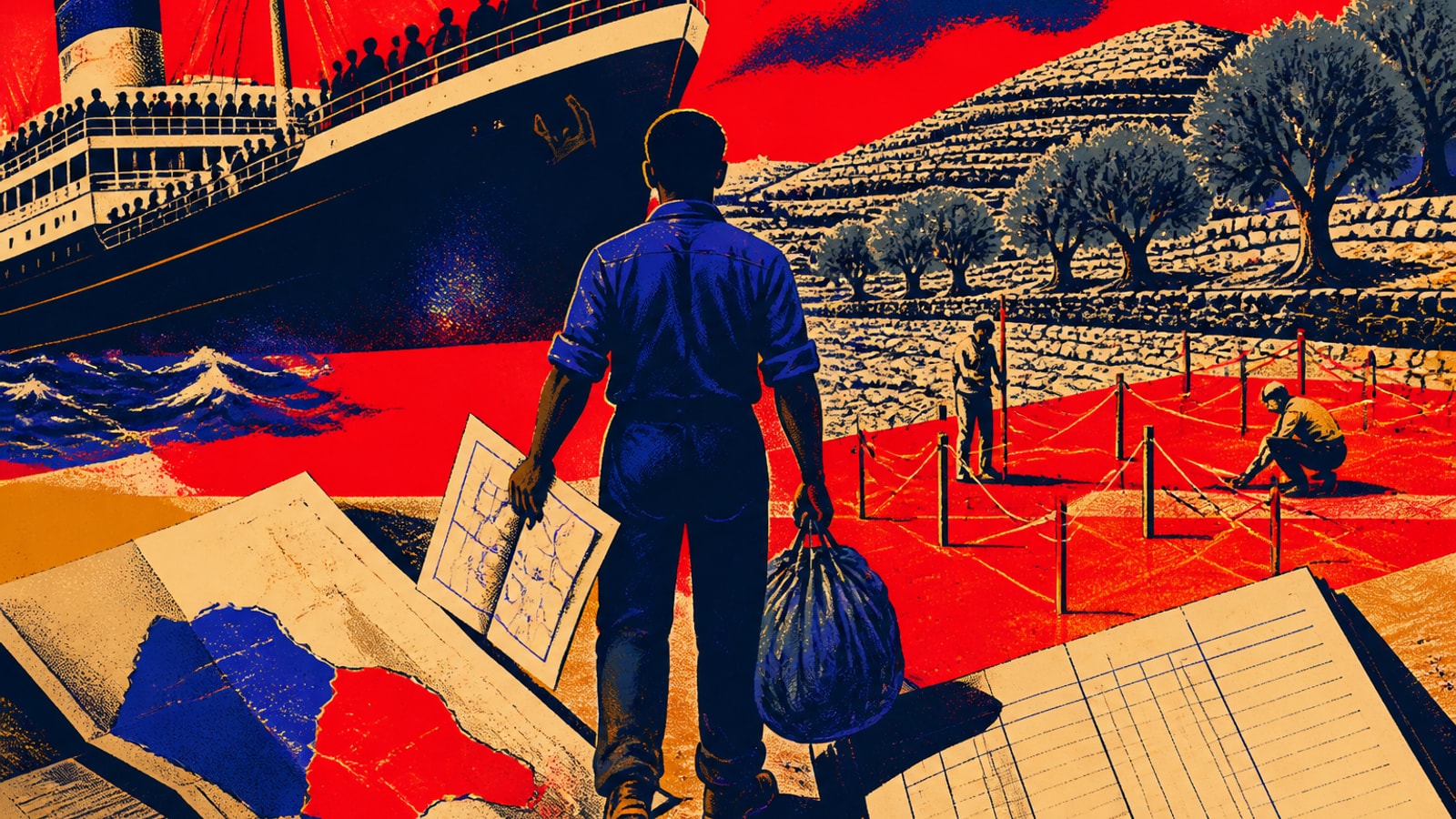
Zionism’s founding texts describe a national movement. The Declaration signed by 37 members of the People’s Council on 14 May 1948 grounds the state in a land it calls “the birthplace of the Jewish people” (Provisional Government of Israel, 1948). A named line of scholarship, from Gershon Shafir’s 1989 Cambridge University Press study to Tariq Dana’s 2024 article in Middle East Critique, reads the same movement through settlement, land and labour. The two readings apply different tests. One asks what the movement sought for Jews. The other asks what it meant for the 1,035,821 people the Government of Palestine enumerated in 1931, 16.9% of whom were recorded as Jews.
Key Findings
- 37 members of the People’s Council signed the Declaration of 14 May 1948. It opens by calling the land “the birthplace of the Jewish people” and traces its claim through the 1897 Congress, the 1917 Balfour Declaration and the 29 November 1947 resolution (Provisional Government of Israel, 1948).
- The settler-colonial reading has named academic holders across 36 years. It runs from Shafir’s 1989 land-and-labour study of 1882 to 1914 (Shafir, 1989) to Locker-Biletzki’s 2025 symposium paper on 1920 to 1956 (Locker-Biletzki, 2025). Dowty’s 2022 essay argues against it (Dowty, 2022).
- The census of 18 November 1931 recorded 174,610 Jews, 16.9% of the 1,035,821 people it enumerated, and 759,712 Moslems (Government of Palestine, 1932).
- Israel’s own statistics office counts Israel’s share of world Jewry at 6% in 1948 and 45% at the beginning of 2024. Of the 7.1 million Jews in Israel in 2024, 5.7 million were born there (Central Bureau of Statistics, 2025).
- The Palestine National Council’s Declaration of 15 November 1988 rests on “the natural, historical and legal right of the Palestinian Arab people to its homeland” (Palestine National Council, 1988). Two founding declarations thus claim a national right in the same land.
Is Zionism national liberation or settler colonialism, on the record?
The Declaration of the Establishment of the State of Israel was read on 14 May 1948 and signed by 37 members of the People’s Council. It opens by calling the land “the birthplace of the Jewish people” (Provisional Government of Israel, 1948). That is the national-liberation reading in the founding instrument’s own words. The settler-colonial reading applies a different test: what the movement meant for the population already living in the land.
The Declaration’s recitals set out its own historical chain. They cite the First Zionist Congress of 1897, convened by Theodor Herzl. They cite the Balfour Declaration of 2 November 1917, the League of Nations Mandate, and the United Nations General Assembly resolution of 29 November 1947, a recognition the text calls “irrevocable.” The recitals are the founding text’s account of its own history and are cited here as what it asserts.
The same text addresses the population already present. In the English text published by the Knesset, the state “will ensure complete equality of social and political rights to all its citizens irrespective of religion, race or sex.” It appeals “to the Arab inhabitants of the State of Israel to preserve peace and participate in the upbuilding of the State on the basis of full and equal citizenship.” The Israeli Ministry of Foreign Affairs publishes the equality sentence with “inhabitants” in place of “citizens.” Both are translations of the Hebrew original.
Named scholars answer the classification question in opposite directions. An essay for the Stroum Center for Jewish Studies at the University of Washington, published on 10 November 2022 under the title “Is Israel a settler colonial state?”, argues against the characterisation (Dowty, 2022). It is signed faculty commentary, not peer-reviewed research. Tariq Dana’s 2024 article in Middle East Critique, a peer-reviewed journal, argues for it and classes Israeli settler colonialism as exceptional within that field (Dana, 2024).
The two framings therefore measure two different things. One reads the movement’s stated purpose: self-rule for a dispersed people in a land its founding text names as its origin. The other reads its effects: land, labour, population and jurisdiction in a territory that already had a majority. Each test has its own dated evidence, and each holder of each reading can be named.
Who calls Zionism settler colonialism, and since when?
Gershon Shafir’s Land, Labor and the Origins of the Israeli-Palestinian Conflict, 1882-1914, was published by Cambridge University Press in 1989. It locates the conflict’s origins in a struggle over land and labour at the frontier of Zionist settlement (Shafir, 1989). The reading has named holders in university presses and refereed journals across the 36 years to 2025. It is an established scholarly position.
The University of California Press, which reissued the book in 1996, describes it as challenging “the heroic myths about the foundation of the State of Israel by investigating the struggle to control land and labor during the early Zionist enterprise.” MERIP’s 1990 review sets the argument out in more detail. The conflict began in “their struggle over the land and labor markets on the frontier of Zionist settlement in Palestine during the last years of Ottoman rule.” That struggle was made possible by a land market created by “the integration of the Ottoman Empire into the world capitalist market.” The review summarises the book as reading the First Aliyah (1882 to 1903) as a settlement colony that became a plantation economy employing Palestinian Arab labour, and the Second Aliyah (1903 to 1914) through the “conquest of labor.” The book is interpretive historical sociology and supplies no rate or count.
Tariq Dana of the Doha Institute for Graduate Studies makes the argument in eight pages of theory (Dana, 2024). He classes Israeli settler colonialism as exceptional for three reasons: its Zionist ideological roots, the absence of a conventional metropole, and its reliance on Western alliance. The article contains no figures. Middle East Critique states in its aims that it publishes analyses “drawing on heterodox theoretical perspectives.”
Locker-Biletzki’s 2025 paper in the Review of Radical Political Economics extends the reading to 1920 to 1956 and frames that period as settler colonialism and empire-building (Locker-Biletzki, 2025). The publisher types it as a meeting report within a themed symposium. It was refereed, but it is a conference paper, not a research article. The journal is published for the Union for Radical Political Economics, which states an explicit political economy commitment.
The framing was established enough by 2018 to be answered by name in the journal literature. Ukashi’s article in Peace and Conflict Studies, a peer-reviewed journal, argues for reconsidering Zionism as an Indigenous emancipation movement. It argues against both the imperial and the settler-colonial characterisations, and the author states his conclusion in his introduction (Ukashi, 2018).
Who framed Zionism as national self-emancipation, and when?
Leon Pinsker’s pamphlet Auto-Emancipation was published anonymously in German in 1882, after the pogroms in the Russian Empire. It concluded that “The international Jewish question must have a national solution” (Pinsker, 1882).
It is the first dated text in a chain that runs through Herzl’s 1896 treatise and the 1897 Basel Program to the 1948 Declaration.
Pinsker’s remedy, in the 1916 English translation by D. S. Blondheim, was “the creation of a Jewish nationality, of a people living upon its own soil.” His diagnosis was his own polemical framing. He called hatred of Jews “Judeophobia,” described it as a hereditary “psychic aberration,” and concluded that “The Jews are not a living nation; they are everywhere aliens; therefore they are despised.” He asked for a land “sufficiently extensive to allow the settlement of several millions.”
Theodor Herzl’s The Jewish State (1896), quoted here from the 1946 American Zionist Emergency Council translation, set the same problem in national terms. He wrote: “It is a national question, which can only be solved by making it a political world-question to be discussed and settled by the civilized nations of the world in council.” He also wrote “We are one people” and added that “our enemies have made us one without our consent, as repeatedly happens in history” (Herzl, 1896).
The First Zionist Congress adopted the Basel Program unanimously at Basel in August 1897. In the Jewish Encyclopedia’s contemporary translation, the program reads: “Zionism aims at establishing for the Jewish people a publicly and legally assured home in Palestine” (First Zionist Congress, 1897). The first of its four means is “the promotion of the settlement of Jewish agriculturists, artisans, and tradesmen in Palestine.” The program’s text does not mention antisemitism. That rationale comes from Pinsker and Herzl.
The liberation chain, then, is dated and quotable. Its own program names settlement as its first instrument.
Why do both framings cite the 1922 Mandate?
The Mandate for Palestine was approved by the Council of the League of Nations in 1922. Its preamble recognises “the historical connection of the Jewish people with Palestine,” which is the clause the national-liberation reading cites (His Majesty’s Government, 1917). The same instrument makes Britain, a European imperial power, responsible for securing “the establishment of the Jewish national home,” which is the sponsorship the settler-colonial reading cites.
The Mandate restated, in different words, the 67-word sentence of the 2 November 1917 letter of Arthur James Balfour inside a League instrument. The letter’s safeguard for “existing non-Jewish communities in Palestine” is limited to their “civil and religious rights.” The Mandate’s Article 2 adds duties toward the population. Britain is to secure the national home “and the development of self-governing institutions, and also for safeguarding the civil and religious rights of all the inhabitants of Palestine, irrespective of race and religion.” Article 4 recognises “An appropriate Jewish agency” as a public body advising the Administration.
The leader of the movement’s Revisionist current tied the Mandate directly to outside protection. In 1923, Ze’ev Jabotinsky wrote of his policy: “That is our Arab policy; not what it should be, but what it actually is, whether we admit it or not. What need, otherwise, of the Balfour Declaration? Or of the Mandate?” (Jabotinsky, 1923).
The Mandatory power later reviewed its own instrument. The Palestine Royal Commission, chaired by Earl Peel, signed its report on 22 June 1937, and the report was presented to Parliament in July 1937. Its central conclusion was that Britain’s obligations to the two communities “have proved irreconcilable.” In Chapter XX, paragraph 17, it wrote that “we cannot” in Palestine as it then was “both concede the Arab claim to self-government and secure the establishment of the Jewish National Home” (Palestine Royal Commission, 1937). This is a British government-commissioned finding about Britain’s own obligations. Its recommendation was partition, which was never enacted.
The Mandate therefore supplies evidence for both readings in a single text. Its preamble speaks the language of restoration, its operative articles assign the work to an imperial administration, and its Mandatory reported 15 years later that the two purposes could not both be met.
Who lived in the land when Britain counted it in 1931?
The Government of Palestine’s census, taken at midnight on 18 November 1931, recorded 174,610 Jews among 1,035,821 people enumerated, a share of 16.9% (Government of Palestine, 1932). That is the mandatory power’s own count of the inhabited land on which the settler-colonial criterion turns.
The census classifies by religion, not by nationality, and has no “Arab” or “Palestinian” column. It recorded 759,712 Moslems, 91,398 Christians, 9,148 Druses, 350 Bahais, 182 Samaritans and 421 people of no religion. Reading Moslems plus most Christians and Druses as Arab is a reasonable derivation, but no such total appears in the census. The count separates 969,268 settled from 66,553 nomadic people, and the nomadic count is wholly Moslem. The figures come from the preliminary tables, which were compiled by E. Mills, Superintendent of Census. The general report followed in 1933.
The Royal Commission described the same land six years later. In Chapter XX, paragraph 5, it wrote: “An irrepressible conflict has arisen between two national communities within the narrow bounds of one small country. About 1,000,000 Arabs are in strife, open or latent, with some 400,000 Jews” (Palestine Royal Commission, 1937). The figures are the Commission’s own rounded characterisation in an argumentative passage, not an enumeration.
Each reading takes something different from these counts. For the settler-colonial reading, a Jewish minority of 16.9% within an enumerated majority of other religions is the baseline condition. For the liberation reading, the same Mandate that ordered the count had recognised the Jewish people’s “historical connection” to the land. The census records the population and is silent on the classification.
How did Israel’s share of world Jewry rise from 6% to 45%?
Israel’s Central Bureau of Statistics, the state’s own statistics office, counts 650,000 Jews in the land in 1948, 6% of a world Jewish population of 11.5 million.
It counts 7.1 million, or 45% of 15.7 million, at the beginning of 2024 (Central Bureau of Statistics, 2025). The rise came through both immigration and birth, and each reading stresses a different one.
On the eve of the Second World War in 1939, the Bureau counts 449,000 Jews in the land, 3% of 16.6 million. Of the 7.1 million Jews in Israel at the beginning of 2024, 5.7 million were born in Israel and 1.4 million abroad. For every country except Israel, the Bureau uses a “core” Jewish population definition drawn from the Hebrew University of Jerusalem’s American Jewish Year Book 2023.
The Bureau’s 2026 Independence Day release, also Israel’s own official statistics, records over 3.5 million immigrants since 1948, about 1.68 million of them since 1990 (Central Bureau of Statistics, 2026). It counts a population of 806,000 at independence and a preliminary 10.244 million in April 2026. Of the April 2026 total, 7.790 million (76%) are Jews and Others and 2.157 million (21.1%) are Arabs.
Israeli law classes this immigration as return. Section 1 of the Law of Return, passed on 5 July 1950, reads in full: “Every Jew has the right to come to this country as an oleh” (Knesset, 1950, amended 1970). The translator’s note in the English text published by the Knesset defines oleh as “a Jew immigrating, into Israel.” Section 4 extends the status to the native-born: every Jew “born in this country” is “deemed to be a person who has come to this country as an oleh under this Law.”
The same counts serve both readings. A settler-colonial reading stresses the 3.5 million immigrants. A liberation reading stresses ingathering, in the statute’s own vocabulary of return.
Do historians agree what 1948 means for the settler-colonial reading?
Benny Morris’s The Birth of the Palestinian Refugee Problem Revisited (Cambridge University Press, second edition 2004) gives roughly 700,000 as his own archival estimate of Palestinians who became refugees in the 1948 war (Morris, 2004). That 1948 displacement is documented on both sides of the scholarly divide. The historians differ on its cause, and the cause is where the settler-colonial argument for the pre-1967 state turns.
Morris draws on Israeli military and state archives. He attributes the exodus to causes that varied by locality and phase: military attack and fear of attack, expulsions in certain sectors, and flight. He rejects both a single master plan of expulsion and the claim that departures were voluntary.
Ilan Pappé’s The Ethnic Cleansing of Palestine (Oneworld, 2006) argues that the 1948 displacement was planned (Pappé, 2006). The book’s title is the named home of the ethnic-cleansing characterisation, and the author states a moral position. The two works are the poles of a named scholarly dispute over contingency and design, and neither has settled it.
An earlier official document sits behind both accounts. In 1937 the Royal Commission recommended in Chapter XXII, paragraph 36, that “Sooner or later there should be a transfer of land and, as far as possible, an exchange of population” (Palestine Royal Commission, 1937). Paragraph 42 makes agreement the first step, scaled to new land being found for resettlement. Paragraph 43 adds that for the Plains, and for Jewish colonies left in the proposed Arab State, “in the last resort the exchange would be compulsory.” The recommendation was conditioned on agreement and on land, and it was never carried out.
For the classification question, the dispute narrows the ground rather than closing it. A reading of 1948 as design supports a settler-colonial classification of the founding itself. A reading of 1948 as the product of war accepts the displacement and contests the intent. Morris and Pappé both document the event and divide on which of those readings it supports.
Does the framing change for territory taken in 1967?
Israel and the PLO signed the Interim Agreement on 28 September 1995. Its Article XII(5) defines “the Settlements” as, in the West Bank, “the settlements in Area C” (Israel and the PLO, 1995). The post-1967 record adds something the earlier period lacks: signed instruments that name settlements as a legal category. The scholarly settler-colonial readings cited here, however, locate the question before 1967.
The Agreement, in the English text published by Israel’s Ministry of Foreign Affairs, a party to it, defines Area C residually. Area C is the “areas of the West Bank outside Areas A and B,” to be “gradually transferred to Palestinian jurisdiction.” Article XVII(1) removes from the Palestinian Council’s jurisdiction “Jerusalem, settlements, specified military locations, Palestinian refugees, borders, foreign relations and Israelis.” Article XVII(4)(a) states that “Israel, through its military government, has the authority over areas that are not under the territorial jurisdiction of the Council.” Article XXXI(6) preserves for both parties “any of its existing rights, claims or positions.” The 18-month redeployment schedule and the 4 May 1996 deadline for opening permanent status talks are what the 1995 text set out.
The restricting authority’s own instrument, a party’s own published policy, opens on the 1967 legal frame. COGAT’s permit document, current to 8 February 2022, states that “Under the Order Concerning Closed Areas (West Bank Area) (Amendment) (No. 34), 1967, the area of Judea and Samaria is a closed military area and not to be entered or exited without a permit issued on behalf of the military commander” (COGAT, 2022). Its quotas are ceilings, not counts. One example is 74,300 for home construction. The edition predates 7 October 2023 and any change to the permit regime since.
The scholarship sits earlier than these instruments. Shafir’s study covers 1882 to 1914, and Locker-Biletzki’s paper covers 1920 to 1956. Dana locates part of the exceptionalism he argues for in Zionist ideological roots, which predate 1967. For these authors the settler-colonial question begins before 1967, and the 1995 and 2022 instruments document a later and legally separate category.
Do Palestinian bodies claim national liberation for themselves?
The Palestine National Council issued its Declaration of Independence at Algiers on 15 November 1988. It proclaimed a state “By virtue of the natural, historical and legal right of the Palestinian Arab people to its homeland, Palestine” (Palestine National Council, 1988). This is a party’s own founding statement. It claims national self-determination in the same land as the 1948 Declaration.
In the United Nations translation, the text grounds Palestinian identity in the land in terms that parallel Israel’s founding instrument. “There it grew and developed, and there it created its unique human and national mode of existence in an organic, indissoluble and unbroken relationship among people, land and history.” It calls the description of Palestine as “a land without a people” a “falsification of history.” It cites Article 22 of the 1919 Covenant of the League of Nations and the Lausanne Treaty of 1923. It names resolution 181 of 1947 as both a “historical injustice” and a source of conditions guaranteeing “the right to sovereignty and national independence.”
The same claim appears in current statements. As reported by WAFA, the Palestinian news agency, the PLO Executive Committee on 1 August 2026 called for “the Palestinian people’s right to self-determination through the establishment of an independent and sovereign Palestinian state on the June 4, 1967 borders, with East Jerusalem as its capital” (PLO Executive Committee and the Palestinian Presidency, 2026). That is the agency’s account of a meeting, not the Committee’s issued text.
| Declaration | Ground stated | Source |
|---|---|---|
| Israel, 14 May 1948 | The land as “the birthplace of the Jewish people” | Provisional Government of Israel (1948) |
| Palestine National Council, 15 November 1988 | “the natural, historical and legal right of the Palestinian Arab people to its homeland” | Palestine National Council (1988) |
| PLO Executive Committee, 1 August 2026 | “the Palestinian people’s right to self-determination” | PLO Executive Committee and the Palestinian Presidency (2026), as reported by WAFA |
Each row is a party’s own statement and is evidence of the position held, not of the facts it asserts. The vocabulary of national liberation does not belong to one side of the record. Both founding declarations use it, each about the same territory.
Can a movement be both, according to the scholars who disagree?
Ze’ev Jabotinsky published “The Iron Wall” in the Berlin weekly Rassvet on 4 November 1923. He was a Revisionist founder, and in that essay he wrote: “Colonisation can have only one aim, and Palestine Arabs cannot accept this aim” (Jabotinsky, 1923). Dowty’s 2022 essay and Dana’s 2024 article reach opposite classifications.
The quotations here come from the English typescript published by the Jabotinsky Institute. The essay’s central sentence reads: “Zionist colonisation must either stop, or else proceed regardless of the native population.” Settlement could therefore continue only “behind an iron wall, which the native population cannot breach.” The same essay also states: “I consider it utterly impossible to eject the Arabs from Palestine.” It invokes the Helsingfors Programme, “the programme of national rights for all nationalities living in the same State.” It pledges that “we shall never try to eject anyone.” Both commitments are conditioned in the same text. The first applies “provided the Jews become the majority.” The second applies to an agreement that would follow only once force had made resistance hopeless. A second essay, “The Ethics of the Iron Wall,” followed on 11 November 1923. The text records what one current’s leader wrote, not Zionism as a whole.
The scholars disagree on classification, not on whether the vocabulary exists. The web address of Dowty’s essay preserves an earlier title, “why Israel isn’t a settler colonial state.” The displayed title now asks the question (Dowty, 2022). Dana counts the absence of a conventional metropole as a feature that makes Israeli settler colonialism exceptional within the category (Dana, 2024). Ukashi argues against the imperial and settler-colonial characterisations altogether and reads Zionism as Indigenous emancipation (Ukashi, 2018). These are three named positions in a live dispute, each with its own criterion.
The movement’s own texts carry both vocabularies at once. The Basel Program of 1897 names a national “home” and lists settlement as its first means. Jabotinsky’s 1923 essay uses the word colonisation, invokes a programme of national rights for all nationalities in one state and pledges equal rights. Whether a movement can be both is, on this record, a question about which criterion the reader applies to texts that already contain both.
Methodology and limitations
The evidence comes from four source types, each labelled where it is used.
- Primary instruments: the 1948 Declaration (Knesset English text), the 1917 letter and the 1922 Mandate (Avalon Project transcriptions), the 1950 Law of Return and its 1970 amendment (Laws of the State of Israel scans hosted by the Knesset), the 1995 Interim Agreement (text published by Israel’s Ministry of Foreign Affairs), the 1937 Royal Commission report, COGAT’s 2022 permit document, the 1988 Palestine National Council Declaration (United Nations translation) and two 2026 Palestinian statements as reported by WAFA.
- Founding movement texts, read in named English translations: Pinsker (Blondheim, 1916), Herzl (American Zionist Emergency Council, 1946), the Basel Program (Jewish Encyclopedia) and Jabotinsky (Jabotinsky Institute typescript).
- Official statistics: the 1931 preliminary census tables, and two releases from Israel’s Central Bureau of Statistics. Both Bureau releases are Israel’s own official statistics. The 2026 figures are preliminary and based on the 2022 census.
- Scholarship: Shafir, Morris and Pappé are scholarly books. Dana, Ukashi and Locker-Biletzki are journal works of argument; Locker-Biletzki’s is a refereed symposium paper. Dowty’s is a university centre essay.
Several limits apply to how these sources were used.
- Shafir’s argument is given in the words of its publisher and of MERIP’s 1990 review, not quoted from the book.
- None of the scholarly works is cited for a measured rate. Morris’s roughly 700,000 is his own archival estimate.
- Party statements are labelled as such: the 1988 Palestine National Council Declaration, the 2026 PLO Executive Committee statement reported by WAFA, and COGAT’s 2022 permit instrument.
- The census classifies by religion, so any Arab total built from it is a derivation.
- The Royal Commission’s population figures are its own rounded characterisation, not an enumeration.
Conclusion
Is Zionism national liberation or settler colonialism? The dated record answers each test on its own terms. Measured by its stated purpose, the movement is a national self-emancipation, in the words of Pinsker’s 1882 pamphlet, Herzl’s 1896 treatise and the Declaration signed by 37 members of the People’s Council in 1948. Measured by its effects on the land, the settler-colonial reading has named scholarly holders from 1989 to 2025 and documents to stand on.
The record is assertive in several directions at once. The program that founded the movement named settlement as its first means, and the Revisionist leader in 1923 called the project colonisation while pledging equal rights. The land it entered was 16.9% Jewish by the mandatory power’s 1931 count. Israel’s share of world Jewry rose from 6% to 45%, on Israel’s own official statistics. Two named historians document the 1948 displacement and divide over its design. And a second people’s founding declaration claims the same national right in the same land.
Each reading, then, is anchored in documents that also appear in the other’s evidence. If the founding documents of one people’s return and those of another’s dispossession are partly the same documents, which half of its own record does a society that insists on a single word for the movement mean that word to leave out?
Frequently Asked Questions
Did Herzl insist on Palestine as the territory?
No. In the 1946 English text of The Jewish State, Herzl set out the choice as “Palestine or Argentine?” and did not fix the territory (Herzl, 1896). Pinsker had also warned in 1882 against choosing a land by “preconceived sympathies” (Pinsker, 1882). Palestine became the movement’s stated aim with the Basel Program of 1897.
Did the Balfour Declaration promise a Jewish state?
Its text says “a national home,” not “a state” and not “the national home” (His Majesty’s Government, 1917). It is a letter from a British government, not a treaty. Its legal force came through the 1922 Mandate, which restated it in different words.
Who counts as a Jew under the Law of Return?
Section 4B, inserted in 1970, defines a Jew “for the purposes of this Law” as “a person who was born of a Jewish mother or has become converted to Judaism and who is not a member of another religion” (Knesset, 1950, amended 1970). Section 4A, added by the same amendment, extends the Law’s rights to a Jew’s spouse, child and grandchild, and to the spouses of the child and grandchild. A person who has been a Jew and voluntarily changed religion is excluded.
Was the Peel Commission’s partition plan carried out?
No. The Royal Commission’s 1937 partition plan was a recommendation (Palestine Royal Commission, 1937). The Woodhead Commission of 1938 found it impracticable, and the 1939 White Paper abandoned it.
What did the Palestinian Presidency say about two states in 2026?
As reported by WAFA on 8 September 2026, the Presidency affirmed a State of Palestine “along the June 4, 1967 lines, with East Jerusalem as its capital, living in security and peace alongside the State of Israel” (PLO Executive Committee and the Palestinian Presidency, 2026). The Presidency and the PLO Executive Committee are separate bodies with overlapping memberships.
Does the Oslo II agreement state what share of the West Bank is Area C?
No. The 1995 Agreement defines Areas A and B by red lines and shading on a map and defines Area C as whatever remains (Israel and the PLO, 1995). No area percentage appears anywhere in the main text. Any share of the West Bank attributed to Area C comes from a later measurement by another body.
Sources
- Central Bureau of Statistics, 2025. On the Occasion of Holocaust Day, 2025. Central Bureau of Statistics, Israel. https://www.cbs.gov.il/he/mediarelease/DocLib/2025/124/11_25_124e.pdf. Official record.
- Central Bureau of Statistics, 2026. Israel’s Independence Day 2026. Central Bureau of Statistics, Israel. https://www.cbs.gov.il/he/mediarelease/DocLib/2026/117/11_26_117e.pdf. Official record.
- COGAT, 2022. Status of Authorizations for entry of Palestinians into Israel; for their passage from Judea and Samaria into the Gaza Strip; and for their departure abroad. Coordination of Government Activities in the Territories, Operations Department, updated to 8 February 2022. https://www.gov.il/BlobFolder/policy/authorizationsforentry/en/Status%20of%20Authorizatios%2008.02.2022.pdf. Official record (party’s own published policy).
- Dana, Tariq, 2024. Notes on the ‘Exceptionalism’ of the Israeli Settler-Colonial Project. Middle East Critique, pp. 165 to 172. DOI 10.1080/19436149.2024.2342733. Peer-reviewed.
- Dowty, 2022. Is Israel a settler colonial state? Stroum Center for Jewish Studies, University of Washington, 10 November 2022. jewishstudies.washington.edu/israel-hebrew/why-israel-isnt-a-settler-colonial-state/. Academic centre essay, not peer-reviewed.
- First Zionist Congress, 1897. The Basel Program. English text in Gotthard Deutsch, “Basel Program,” The Jewish Encyclopedia. https://www.jewishencyclopedia.com/articles/2612-basel-program. Primary record.
- Government of Palestine, 1932. Census of Palestine 1931: Population of Villages, Towns and Administrative Areas. E. Mills, Superintendent of Census, Jerusalem. https://www.palestine.pl/wp-content/uploads/2021/01/PalestineCensus1931.pdf. Official record.
- Herzl, Theodor, 1896. The Jewish State (Der Judenstaat). American Zionist Emergency Council translation, 1946; Project Gutenberg eBook #25282. https://www.gutenberg.org/ebooks/25282. Primary record.
- His Majesty’s Government, 1917. The Balfour Declaration, letter of 2 November 1917, and its restatement in the Mandate for Palestine (1922). Avalon Project, Yale Law School. https://avalon.law.yale.edu/20th_century/balfour.asp and https://avalon.law.yale.edu/20th_century/palmanda.asp. Official record.
- Israel and the PLO, 1995. The Israeli-Palestinian Interim Agreement on the West Bank and the Gaza Strip (Oslo II). Text published by the Israeli Ministry of Foreign Affairs. https://www.gov.il/en/Departments/General/the-israeli-palestinian-interim-agreement. Official record.
- Jabotinsky, Ze’ev, 1923. The Iron Wall (We and the Arabs), and The Ethics of the Iron Wall. Rassvet, Berlin; English typescript, Jabotinsky Institute in Israel, en.jabotinsky.org, archive reference A 1 - 7/14. Primary record.
- Knesset, 1950, amended 1970. Law of Return, 5710-1950, and Law of Return (Amendment No. 2), 5730-1970. English texts in the Laws of the State of Israel series, hosted by the Knesset. https://main.knesset.gov.il/EN/about/history/documents/kns1_return_eng.pdf and https://main.knesset.gov.il/EN/about/history/documents/kns7_return_eng.pdf. Official record (enacted legislation).
- Locker-Biletzki, 2025. Settler-Colonialism and Empire-Building in Palestine/Israel, 1920 to 1956. Review of Radical Political Economics, SAGE Publishing for the Union for Radical Political Economics. DOI 10.1177/04866134251322919. Peer-reviewed (refereed meeting report in a themed symposium).
- Morris, Benny, 2004. The Birth of the Palestinian Refugee Problem Revisited. Cambridge University Press, 2nd edition, Cambridge Middle East Studies 18. ISBN 978-0521009676. Scholarly book.
- Palestine National Council, 1988. Declaration of Independence, 15 November 1988. English text circulated by the United Nations as Annex III to A/43/827–S/20278. https://unispal.un.org/pdfs/6EB54A389E2DA6C6852560DE0070E392.pdf. Primary record (party’s own statement).
- Palestine Royal Commission, 1937. Report of the Palestine Royal Commission (the Peel Commission). His Majesty’s Stationery Office, London, Cmd. 5479. https://archive.org/details/palestine-royal-commission-report. Official record (government-commissioned review).
- Pappé, Ilan, 2006. The Ethnic Cleansing of Palestine. Oneworld Publications. Scholarly book.
- Pinsker, Leon, 1882. Auto-Emancipation: An Appeal to His People by a Russian Jew. English translation by D. S. Blondheim, Federation of American Zionists, 1916; Jewish Virtual Library. https://www.jewishvirtuallibrary.org/quot-auto-emancipation-quot-leon-pinsker. Primary record.
- PLO Executive Committee and the Palestinian Presidency, 2026. Two dated statements of the two-state position, as reported by WAFA, 1 August 2026 and 8 September 2026. https://english.wafa.ps/Pages/Details/173094 and https://english.wafa.ps/Pages/Details/174557. Party’s own published position, as reported.
- Provisional Government of Israel, 1948. Declaration of the Establishment of the State of Israel. Official Gazette Number 1, Tel Aviv, 14 May 1948; Knesset English text. https://main.knesset.gov.il/en/about/pages/declaration.aspx. Official record (founding instrument).
- Shafir, Gershon, 1989. Land, Labor and the Origins of the Israeli-Palestinian Conflict, 1882-1914. Cambridge University Press, Cambridge Middle East Library 20. ISBN 978-0521353007. Scholarly book.
- Ukashi, 2018. Zionism, Imperialism, and Indigeneity in Israel/Palestine: A Critical Analysis. Peace and Conflict Studies, volume 25, number 1, article 7, Nova Southeastern University. nsuworks.nova.edu/pcs/vol25/iss1/7. Peer-reviewed.