
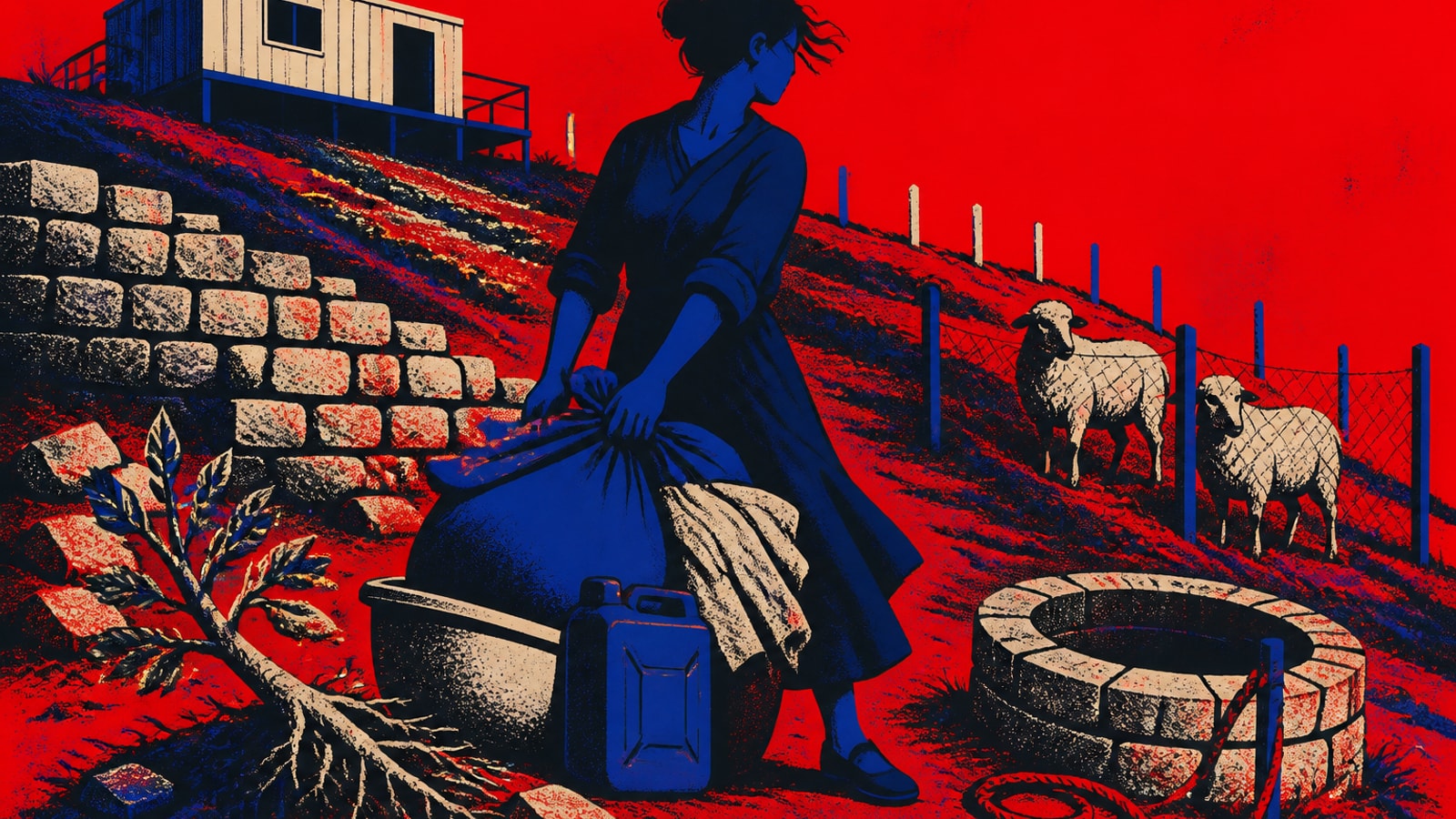
Three method groupings recur across nearly every documented account of settler displacement of Palestinians in the West Bank: attacks on homes and village property, sustained harassment and physical assault, and pressure on livelihoods through grazing land, water, livestock and crops. Human Rights Watch’s 2025 publication records Palestinians displaced from 20 communities, 7 of them entirely uprooted, between 7 October 2023 and 3 April 2024, on its own criteria. The documentation of how the outposts at the center of that pattern came to exist is Israeli and official: a 2005 opinion commissioned by the Israeli Prime Minister’s Office found that unauthorized outposts were established without lawful authority while government ministries transferred funds and infrastructure to them, and the Israeli High Court of Justice has twice ordered outposts on registered private Palestinian land evacuated.
Key Findings
- The 2005 opinion written by Talia Sasson for the Israeli Prime Minister’s Office found that unauthorized West Bank outposts were established without lawful authority and that Israeli government ministries transferred funds and infrastructure to them.
- The Israeli High Court of Justice ordered the evacuation of two outposts built on registered private Palestinian land: Migron, ruled on in 2011 and evacuated in 2012, and Amona, ruled on in 2014 and evacuated in 2017.
- The Palestinian Central Bureau of Statistics counted 2,881,687 West Bank residents in its 2017 census, the most recent full enumeration, so every later total for the territory is a projection off that base.
- Sergio DellaPergola’s estimate in the American Jewish Year Book 2019 put the core Jewish population at 418,900 in West Bank localities and 221,800 in East Jerusalem neighborhoods incorporated after 1967, at the beginning of 2019.
What methods do monitoring groups document most often?
Human Rights Watch’s 2025 publication records Palestinians displaced from 20 communities, 7 of them entirely uprooted, between 7 October 2023 and 3 April 2024, its own count on its own criteria. The method set behind those departures is described consistently across monitoring reports, and it resolves into three groupings.
Amnesty International’s documentation of West Bank herding and Bedouin communities sets out the three: attacks on homes and village property, persistent harassment and assault, and pressure on livelihoods. Under the first it records raids on homes and villages, beatings, death threats, destruction of property and village infrastructure, and the burning or vandalizing of homes and crops. Under the third it records restriction of access to grazing land and to water sources, the theft or killing of livestock, and the destruction of agricultural fields. Human Rights Watch’s account of the same communities lists the burning of homes and property alongside forced departure. These are the organizations’ own classifications, built from field documentation and from complaints brought to them, and both bodies state an advocacy mission.
Two features of that record bear on how the list should be read. The groupings are categories, not measured shares: no published series breaks the recorded incidents into percentages by method, so the order in which raids, threats, crop destruction and livestock loss appear in any list reflects the classifying body’s arrangement rather than a measured distribution. And the counting unit is the community, not the person. Human Rights Watch’s 20 and 7 count settlements of people who left, with no accompanying population figure for those settlements, so the record does not support a statement about how many individuals the documented methods moved.
The narrower point holds regardless of the counting unit. Across every body documenting these communities, the same physical acts appear: entry into inhabited villages, injury to people, damage to structures, and interference with the animals, fields and water on which pastoral livelihoods rest.
Is settler violence the main channel of displacement?
Amnesty International’s 2026 report records 117 Palestinian communities across the West Bank facing full or partial displacement between January 2023 and April 2026, its own count on its own definitions. That figure attributes departure jointly to settler pressure and to state-administered planning refusals, demolition orders and movement restrictions, counting the two channels inside one total.
It is often said that settler violence is the mechanism that empties Palestinian villages. On the organizational record the direction of that claim holds: every body documenting these communities places settler raids, threats and assaults among the immediate events preceding departure, and Human Rights Watch attributes the 20 communities in its own 2023 to 2024 count to settler violence directly.
The reframe is the denominator and the classification. The larger of the two circulating totals, Amnesty International’s 117, is constructed to include administratively driven displacement, and no published breakdown separates a settler-driven share from an administratively driven one within it. A reader who carries the 117 as a count of communities emptied by settlers is carrying a figure its own publisher assembled on a broader definition. The two counts are also not additive: they cover overlapping territory, overlapping years and different criteria, and neither publisher states a rule for reconciling them with the other.
What sits underneath both is the same underlying question of how land use changes, and the longer-run population and settlement record is measured by different bodies again. The gap between the community-level tallies and the population statistics is not a small one: 117 communities is a count with no published population attached, while the census and projection series report millions of residents and no community-level events at all.
How does the shepherding-outpost pattern work?
J Street’s 2025 analysis states that at least 59 Palestinian communities had departed since 2023 in what it describes as an outpost-driven pattern, its own figure and worded as a floor rather than a total. Peace Now sets out the sequence the figure is meant to capture, in four ordered steps.
In Peace Now’s account, a shepherding outpost is established near an existing Palestinian herding community; the grazing range available to that community narrows as the outpost’s herds and its residents occupy surrounding land; residents leave; and the vacated land comes into the outpost’s effective range, from which the sequence can repeat. The pattern is a description of a mechanism, published by an Israeli organization with a stated advocacy mission, and neither Peace Now nor J Street publishes an incident-level dataset behind it, a method for classifying a community as departed, or a denominator of herding communities against which 59 could be read as a rate.
The step in that sequence with an independent documentary trail is the first one. Outposts are physical, they are named, they appear in Israeli administrative and judicial records, and their legal status has been the subject of both an Israeli government-commissioned review and litigation in Israel’s highest court. Counting them is a separate exercise from counting departures: the Israeli Central Bureau of Statistics excludes unrecognized outposts from its locality counts altogether, as Hirsch-Hoefler and Ben Shitrit documented in their 2020 review of the yearbook, with Peace Now recording about 121 such outposts in 2019.
That divergence matters for anyone reading the outpost pattern as a documented method. The sequence is asserted by the organizations that describe it; the existence, funding and legality of the structures at its first step are recorded by the Israeli state itself.
What did Israel’s own commissioned review find about outposts?
The 2005 opinion written by Talia Sasson, a former director in Israel’s State Attorney’s Office, for the Israeli Prime Minister’s Office, found that unauthorized outposts in the West Bank had been established without lawful authority, and that Israeli government ministries had transferred funds and infrastructure to them. It is a government-commissioned official record, produced by the state whose territory and ministries it examined.
Two findings in it are load-bearing for the question of method. The first is legality: the outposts the opinion examined lacked the authorizations Israeli law required for their establishment, which places them outside the category of state-planned settlement construction and outside the category of purely private action. The second is resourcing: the opinion identified ministry-level transfers of money and infrastructure to structures that had no lawful basis, which is a finding about state conduct rather than about settler conduct.
An Israeli reader in 2005 therefore had, from the state’s own commissioned reviewer, a documented account of how the physical facts on the ground came into being. This report’s companion reading of Israel’s own reviews and court records on outposts sets out that record at length.
One adjacent government document does not exist in citable form. The Levy Commission report on the legal status of building in Judea and Samaria, prepared in 2012, was never officially published or adopted by the Israeli government, and the text in circulation is an advocacy reprint rather than a state record. It can be named as a position that was drafted; it is not available as an official finding, and no government record of its adoption exists to cite.
What have Israeli courts ordered on unauthorized outposts?
The Israeli High Court of Justice has ordered the evacuation of outposts built on registered private Palestinian land in two rulings whose execution is on the record: Migron, ruled on in 2011 and evacuated in 2012, and Amona, ruled on in 2014 and evacuated in 2017.
Both cases turned on the same legal fact rather than on any characterization of settler conduct: the land beneath the structures was registered as privately owned by Palestinians, and the court ordered the remedy of removal. In each case the interval between the judgment and its execution ran to years, one year at Migron and roughly three at Amona, which is itself a documented feature of the record rather than an inference.
This tier of the record cuts against reading outposts as uniformly state-backed and against reading them as uniformly tolerated. The same state whose ministries the 2005 opinion found had transferred funds and infrastructure to unauthorized outposts also, through its highest court, ordered two of them removed and carried the orders out. Neither of those facts describes the other away, and both are documented by Israeli institutions rather than asserted by parties outside them.
What the two rulings do not supply is a rate. Migron and Amona are individual cases decided on registered private ownership, and the court record does not publish how many outposts have been the subject of an evacuation order, how many orders were executed, or how many outposts sit on land whose registration is undetermined.
How many Palestinians and settlers live in the West Bank?
The Palestinian Central Bureau of Statistics counted 2,881,687 West Bank residents in its 2017 census, alongside 1,899,291 in the Gaza Strip, an official national enumeration with a reference date of 1 December 2017. It is the most recent full census of the territory, so every later total published for the West Bank by any body is a projection off that measured base rather than a count.
On the other side of the ledger, Sergio DellaPergola’s estimate in the American Jewish Year Book 2019 put the core Jewish population at 418,900 in West Bank localities and 221,800 in the East Jerusalem neighborhoods incorporated after 1967, at the beginning of 2019. The United Nations Population Division’s World Population Prospects 2024 reports the State of Palestine, including East Jerusalem, at about 5.6 million, a model projection rather than an enumeration, and it does not publish the West Bank and Gaza separately.
The counting conventions differ by publisher, which is why totals differ. The Israeli Central Bureau of Statistics counts East Jerusalem residents and West Bank settlers inside Israel’s national total, reporting Israel at about 10.148 million in September 2025. Hirsch-Hoefler and Ben Shitrit’s 2020 review traces how that convention developed in the CBS yearbook: East Jerusalem entered the general count for Israel in the 1968 edition, a 1970 footnote folded settlers into the national total as Israeli residents in the administered territories, settlement localities were counted in the total number of Israeli localities by 1983, and the separate territories chapter was removed in 1997. International monitors including B’Tselem instead publish the West Bank and East Jerusalem as separate series. Neither convention is an error; each produces a different number from the same underlying residents, which is the core reason population totals for this territory diverge.
What counts as displacement in the research literature?
A 2025 peer-reviewed article in the Journal of Genocide Research on the displacement and immobility nexus in Israeli policy (DOI 10.1080/14623528.2025.2547445) separates two measurable phenomena that organizational tallies carry under one word: forced movement, and constrained movement in which people remain in place under restriction.
The distinction has a methodological consequence. A restriction on staying and a restriction on leaving are measured with different instruments and produce different units: the first is counted as departures, the second as conditions, permits refused, routes closed, or access denied. A community tally that records a community as displaced does not record which of the two it measured, and a tally that records movement restrictions does not record how many people left because of them.
The gap that opens between the literatures is therefore definitional rather than factual. Organizational counts of communities displaced fold physical expulsion, structural demolition and departure under conditions described as untenable into a single unit, because the reporting body’s purpose is documentation of harm rather than the separation of mechanisms. The academic treatment separates the mechanisms and, in doing so, gives up the aggregate count: the 2025 article’s contribution is conceptual, and it publishes no total.
For a reader trying to answer the question of method, that means the two available bodies of work answer different halves. The organizational documentation names the acts and produces the numbers, on its own definitions. The peer-reviewed literature specifies what would have to be measured separately for those numbers to be read as a distribution of methods, and no published dataset yet measures them that way. Nothing in either literature supplies a rate at which any one documented method precedes a departure.
Do historians agree that displacement followed a plan?
Benny Morris’s 2004 archival history, The Birth of the Palestinian Refugee Problem Revisited, estimates that roughly 700,000 Palestinians became refugees during the 1948 war, worked out from Israeli military and state archives, and attributes the exodus to multiple causes that varied by locality and by phase of the war.
Morris’s account rejects two propositions at once. It finds no single master plan of expulsion directing the displacement, and it rejects the claim that departures were voluntary, recording military attack, fear of attack, and expulsions in particular sectors alongside flight. Ilan Pappé’s 2006 book, The Ethnic Cleansing of Palestine, argues from the same period that the displacement was a planned ethnic cleansing, and it is the named home of that characterization in the scholarly literature. A third position, set out in the Institute for Palestine Studies’ treatment of the concept of transfer in Zionist thinking and practice, traces the idea of population transfer as a strand within pre-state political thought rather than as an operational order.
These are dated, named, individually argued positions from identified archives, and the disagreement between them is on the record rather than settled by it. The relevance to a question about present-day method is narrow and worth stating precisely: the historiographical dispute is about intent and direction in 1948, and it supplies no measurement of what happens in a West Bank herding community in 2024. A reader who reaches for the 1948 literature to establish that today’s documented methods are coordinated is reaching across a gap the literature itself does not close, in either direction.
The three positions do converge on one factual point. Displacement in 1948 occurred at the scale Morris’s archival figure describes, and no participant in the dispute contests the order of magnitude.
Methodology and limitations
This report reads the documentary and measurement record on a contested land dispute. It measures what the record documents about methods, counts and conventions, not the underlying dispute over land or law.
Four source types carry the findings. Official and primary records: the 2005 opinion commissioned by the Israeli Prime Minister’s Office, Israeli High Court of Justice judgments in the Migron and Amona cases with their recorded execution dates, the Palestinian Central Bureau of Statistics 2017 census, the Israeli Central Bureau of Statistics population releases, and the United Nations Population Division’s World Population Prospects 2024. Peer-reviewed research: the 2025 Journal of Genocide Research article on displacement and immobility. Academic reference and scholarly books: DellaPergola’s American Jewish Year Book estimates, Morris (2004) and Pappé (2006). Organizational documentation: figures published by Amnesty International, Human Rights Watch, Peace Now and J Street, each named in the body as that organization’s own count on its own definitions, each carrying a stated advocacy mission, and none of them an independently verified or official statistic.
Limits on the numbers. The community-level counts (20 and 7, 117, at least 59) come from different publishers with different criteria, different windows and different scope decisions on whether administratively driven displacement is included, so they are not summable and not directly comparable. No published series breaks documented incidents into shares by method, so no distribution of methods can be stated. The PCBS 2017 census could not directly enumerate East Jerusalem and used administrative estimates there, and it is the last full census, so later territory totals are projections. The UN figure is a projection and publishes no separate Gaza or West Bank series. DellaPergola’s territory figures are his own estimates for 1 January 2019, on a core-Jewish-population definition. Settler and Palestinian population totals differ across publishers because the treatment of East Jerusalem differs, and the Israeli Central Bureau of Statistics excludes unrecognized outposts from locality counts.
Two named disagreements are carried rather than resolved: Morris (2004) against Pappé (2006) on 1948, and the definitional split between organizational counts of displacement and the peer-reviewed distinction between forced and constrained movement. The Levy Commission report on the legal status of building in Judea and Samaria was never officially published or adopted, and the circulating text is an advocacy reprint, so no government record of it appears here.
Conclusion
So what methods are actually documented? Three groupings, repeatedly and consistently: entry into inhabited villages with injury to people and damage to structures, sustained threat and assault, and interference with the grazing land, water, livestock and crops that pastoral communities live on. That set is described the same way by every body documenting it, and each of those bodies publishes its own count on its own definitions.
Everything downstream of the list is where the record diverges. Human Rights Watch counts 20 communities and 7 uprooted for a six-month window; Amnesty International counts 117 communities over three years while folding planning refusals, demolition orders and movement restrictions into the same total; J Street’s at least 59 is a floor with no stated criterion. The unit is the community, never the person, and no published series distributes the incidents across the method groupings. The Israeli record, by contrast, is specific where the tallies are broad: a 2005 opinion for the Prime Minister’s Office finding unauthorized outposts established without lawful authority and ministries transferring funds and infrastructure to them, and two High Court rulings, Migron in 2011 and Amona in 2014, ordering removal from registered private Palestinian land and executed in 2012 and 2017. The population base rate is measured too, and by a different body again: 2,881,687 West Bank residents in the 2017 census, 418,900 core Jews in West Bank localities on DellaPergola’s 2019 estimate.
What the record does not contain is the arithmetic that would join its parts. The community tallies count settlements of people and publish no population figure for them; the court record names two outposts and publishes no rate at which an evacuation order is issued or executed; the census counts residents and registers no event at all. Each body measured what its own mandate asked of it, and none measured the join, which is why the question a reader arrives with, how many people the documented methods moved, sits outside all three. Who would have to count what, and on whose definitions, for that number to exist?
Frequently Asked Questions
Who counts West Bank settlers, and why do published totals differ?
They differ because publishers place East Jerusalem differently. The Israeli Central Bureau of Statistics counts East Jerusalem residents and West Bank settlers inside Israel’s national total, reporting about 10.148 million residents in September 2025, while international monitors publish the West Bank and East Jerusalem as separate series; DellaPergola’s American Jewish Year Book 2019 estimate splits them, at 418,900 and 221,800.
Why is the 2017 census the basis for every later Palestinian population figure?
Because it is the most recent full enumeration. The Palestinian Central Bureau of Statistics counted 2,881,687 West Bank and 1,899,291 Gaza residents with a reference date of 1 December 2017, and both the United Nations Population Division and the World Bank build their later totals as projections off that base rather than as counts.
What did Israel’s Levy Commission conclude about building in the West Bank?
No official finding is available. The report on the legal status of building in Judea and Samaria was never officially published or adopted by the Israeli government, and the text in circulation is an advocacy reprint, so it can be named as a document that was drafted but not cited as a state record.
Where does the figure of about 700,000 displaced in 1948 come from?
From Benny Morris’s 2004 archival history, worked out from Israeli military and state archives, which puts the number of Palestinians who became refugees during the 1948 war at roughly 700,000. Ilan Pappé’s 2006 book argues the same displacement was a planned ethnic cleansing, a characterization Morris’s account rejects while also rejecting the claim that departures were voluntary.
How does Israel count Jerusalem’s own population?
As one municipal total. The Israeli Central Bureau of Statistics reported the city passing one million residents at the end of 2023, 60.5% Jews and Others and 39.5% Arabs, counting the East Jerusalem neighborhoods annexed after 1967 inside that single figure. No separate East Jerusalem series appears in the city’s own published numbers, which is why a reader comparing Israeli and international totals for the same residents finds two different quantities.
Does any research measure how often each documented method occurs?
No published dataset reports incident shares by method. Organizational documentation lists the method categories and publishes community-level totals, and the 2025 Journal of Genocide Research article on displacement and immobility specifies why forced and constrained movement would have to be measured separately, without publishing a count of either.
Sources
- DellaPergola, S., 2019. World Jewish Population, 2019. American Jewish Year Book 2019, vol. 119, Springer (Berman Jewish DataBank reprint). Academic reference.
- High Court of Justice (Israel), 2011 and 2014. Judgments ordering the evacuation of the Migron and Amona outposts from registered private Palestinian land, executed in 2012 and 2017. Official record (court rulings).
- Hirsch-Hoefler, S., and Ben Shitrit, L., 2020. So, how many settlements are there? Counting, tracking, and normalizing Jewish settlements in the Israeli Central Bureau of Statistics Yearbook, 1967 to the present. POMEPS. Think-tank report.
- Israel Central Bureau of Statistics, 2024. Selected Data on the Occasion of Jerusalem Day, 2024. Media release 165/2024. Official record.
- Israel Central Bureau of Statistics, 2025. Population of Israel on the Eve of Rosh Hashana 5786. Media release. Official record.
- Journal of Genocide Research, 2025. Settler Colonialism and the Displacement/Immobility Nexus: Israeli Policy. DOI 10.1080/14623528.2025.2547445. Peer-reviewed.
- Morris, B., 2004. The Birth of the Palestinian Refugee Problem Revisited, 2nd edition. Cambridge University Press. ISBN 978-0521009676. Scholarly book (archival history).
- Palestinian Central Bureau of Statistics, 2018. Population, Housing and Establishments Census 2017: Final Results. Ramallah. Official record (national census).
- Pappé, I., 2006. The Ethnic Cleansing of Palestine. Oneworld Publications. Scholarly book.
- Sasson, T., 2005. Opinion on unauthorized outposts, commissioned by the Israeli Prime Minister’s Office. Official record (government-commissioned review).
- United Nations Department of Economic and Social Affairs, Population Division, 2024. World Population Prospects 2024. population.un.org/wpp. Official record (statistical series).