
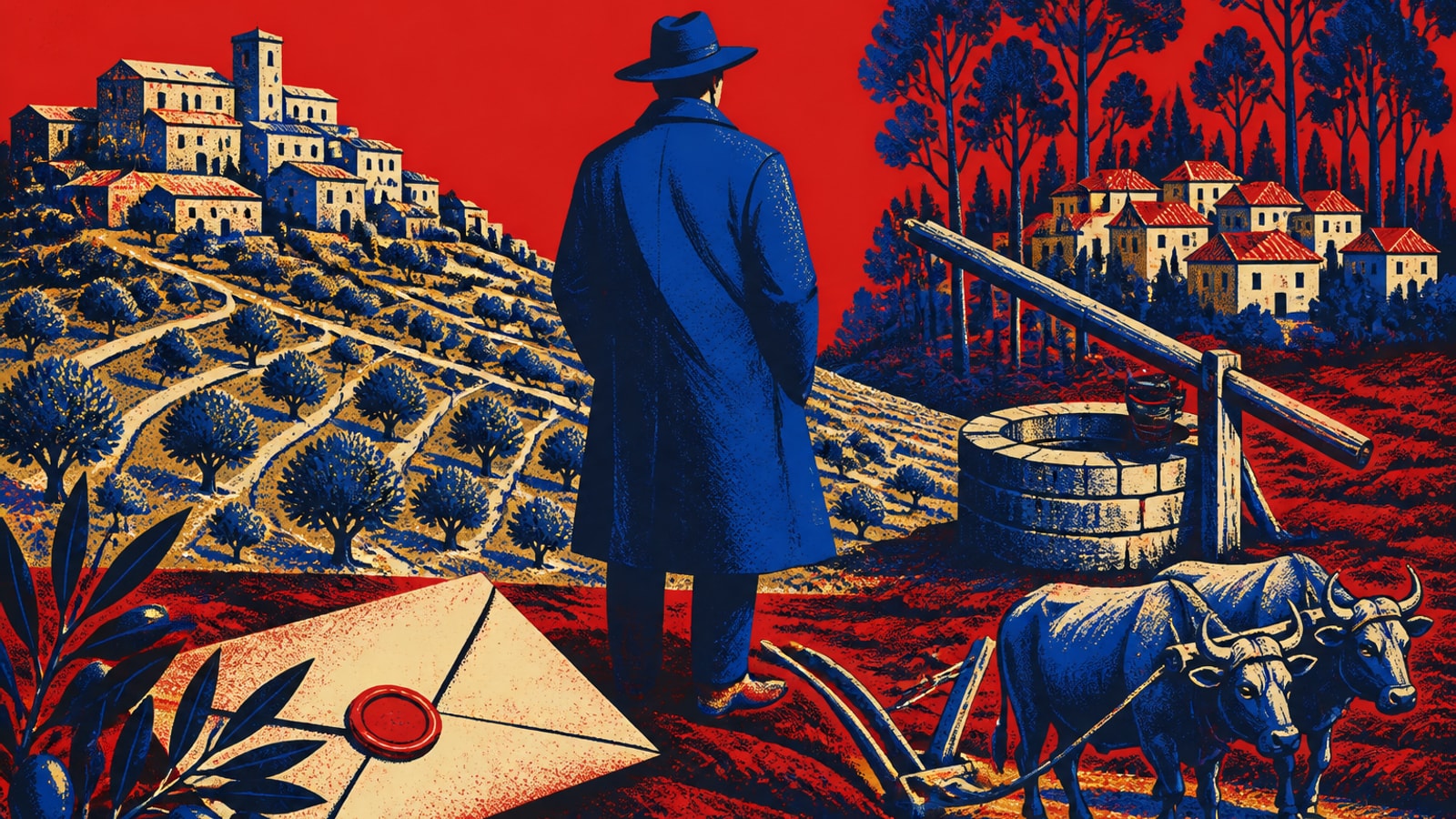
The Arab Question in early Zionist thought was the problem the Hebrew essayist Ahad Ha’am set down in 1891, after three months in Palestine. He found the land already tilled. He wrote that its Arab inhabitants “understand our deeds and our desires,” and that if Jewish settlement grew “to the point of encroaching upon the native population, they will not easily yield their place.”
The Government of Palestine’s census of 18 November 1931 counted 174,610 Jews in a population of 1,035,821, about 16.9%, so the majority at the centre of the question was still in place four decades later. The movement’s founding texts treated it unevenly. The 1897 Basel Program does not mention the land’s inhabitants, and the 1917 Balfour Declaration protects only the “civil and religious rights of existing non-Jewish communities.” By 1937 a British Royal Commission was describing “an irrepressible conflict” between “two national communities.”
Key Findings
- 1891: Ahad Ha’am’s essay “Truth from Eretz Yisrael” warned that the native population “will not easily yield their place” if Jewish settlement encroached upon it. In Alan Dowty’s translation, the essay gives the subject two paragraphs (Ahad Ha’am, 1891).
- 16.9%: the Government of Palestine’s 1931 census enumerated 174,610 Jews in a total population of 1,035,821. The census classified residents by religion, not nationality (Government of Palestine, 1932).
- Zero references: the Basel Program adopted by the First Zionist Congress in August 1897 states one aim and four means, and none of them mentions the existing population of Palestine (First Zionist Congress, 1897).
- 67 words: the Balfour Declaration of 2 November 1917 refers to the country’s majority as “existing non-Jewish communities” and safeguards their “civil and religious rights” (His Majesty’s Government, 1917).
- 22 June 1937: the Palestine Royal Commission, a British government-commissioned inquiry, signed a report that described two national communities in conflict and recommended partition, a plan that was never enacted (Palestine Royal Commission, 1937).
What did early Zionists mean by the Arab Question?
Ahad Ha’am’s essay “Truth from Eretz Yisrael,” serialised in the Hebrew daily Ha-Melitz in 1891, states the problem in a Zionist writer’s own words. The country was not empty, its Arab population was not unaware of Zionist aims, and expansion would meet resistance. In Alan Dowty’s translation, he warned that if Jewish life developed “to the point of encroaching upon the native population, they will not easily yield their place.”
The essay is dated by its own text and by its translator. Ahad Ha’am, the pen name of Asher Ginzberg, writes “When I arrived three months ago.” Dowty, writing in Israel Studies in 2000, cites a letter Ahad Ha’am sent from Jaffa dated 15 March 1891. The essay reports on the Jewish colonies and is mostly a critique of how the settlement movement was run. Its remarks on the Arab population sit inside that report.
He built the problem from three corrections to what he called the view “from abroad.” The first concerned the land: “From abroad, we are accustomed to believe that Eretz Yisrael is presently almost totally desolate, an uncultivated desert, and that anyone wishing to buy land there can come and buy all he wants. But in truth it is not so. In the entire land, it is hard to find tillable land that is not already tilled.”
The second concerned the people. Ahad Ha’am first reports the diaspora view in its own period language and then rejects it: “From abroad we are accustomed to believing that the Arabs are all desert savages, like donkeys, who neither see nor understand what goes on around them. But this is a big mistake.” He continues: “The Arabs, and especially those in the cities, understand our deeds and our desires in Eretz Yisrael, but they keep quiet and pretend not to understand, since they do not see our present activities as a threat to their future.”
The third concerned the future, and it carries the warning quoted above. Taken together, the three passages define the question as Ahad Ha’am framed it. The settlement movement assumed an empty, unaware country. He reported a cultivated, aware one, whose silence depended on the movement staying small.
He also recorded the colonists’ conduct. In Dowty’s translation, they “walk with the Arabs in hostility and cruelty, unjustly encroaching on them, shamefully beating them for no good reason, and even bragging about what they do, and there is no one to stand in the breach and call a halt to this dangerous and despicable impulse.”
Who first named Arab relations as Zionism’s hardest test, and when?
Alan Dowty judged in a 2000 Israel Studies article that Ahad Ha’am’s 1891 essay was “the first, and for some time the only, serious commentary with at least a glimmer of recognition that relations with the Arab population would be one of Zionism’s most severe tests.” Dowty also counts the space the subject receives in the essay: two paragraphs.
The recognition came early, then, and it came from inside the movement, but it was brief. Dowty writes that “only two paragraphs in ‘Truth from Eretz Yisrael’ actually address the issue of relations with the non-Jewish population there.” The rest of the essay concerns the colonies’ finances, administration and methods.
Dowty’s reading also limits how far the essay went. On his account, Ahad Ha’am framed the Arabs as “an obstacle to be overcome rather than an opposed party.” Dowty adds that Ahad Ha’am did not treat the matter as a political problem in 1891. That reading is Dowty’s, and it marks a distance between the 1891 observation and the later language of two competing national movements. By 1937, as the last finding section shows, a British inquiry used that later language outright.
The same passage on the colonists’ conduct circulates in an older translation. Tyler Weisman of Randolph-Macon College relays it in an undergraduate survey published in the 2014 proceedings of the National Conference on Undergraduate Research, which is not peer-reviewed. In that wording, the colonists “trespass unjustly upon their boundaries, beat them shamefully without reason and even brag about it.” Dowty’s version reads “unjustly encroaching on them, shamefully beating them for no good reason.” The two are renderings of one Hebrew passage. Neither should be quoted as the other, and Weisman gives no year for the testimony; the date comes from the essay itself.
Weisman’s survey adds context on the employment relationship Ahad Ha’am was observing. He writes that most of the early colonists, lacking practical farming knowledge, “ended up working on colonies controlled by the wealthy British Jew, Baron de Rothschild.” He also writes that “many Jews began hiring Arabs as laborers or tenant farmers, paying very low wages that did little to change their economic or societal position.” That is Weisman’s survey reading, not a measured wage series, and it carries no figure of its own.
How large was the Arab majority behind the question?
The Government of Palestine’s census, taken at midnight on 18 November 1931 and published in 1932 under Superintendent of Census E. Mills, enumerated 174,610 Jews in a total population of 1,035,821. That is a share of 16.9%.
The count is the Mandatory government’s own, taken 14 years after the Balfour Declaration and 40 years after Ahad Ha’am’s essay.
The census classified residents by religion. It recorded 759,712 Moslems (73.3% of the total), 91,398 Christians (8.8%), 9,148 Druses (0.9%), 350 Bahais, 182 Samaritans and 421 people of no religion. These categories sum exactly to 1,035,821. There is no column for “Arab” or “Palestinian.” Reading the Arab population as Moslems plus most Christians and Druses is a reasonable derivation, but it is not a figure the census prints. The 16.9% Jewish share is the census’s own category against its own total.
The tables are preliminary. Mills wrote that “Discussion of the statistics is reserved for the General Census Report,” which followed in 1933. The preliminary volume reports every village, town, sub-district and district by religion and sex. Its national totals were checked here against the male and female columns, which reproduce the printed figures: 174,610 Jews are 88,100 men and 86,510 women.
The count bears on how the question was framed. Ahad Ha’am wrote in 1891 without a census, from what he saw in the colonies and towns. Four decades of immigration later, the Mandatory government’s own enumeration still showed Jews as roughly one resident in six.
Did the 1897 Basel Program mention the land’s inhabitants?
The Basel Program, adopted by the First Zionist Congress on 30 August 1897, states one aim and four means. Its text refers to the existing population of Palestine zero times. In the Jewish Encyclopedia’s contemporary translation, the aim reads: “Zionism aims at establishing for the Jewish people a publicly and legally assured home in Palestine.”
The four means, verbatim in the same translation, are: “(1) the promotion of the settlement of Jewish agriculturists, artisans, and tradesmen in Palestine; (2) the federation of all Jews into local or general groups, according to the laws of the various countries; (3) the strengthening of the Jewish feeling and consciousness; (4) preparatory steps for the attainment of those governmental grants which are necessary to the achievement of the Zionist purpose.”
The first means names the settlers and the place. It does not name the people already living there, and no other clause does either. The program was written six years after Ahad Ha’am had described a country in which tillable land was “already tilled.”
The Congress opened on 29 August 1897, and the program was submitted on 30 August, according to the Jewish Virtual Library. Gotthard Deutsch, writing the Jewish Encyclopedia’s entry, records that it “was unanimously accepted at the morning session of the second day of the first Congress, after a report by Max Nordau.” Deutsch also records the Congress’s gloss on whom the home was meant for: “the struggle for a publicly and legally assured home was meant to be only for those Jews who either could not or would not assimilate in their respective dwelling-places.” That gloss is Deutsch’s account, not program text.
The wording itself varies between translations. The German “öffentlich-rechtlich gesicherte Heimstätte” is rendered “a publicly and legally assured home” by the Jewish Encyclopedia. The Jewish Virtual Library prints a later version: “a home for the Jewish people in Eretz-Israel secured under public law.” The aim and the four means are the same in both, and neither translation adds a reference to the inhabitants.
Did the question surface first in the colonies or the congresses?
Yuval Ben-Bassat’s 2009 peer-reviewed study in the Journal of Palestine Studies covers six Judean colonies southeast of Jaffa from 1882 to 1903. Built from the colonies’ own logbooks, letters and contracts, it places the friction in daily colony life. Clashes with neighbouring villagers “were not common, but they did occur from time to time,” and “the immediate causes were generally disputes over property boundaries and grazing.”
Ben-Bassat names the colonies where clashes occurred, Gederah, Rehovot and Qastina, and reports that they ended in “injuries and even deaths.” He documents the legal side as well. The colonies financed one another’s lawsuits, including a trial Rehovot brought against the village of Zarnuqa “following a severe clash between them sparked by a dispute over grazing rights.” The study gives no count of clashes and no frequency beyond “from time to time.”
The economic tie ran through wage labour. “Economic connections with the Arab population predominantly revolved around the employment of low-wage day workers,” Ben-Bassat writes, which “according to some indications, created pockets of resentment among the Arab workers.” In the colonies it ran, the Rothschild administration “set the ratio between Jewish and Arab workers, fixed the workers’ wages, established the rules of conduct vis-a-vis the Arab workers, negotiated the purchase of land from local landowners, and acted to resolve problems with the Arab villagers.”
Land policy then shifted. In 1899 Baron Edmond de Rothschild expressed the wish to see “the whole region [hevel] between Eqron and Rishon le-Zion cultivated by Jewish workers and blooming.” Gederah’s managing committee decided in 1903 to stop leasing land to Arabs, and “similar decisions were approved by Rehovot and Rishon le-Zion around that time in an effort to limit Arab presence in the colonies and reduce theft and damage to property.” Ben-Bassat reports the theft rationale as the colonists’ own: the losses were “claimed to have been committed by the Arab rural population.”
This record and the congress record sit side by side. The Basel text of 1897 is silent on the inhabitants, while the colonies’ own documents from the same decades record boundary, grazing, employment and leasing decisions. Ahad Ha’am’s 1891 essay was itself a report on the colonies. Ben-Bassat does not date the first clash, so this record does not establish which came first, the colony disputes or the 1891 essay. The study covers one region only. The wider record of early Zionist contact with Palestinians draws on additional sources.
How did the 1917 Declaration describe the existing population?
The Balfour Declaration is a letter from Foreign Secretary Arthur James Balfour to Lord Rothschild, dated 2 November 1917. It contains one operative sentence of 67 words. That sentence refers to the country’s majority as “existing non-Jewish communities” and protects their “civil and religious rights.” It does not name an Arab population, and it grants those communities no political rights.
The sentence in full, as the Avalon Project transcribes it: “His Majesty’s Government view with favour the establishment in Palestine of a national home for the Jewish people, and will use their best endeavours to facilitate the achievement of this object, it being clearly understood that nothing shall be done which may prejudice the civil and religious rights of existing non-Jewish communities in Palestine, or the rights and political status enjoyed by Jews in any other country.”
The sentence has two safeguard clauses. Political status appears only in the second, which protects Jews “in any other country.” The first clause, covering those already in Palestine, is limited to civil and religious rights. The promise is “a national home,” not “a state” and not “the national home.” The letter describes the text as a “declaration of sympathy with Jewish Zionist aspirations which has been submitted to, and approved by, the Cabinet.”
The Mandate for Palestine, approved by the Council of the League of Nations in 1922, carried the Declaration into an international instrument in different words. Its preamble makes the Mandatory “responsible for putting into effect the declaration originally made on November 2nd, 1917.” Article 2 assigns the Mandatory responsibility for securing “the establishment of the Jewish national home” and “the development of self-governing institutions,” and also for “safeguarding the civil and religious rights of all the inhabitants of Palestine, irrespective of race and religion.” Article 4 provides that “an appropriate Jewish agency shall be recognised as a public body for the purpose of advising and co-operating with the Administration of Palestine.”
| Text and date | How it names the existing population | Source |
|---|---|---|
| Basel Program, 30 August 1897 | No reference | First Zionist Congress, 1897 |
| Balfour Declaration, 2 November 1917 | “existing non-Jewish communities in Palestine,” limited to “civil and religious rights” | His Majesty’s Government, 1917 |
| Mandate for Palestine, Article 2, 1922 | “all the inhabitants of Palestine, irrespective of race and religion” | Mandate text, Avalon Project |
How did Jewish opponents of a Jewish state answer it?
Edwin Montagu, Secretary of State for India and, in his own words, “the one Jewish Minister in the Government,” circulated War Cabinet paper G.T. 1868 on 23 August 1917. In it he assumed the proposed policy meant “that Mahommedans and Christians are to make way for the Jews.” The paper answered a draft declaration, ten weeks before the Balfour Declaration was issued.
Montagu’s full sentence continues: “that Turks and other Mahommedans in Palestine will be regarded as foreigners, just in the same way as Jews will hereafter be treated as foreigners in every country but Palestine.” His alternative, on the paper’s third page, was narrow: “I would say to Lord Rothschild that the Government will be prepared to do everything in their power to obtain for Jews in Palestine complete liberty of settlement and life on an equality with the inhabitants of that country who profess other religious beliefs. I would ask that the Government should go no further.”
Page 1 of the paper was read from the image The National Archives publishes (CAB 21/58, folio 218; also catalogued as CAB 24/24/71). That page matches word for word a scan of the same print, and pages 2 and 3, including the equality passage, were read from that relayed scan rather than from the archive’s own publication. The paper records one minister’s argument on one date. Montagu was answering Lord Rothschild’s letter of 18 July 1917 and a reply by Balfour that had not yet been sent.
A second answer came from the United States. A Statement to the Peace Conference, drafted by Rabbi Henry Berkowitz, Professor Morris Jastrow and Max Senior, was presented to President Woodrow Wilson by Representative Julius Kahn of California on 4 March 1919. The Douglas Daily International of 5 March 1919 and the Wisconsin Weekly Blade of 15 March 1919 both reported 300 signatories. The document itself states no count.
Its closing request, in the text Irving Levitas reproduced from the drafting committee’s file in American Jewish Archives in 1962, reads: “We ask that Palestine be constituted as a free and independent state, to be governed under a democratic form of government recognizing no distinctions of creed or race or ethnic descent, and with adequate power to protect the country against oppression of any kind. We do not wish to see Palestine, either now or at any time in the future, organized as a Jewish State.”
Both texts approached the existing population through equality of status, and both rejected Jewish statehood. Further detail on the 1919 petition and its count is recorded separately.
What was the Iron Wall answer to the question?
Ze’ev Jabotinsky’s essay “The Iron Wall (We and the Arabs),” published in the Berlin weekly Rassvet on 4 November 1923, answered the question by denying that Arab consent was available. In the Jabotinsky Institute’s English typescript, he wrote: “There can be no voluntary agreement between ourselves and the Palestine Arabs. Not now, nor in the prospective future.”
He treated the project as colonisation and Arab opposition as its predictable result: “Colonisation carries its own explanation, the only possible explanation, unalterable and as clear as daylight to every ordinary Jew and every ordinary Arab. Colonisation can have only one aim, and Palestine Arabs cannot accept this aim.” He appealed to precedent: “I suggest that they consider all the precedents with which they are acquainted, and see whether there is one solitary instance of any colonisation being carried on with the consent of the native population. There is no such precedent.”
From this he drew the essay’s central conclusion: “Zionist colonisation must either stop, or else proceed regardless of the native population. Which means that it can proceed and develop only under the protection of a power that is independent of the native population, behind an iron wall, which the native population cannot breach.”
Jabotinsky presented this as a description of existing policy rather than a proposal, and he tied it to the instruments of 1917 and 1922: “That is our Arab policy; not what it should be, but what it actually is, whether we admit it or not. What need, otherwise, of the Balfour Declaration? Or of the Mandate?” The Declaration is the 67-word sentence quoted above, and the Mandate is the League instrument whose Article 2 placed the country under the Mandatory’s conditions.
A second essay, “The Ethics of the Iron Wall,” appeared in Rassvet on 11 November 1923 and answered the charge that the first was immoral. The two are often run together, but they are separate texts with separate dates. Both were written in Russian; the quotations here are the Institute’s English typescript, archive reference A 1 - 7/14. Brian Horowitz’s article in Israel Studies supplies the Russian issue and page citations.
The essays record what their author, who led Zionism’s Revisionist current, wrote in 1923. Like Ahad Ha’am in 1891, Jabotinsky expected a native population that understood the project and would resist it. His conclusion was force supplied by an outside power. Comparison of this vocabulary with Herzl’s appears in the Institute’s reading of the colonial vocabulary in the founding texts.
Had the question become a clash of two nations by 1937?
The Palestine Royal Commission was a British government-commissioned inquiry, and its six members signed their report on 22 June 1937. It recorded that “an irrepressible conflict has arisen between two national communities within the narrow bounds of one small country.” It concluded that Britain could not “both concede the Arab claim to self-government and secure the establishment of the Jewish National Home.”
Appointed by Royal Warrant on 7 August 1936 and chaired by Earl Peel, the Commission was asked to find the causes of the disturbances that began in April 1936. It heard 60 witnesses at 30 public sessions and 53 at 40 private sessions, all in Jerusalem. The report was presented to Parliament in July 1937 as Command Paper 5479. It is the Mandatory power’s review of its own obligations, so its findings are a British government finding.
The Commission put the conflict in round numbers: “About 1,000,000 Arabs are in strife, open or latent, with some 400,000 Jews.” Both figures are the report’s own approximations inside an argumentative passage, not an enumeration. It described the Government of Palestine as “poised as it is above two irreconcilable communities, compelled to follow a path between them marked out by an elaborate, yet not very lucid, legal instrument.” It held that the obligations Britain had undertaken towards both communities “have proved irreconcilable; and, as far ahead as we can see, they must continue to conflict.”
Its remedy was partition, “the only method we are able to propose for dealing with the root of the trouble.” Chapter XXII proposes ending the Mandate in favour of a treaty system and creating two sovereign states. One would be an Arab state uniting Trans-Jordan with part of Palestine; the other would be a Jewish state. A new Mandate would cover the Holy Places. The report also recommended a “political high level” of Jewish immigration, “fixed for the next five years at 12,000 per annum.”
The plan remained a recommendation. The Woodhead Commission of 1938 found it impracticable, and the 1939 White Paper abandoned it. The report did record, in the language of an official inquiry, the shift Dowty traced from the 1891 essay. Arabs who had appeared in that essay as “an obstacle to be overcome” were now one of “two national communities.”
Methodology and limitations
This report assembles dated primary texts and one peer-reviewed study, and it quotes each in its own words. The primary records are Ahad Ha’am’s 1891 essay; the Basel Program of 1897; the Balfour Declaration of 1917 and the 1922 Mandate; Montagu’s Cabinet paper of 23 August 1917; the 1919 Statement to the Peace Conference; Jabotinsky’s two 1923 essays; the 1931 census; and the 1937 Royal Commission report. The peer-reviewed study is Ben-Bassat (2009), an archive-based social history of six colonies. It carries no rates or counts. Weisman (2014) is undergraduate research, not peer-reviewed, and is cited only as a relay of a translation and for survey context.
Several texts are translations or reproductions, and the version matters. Ahad Ha’am is quoted only in Dowty’s translation, as abridged in Kaplan and Penslar (2011). The Basel Program is quoted in the Jewish Encyclopedia’s contemporary English, and Jabotinsky in the Jabotinsky Institute’s English typescript of the Russian. Page 1 of Montagu’s paper comes from The National Archives’ published image; pages 2 and 3 come from a relayed scan of the same print. The 1919 Statement is quoted from Levitas’s 1962 reproduction of the committee’s copy. Its signatory count of 300 comes from two 1919 wire reports, because the document states none.
The census figures are preliminary tables classified by religion. Any Arab total derived from them is a derivation, not a census figure. The Royal Commission’s population figures are its own rounded characterisation. Its partition plan was a recommendation that was never enacted. None of these sources counts how many Zionist writers addressed the Arab population before 1937, so this record cannot say how widespread any single position was.
Conclusion
So what was the Arab Question? On the dated record, it was the problem Ahad Ha’am named in 1891. Palestine was cultivated and inhabited, its people understood what the settlers intended, and growth would meet resistance. Dowty’s reading credits that essay as the first serious statement of the problem and notes that it gave the subject two paragraphs. Across the following decades, the problem was treated in very different ways.
The founding program of 1897 is silent on the inhabitants. The colonies’ own records from 1882 to 1903 show boundary and grazing disputes and, in 1903, decisions to stop leasing land to Arabs. The 67-word Declaration of 1917 called the 73.3% Moslem majority, as the 1931 census would later count it, “existing non-Jewish communities” with civil and religious rights. Montagu in 1917 and the 300 signers of 1919 answered by refusing Jewish statehood and asking for equality. Jabotinsky in 1923 answered that no agreement was possible and that only an iron wall would serve. By 1937 a British inquiry described two national communities and recommended partition.
Ahad Ha’am’s 1891 essay said the people of the country were watching and would not yield. The Basel Program six years later did not mention them, and the 1937 inquiry needed a partition map to describe the result. The record leaves open what happened in between: whether the question was set aside, assumed away or simply postponed. Each later text in this record had to address it again.
Frequently Asked Questions
Was the Balfour Declaration legally binding?
The Declaration is a letter dated 2 November 1917, conveying a policy approved by the British Cabinet; it is not a treaty. Its legal force came through the Mandate for Palestine, approved by the Council of the League of Nations in 1922, whose preamble made the Mandatory responsible for “putting into effect” the Declaration.
Why do some accounts give 299 signatories for the 1919 Statement?
The figure traces to Max E. Berkowitz’s 1932 biography, “The Beloved Rabbi,” which refers to “the two hundred and ninety-nine other signatories” besides his uncle, Henry Berkowitz. Counting the drafter, that is 300, which matches the two 1919 wire reports. Levitas (1962) records that signatures were still being collected after the 4 March presentation, so any count applies to a particular date.
How were Beduin counted in the 1931 census?
The Government of Palestine enumerated Beduin separately, using a count that was not taken at the same time as the main census, and listed them as “nomadic” (Government of Palestine, 1932). The census recorded 969,268 settled residents and 66,553 nomadic ones, and the nomadic count was entirely Moslem.
Who sold the land on which the Judean colonies were built?
Ben-Bassat (2009) writes that “about a dozen absentee landlords owned property in the region,” and that these owners, “in many cases Christians from nearby Jaffa,” sold the colonists much of their land. The finding applies only to the six Judean colonies southeast of Jaffa.
Did the Royal Commission’s partition plan take effect?
No. The Woodhead Commission of 1938 found the 1937 plan impracticable, and the 1939 White Paper abandoned it. The Royal Commission’s report (1937) records what Britain was advised to do, not what it did.
Which current of Zionism did the Iron Wall essays speak for?
Jabotinsky led the Revisionist current, and Rassvet, the Berlin weekly that published both essays in November 1923, was its Russian-language organ under his editorship (Jabotinsky, 1923). The essays record his own argument and cannot be read as the position of Zionism as a whole.
Did the Basel Program mention antisemitism?
No. The program adopted at Basel in 1897 names a goal and four means and does not mention antisemitism (First Zionist Congress, 1897). Gotthard Deutsch’s Jewish Encyclopedia entry records that opponents of the Congress argued it confirmed “the assertions of the anti-Semites.”
Sources
- Ahad Ha’am (Asher Ginzberg), 1891. Truth from Eretz Yisrael (Emet me-Eretz Yisrael). Ha-Melitz, St. Petersburg. English translation by Alan Dowty, “Much Ado about Little: Ahad Ha’am’s ‘Truth from Eretz Yisrael,’ Zionism, and the Arabs,” Israel Studies 5(2), 2000, pages 154 to 181, DOI 10.2979/isr.2000.5.2.154; abridged in Eran Kaplan and Derek J. Penslar (eds.), The Origins of Israel, 1882-1948: A Documentary History, University of Wisconsin Press, 2011, pages 27 to 38. Official or primary record (primary historical text, scholarly translation).
- Ben-Bassat, Yuval, 2009. Proto-Zionist-Arab Encounters in Late Nineteenth-Century Palestine: Socioregional Dimensions. Journal of Palestine Studies 38(2), pages 42 to 63. DOI 10.1525/jps.2009.38.2.42. Peer-reviewed.
- Berkowitz, Henry, Morris Jastrow, Max Senior and the signers, 1919. A Statement to the Peace Conference. As printed in The Denver Jewish News, 19 March 1919, pages 1 and 3, Library of Congress, Chronicling America, https://www.loc.gov/resource/sn91052360/1919-03-19/ed-1/?sp=1. Primary historical artifact (signed petition, in reproduction).
- Berkowitz, Max E., 1932. The Beloved Rabbi. New York: Macmillan, page 91, as quoted in Levitas, 1962. Biography.
- Douglas Daily International, 1919. Report of 5 March 1919, page 1, Philadelphia dateline. Library of Congress, Chronicling America, https://www.loc.gov/resource/sn95060770/1919-03-05/ed-1/?sp=1. Primary historical record (newspaper).
- First Zionist Congress, 1897. The Basel Program. English text in Gotthard Deutsch, “Basel Program,” The Jewish Encyclopedia, Funk and Wagnalls, 1901 to 1906, https://www.jewishencyclopedia.com/articles/2612-basel-program; dates per Jewish Virtual Library, https://www.jewishvirtuallibrary.org/first-zionist-congress-and-basel-program-1897. Official or primary record.
- Government of Palestine, 1932. Census of Palestine 1931: Population of Villages, Towns and Administrative Areas. E. Mills, Superintendent of Census. Jerusalem: Greek Convent and Goldberg Presses. Scan at https://www.palestine.pl/wp-content/uploads/2021/01/PalestineCensus1931.pdf. Official or primary record (Mandate government census).
- His Majesty’s Government, 1917. The Balfour Declaration, letter of 2 November 1917, and the Mandate for Palestine (1922). Avalon Project, Yale Law School, https://avalon.law.yale.edu/20th_century/balfour.asp and https://avalon.law.yale.edu/20th_century/palmanda.asp. Official or primary record.
- Jabotinsky, Ze’ev, 1923. The Iron Wall (We and the Arabs), Rassvet 42/43, 4 November 1923; and The Ethics of the Iron Wall, Rassvet 44/45, 11 November 1923. English typescript, Jabotinsky Institute in Israel, en.jabotinsky.org, archive reference A 1 - 7/14. Primary political text.
- Levitas, Irving, 1962. Reform Jews and Zionism, 1919-1921. American Jewish Archives 14(1), beginning page 3. https://sites.americanjewisharchives.org/publications/journal/PDF/1962_14_01_00.pdf. Scholarly article reproducing a primary text.
- Montagu, E. S., 1917. The Anti-Semitism of the Present Government. War Cabinet paper G.T. 1868, 23 August 1917. The National Archives, Kew, CAB 24/24/71 and CAB 21/58 folio 218, https://discovery.nationalarchives.gov.uk/details/r/D7640371. Official or primary record (pages 2 and 3 read from a relayed scan of the print).
- Palestine Royal Commission, 1937. Report of the Palestine Royal Commission. His Majesty’s Stationery Office, London, Cmd. 5479. https://archive.org/details/palestine-royal-commission-report. Official or primary record (British government-commissioned review).
- Weisman, Tyler, 2014. Zionism, 1862 to 1897: Foundations of a Movement. Proceedings of the National Conference on Undergraduate Research 2014, published by the University of North Carolina Asheville, libjournals.unca.edu/ncur/wp-content/uploads/2021/08/1106-Weisman-1.pdf. Undergraduate research, not peer-reviewed.
- Wisconsin Weekly Blade, 1919. Report of 15 March 1919, page 1, Philadelphia dateline. Library of Congress, Chronicling America, https://www.loc.gov/resource/sn84025842/1919-03-15/ed-1/?sp=1. Primary historical record (newspaper).