
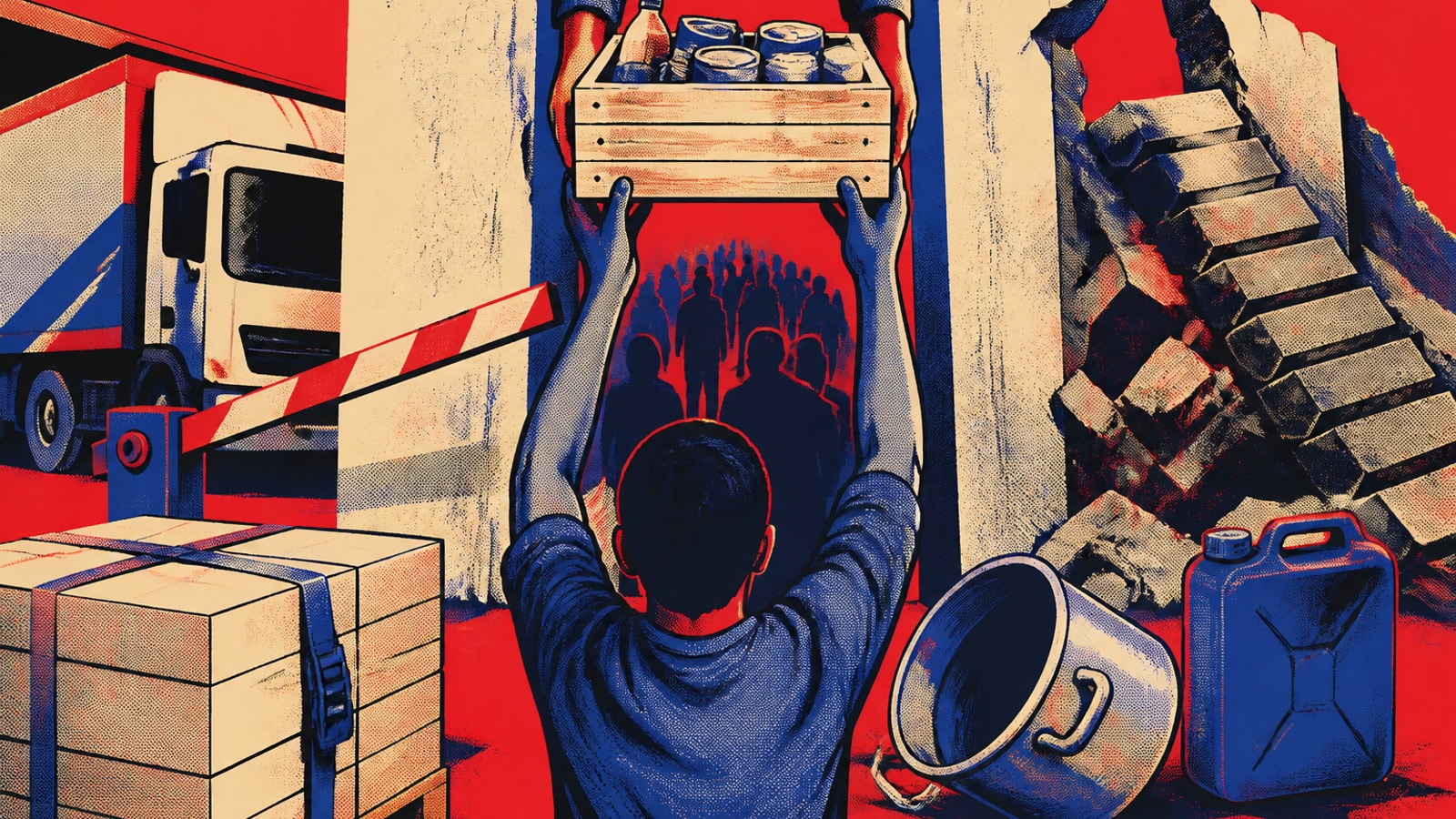
A population-representative survey published in The Lancet Global Health estimated 75,200 violent deaths in the Gaza Strip between 7 October 2023 and 5 January 2025, and about 8,540 further deaths linked to the war from non-violent causes, for a total near 83,700 in that period. The Palestinian Health Ministry, whose registry is the count most widely circulated, reported 67,075 people killed as of 3 October 2025 and 71,662 as of 27 January 2026. The starvation half of the question rests on a much smaller and separately compiled number: the same ministry recorded 460 malnutrition-related fatalities amid famine conditions in northern Gaza by early October 2025, and does not include them in its cumulative fatality count. Two words in the question carry different burdens of proof, and the counts answer them unequally.
Key Findings
- A population-representative survey published in The Lancet Global Health estimated 75,200 violent deaths in the Gaza Strip from 7 October 2023 to 5 January 2025.
- The same survey estimated about 8,540 additional non-violent deaths linked to the war by 5 January 2025, bringing its total for the period to roughly 83,700.
- The Palestinian Health Ministry, a party to the conflict reporting its own registry, gave 67,075 killed as of 3 October 2025, 71,662 as of 27 January 2026 and 72,063 as of 16 February 2026.
- The same ministry recorded 460 malnutrition-related fatalities in northern Gaza by early October 2025, a count it keeps outside its cumulative fatality total, and at least 440 deaths from starvation as of 30 January 2026, on a separate compilation.
- COGAT, the Israeli Ministry of Defense unit, recorded 1,778,363 metric tons of food entering Gaza between 10 October 2025 and 7 June 2026, its own operational count resting on self-declaration by suppliers rather than weighing at the crossings.
How many people have been killed in Gaza?
A population-representative survey published in The Lancet Global Health estimated 75,200 violent deaths in the Gaza Strip between 7 October 2023 and 5 January 2025, the largest independently produced violent-mortality estimate for the war and higher than the registry figure the Palestinian Health Ministry was publishing for the same period.
The ministry registry is the count that circulates most. It reported 67,075 people killed as of 3 October 2025, 71,662 as of 27 January 2026 and 72,063 as of 16 February 2026. Those are a party’s own compiled counts, drawn from hospital and morgue records and from reports the ministry accepts, and they are not independently verified. The Costs of War project at Brown University, compiling the ministry’s own reporting, records 67,075 killed and 169,430 injured as of 3 October 2025, a combined casualty count of 236,505 against a pre-war population of about 2.2 million. The Associated Press, reporting in 2024 when the toll passed 40,000, recorded at least 10,627 children among the dead on the health authorities’ own figures.
The three series are not versions of one another. The Lancet Global Health survey estimated deaths from a household sample, 2,000 households and 9,729 individuals interviewed between 30 December 2024 and 5 January 2025, and reports its 75,200 with a 95% confidence interval of 63,600 to 86,800; it stops in January 2025. The ministry registry accumulates recorded and reported deaths and continues past it. Neither separates combatants from civilians in the totals reported above, a distinction that governs much of the argument over civilian harm in Gaza and one the mortality figures themselves do not settle.
Is it said that Gaza faced mass starvation and killings?
It is often said that the population of Gaza has been subjected to mass starvation and killings. Amnesty International stated in February 2024 that new evidence of unlawful Israeli attacks had caused mass civilian casualties amid what it called a real risk of genocide, and in July 2025 that evidence pointed to the continued use of starvation to inflict genocide. Human Rights Watch counted at least 859 people killed while seeking aid at distribution sites over the period it reviewed.
The mortality scale in that claim is supported by the measured record. The Lancet Global Health estimate of 75,200 violent deaths to January 2025, and the ministry registry passing 70,000 in early 2026, place the war among the largest civilian death tolls of the century by any of the published counts. On that point the claim and the evidence agree, and the disagreement between the survey and the registry is about how much higher the true figure runs, not whether the scale is large.
The word carrying the second burden is different in kind. A United Nations Special Rapporteur report published on 20 October 2025 described Israel’s campaign as having deliberately sought to destroy the humanitarian system and characterised the resulting conditions as a siege-induced famine. Amnesty International, Human Rights Watch and a mandate-holder each produced a finding on their own definitions, on their own review periods, and each states a conclusion about purpose. A conclusion about purpose is a different object from a count: it is reached by argument from a body of documented conduct, and it is the object over which the legal record is contested rather than the object a mortality figure produces. The sections below give the counts each side of the question rests on, and say what each one measured.
How many deaths does the health ministry attribute to hunger?
The Palestinian Health Ministry recorded 460 malnutrition-related fatalities amid famine conditions in northern Gaza by early October 2025, and states that it does not include them in its cumulative fatality count. That is the ministry’s own figure and the recurring published count of deaths attributed to hunger.
A second ministry compilation gave at least 440 deaths from starvation as of 30 January 2026. The two numbers are close but they are not points on one continuous series: they are separate ministry statements, differently worded, one describing malnutrition-related fatalities in a named region and the other describing starvation deaths without that geographic restriction. Neither is presented by the ministry as a cumulative total across all causes of hunger-related death for the whole war, and neither has been independently verified.
Set against the same body’s overall count, the hunger figure is small. The registry stood at 67,075 as of 3 October 2025, so the malnutrition deaths the ministry recorded separately are under 1% of that total. Because the ministry keeps the two counts apart, they may not be added together; the ratio is a comparison of two ministry-sourced numbers, and it carries the limits of both.
Two features of the registry explain why a hunger figure of this size is not the whole of the nutritional record. A death attributed to malnutrition requires a clinical attribution at the point of death, so deaths in which under-nutrition contributed to a fatal infection, an untreated chronic condition or a maternal complication may be recorded under the proximate cause instead. And a registry that depends on hospital and morgue reporting records fewest deaths where health facilities have stopped functioning, which is where the nutritional pressure is heaviest. The survey estimate in the next section addresses that second gap directly, by counting deaths in households rather than in facilities.
How many deaths are estimated to be indirect rather than violent?
The Lancet Global Health survey estimated about 8,540 additional non-violent deaths linked to the war by 5 January 2025, alongside its 75,200 violent deaths, bringing its total for that period to roughly 83,700. Non-violent here means deaths from causes other than direct injury: untreated disease, complications of pregnancy and birth, and the failure of the treatment a person would otherwise have received.
The same study reported that women, children and elderly people made up more than 56% of those violently killed.
This is the category on which the starvation question turns, and it is the category hardest to measure. Costs of War, the research programme at Brown University, sets out the standing distinction in war-mortality research between direct deaths, caused by weapons, and indirect deaths, caused by the destruction of the systems that keep people alive: water, sanitation, food supply, medical care and shelter. Indirect deaths in large conflicts are ordinarily estimated rather than registered, because the people who die of them do so away from any counting mechanism, and because attributing a death to a war rather than to a background rate requires a comparison the registry cannot supply.
The 8,540 figure is therefore not a count of people who starved. It is an estimate of excess deaths from all non-violent causes over a fifteen-month window, of which malnutrition is one contributor among several, and it sits between the ministry’s 460 malnutrition attributions and the far larger totals that appear in general descriptions of humanitarian collapse.
What did famine monitors classify, and what did they measure?
The Integrated Food Security Phase Classification, the UN-backed food-security monitoring body whose findings BBC reporting states confirmed famine conditions in parts of Gaza, classifies on three measured criteria: household food consumption, acute malnutrition among young children, and the crude death rate. It classifies conditions inside a defined area over a defined period.
What the instrument produces is a phase label for a place and a time. What it does not produce is an attribution of responsibility for the conditions it labels. The classification is agnostic as to whether a shortfall arises from crop failure, from a collapsed distribution network, from restrictions imposed by a belligerent, or from a combination, and it names no party. BBC reporting notes separately that Israel has been accused of contributing to the conditions through restrictions on food and medical supplies, which is an accusation carried by named accusers and not a component of the classification itself.
This is the seam where the word deliberate enters the question. A famine classification and an intent finding are two different instruments producing two different objects: a measured condition on one side, an argued conclusion about purpose on the other. The first is reproducible from survey data by anyone with the same inputs. The second requires evidence about decisions, and it is reached, when it is reached formally, by tribunals and by commissions of inquiry working from documentary and testimonial records rather than from nutrition surveys.
The practical consequence for a reader is that a famine classification, on its own, supports the first half of the phrase and is silent on the second. Anyone building an intent claim on top of a classification is adding a second body of evidence to it, and the strength of the claim rests on that second body rather than on the phase label.
Which death counts has the UN independently verified?
The United Nations human rights office reported that it had verified 8,119 Palestinian deaths in Gaza by 2 September 2024, including 3,588 children and 2,036 women, against its own multi-source verification standard, which requires corroboration of an individual death from separate independent sources before it is entered.
That verified set is a fraction of the totals reported elsewhere for the same period, and the gap is a property of the method rather than a dispute about the larger numbers. Verification of individual deaths in an active conflict is slow: each entry requires identification, corroboration and cross-checking, and cases that cannot be corroborated stay out of the verified count regardless of how likely they are. The same office separately reported 34,535 Palestinians killed and 77,704 injured by 30 April 2024, figures it drew from Gaza Ministry of Health data rather than measuring itself, so those two numbers belong to the ministry registry described above and are the ministry’s own count relayed onward.
The two categories therefore behave in opposite directions. The verified subset is a floor: it understates by construction, because everything unconfirmed is excluded. The registry total and the survey estimate are attempts at completeness, one from records and one from a household sample, and the survey’s higher figure is the standing indication that the record-based total is itself incomplete.
Reading them together is what allows a claim about scale to be stated with a bound rather than a single number. The verified count establishes what has been individually corroborated. The survey estimate establishes what a population-representative sample implies. The registry sits between them, and the distance between the three is the honest width of the answer, not a contradiction inside it.
What does Israel’s own record state about aid into Gaza?
COGAT, the Israeli Ministry of Defense unit that coordinates activity in the territories, recorded 1,778,363 metric tons of food entering Gaza between 10 October 2025 and 7 June 2026. That is the unit’s own operational count, produced by a party to the events it describes, and its tonnages rest on self-declaration by humanitarian organisations and private suppliers rather than on weighing at the crossings.
The rest of Israel’s published record follows the same form: figures compiled by a party about its own conduct, dated, and not independently audited.
| Reported figure | Period | Reporting body |
|---|---|---|
| 1,778,363 metric tons of food; more than 70,000 cubic metres of water per day; 18,000 tons of medical supplies | 10 October 2025 to 7 June 2026 | COGAT (2026) |
| Over 1.9 million tons of aid delivered, including 7,800 tons by the aerial route | Start of the war to 19 August 2025 | Israel Defense Forces (2025) |
| Over 70,000 tons of aid, including over 6,500 tons of medical supplies | To 16 December 2023 | Israel Ministry of Foreign Affairs (2023) |
COGAT also reports its food entry as nearly threefold the World Food Programme’s monthly requirement benchmark, a ratio in which the numerator is COGAT’s own and the denominator another body’s, and reports an approximately 72% decline in the Gaza food consumer price index between September 2025 and May 2026, without identifying the source of the price data.
On conduct, the IDF Military Advocate General’s Corps reported in its update of 3 August 2024 that it had opened 74 criminal investigations, including 44 concerning the death of detainees held by the IDF, and had referred over 1,000 incidents to the General Staff’s Fact-Finding and Assessment Mechanism. The same document states the threshold that produces those counts: in armed conflict, in the Corps’ words, “death or injury to a civilian or harm to civilian objects, while tragic and regrettable, in most cases do not by themselves indicate a reasonable suspicion of criminal conduct, as they can be explained as reasonable aftermath of lawful operational activity.” The 74 is a count of investigations opened, not of findings or indictments, and it is a function of that standard.
Methodology
This report draws on four source types, each labelled where it appears. Peer-reviewed research supplies the mortality estimate (The Lancet Global Health, 2026). Named press reporting supplies dated relays of registry figures (Associated Press, 2024; BBC on the famine classification). Parties to the conflict supply their own published counts: the Palestinian Health Ministry registry and its separately kept malnutrition-fatality count, and the Israeli COGAT, IDF, Military Advocate General’s Corps and Foreign Ministry records, each attributed as that party’s own reporting and none independently verified. Research-institute material (Costs of War, Brown University) supplies the direct-versus-indirect mortality distinction and the compilation of the ministry’s 3 October 2025 counts.
Positions held by Amnesty International, Human Rights Watch and the United Nations Special Rapporteur are named and dated in the body as those bodies’ own findings on their own definitions and review periods. The United Nations human rights office figures are given as that office’s own verification against its own standard, with its relay of Gaza Ministry of Health data attributed back to the ministry that produced it.
Three limitations bear on every figure above. First, the survey estimate and the registry are different instruments over different windows and are not additive or directly comparable; the survey stops at 5 January 2025 while the registry continues. Second, none of the totals reported here separates combatants from civilians, a division on which the published sources disagree and which the numbers themselves do not resolve. Third, tonnage figures from COGAT and the IDF rest on self-declaration rather than measurement at the crossings, and the Military Advocate General’s investigation counts are a function of the criminal-suspicion threshold that document states.
Conclusion
Does the record show mass killings and deliberate starvation? On the first, the counts converge on scale and disagree only on how far above 70,000 the true figure sits: 75,200 violent deaths on the Lancet Global Health survey to January 2025, 72,063 on the ministry registry by February 2026, 8,119 individually verified deaths by September 2024 as the corroborated floor beneath both. On the second, the record separates into two things that are often spoken as one. Famine conditions were classified by a monitoring body that measures food consumption, child malnutrition and death rates and names no responsible party. Deaths attributed to hunger by the ministry that keeps the registry number 460 in one compilation and at least 440 in another, under 1% of the deaths that ministry recorded overall, while a survey estimate of 8,540 non-violent excess deaths marks the wider category into which malnutrition disappears. Israel’s own units report 1,778,363 metric tons of food entering during the ceasefire period and 74 criminal investigations opened against a stated standard under which civilian death does not by itself raise criminal suspicion.
The word doing the most work in the question is deliberate, and no count in this report reaches it. Intent is established from decisions, not from death tolls, which is why Amnesty International, Human Rights Watch and a UN mandate-holder each argue to that conclusion rather than measure it, and why the mortality figures they cite are the same figures used by those who reject the conclusion.
What would have to be on the record, then, before a figure about an outcome could carry a conclusion about intent, and which body is in a position to put it there?
Frequently Asked Questions
How does a survey estimate of war deaths differ from a health ministry registry?
A registry counts deaths that reach a recording point, ordinarily a hospital or a morgue, so it undercounts wherever those institutions have stopped functioning. A population-representative survey asks households about deaths directly, which captures deaths no facility saw. The Lancet Global Health survey’s 75,200 violent deaths to January 2025 exceeded the ministry registry for the same period, the pattern that difference in method predicts.
Why is the count of hunger deaths so much smaller than the overall death toll?
A malnutrition attribution requires a clinical judgement at the point of death, so hunger that contributes to a fatal infection or an untreated condition is usually recorded under the proximate cause. The Palestinian Health Ministry’s 460 malnutrition-related fatalities, which it records separately from its cumulative fatality total, cover only deaths so attributed, not the wider effect of under-nutrition on mortality.
What does a famine classification not tell a reader?
It does not assign responsibility. The Integrated Food Security Phase Classification labels conditions in a defined area and period on food consumption, child acute malnutrition and death rates, and names no party as the cause. Any claim about who produced the conditions rests on a separate body of evidence.
How many people were living in Gaza when the war began?
The Palestinian Central Bureau of Statistics reported roughly 2.2 million residents in Gaza on the eve of the war and about 2.13 million at the end of 2025, a net decline of approximately 254,000 people, or 10.6% against its pre-war population estimates. The Bureau attributes that change to war-related deaths, missing persons, reduced births and forced out-migration, so it is a demographic net change and not a casualty count.
Who verifies individual deaths, and why is that number so much lower?
The United Nations human rights office reported 8,119 Palestinian deaths verified by 2 September 2024 against its own multi-source standard, which requires independent corroboration of each individual death. Cases that cannot be corroborated are excluded regardless of likelihood, which makes a verified count a floor rather than an estimate of the total.
How are Israel’s aid tonnage figures produced?
COGAT states that its tonnages rest on self-declaration by humanitarian organisations and private-sector providers rather than on weighing at the crossings, and it is a party to the events it records. Its report also compares its own recorded food entry against a World Food Programme requirement benchmark, so only the numerator of that comparison is COGAT’s own measurement.
Sources
- Associated Press, 2024. With Gaza death toll over 40,000, here’s the conflict by numbers. Associated Press. apnews.com. News reporting.
- BBC News, 2025. Reporting on famine classification in Gaza. BBC. bbc.com. News reporting.
- Coordinator of Government Activities in the Territories (COGAT), 2026. Humanitarian Situation Report During the Ceasefire. Israeli Ministry of Defense. gaza-aid-data.gov.il. Official record, party’s own reporting.
- Costs of War, Brown University. The Human Toll of the Gaza War: Direct and Indirect Death. Watson Institute, Brown University. costsofwar.watson.brown.edu. Research-institute report.
- Israel Defense Forces, 2025. Clearing Up the Misconceptions: Everything You Need to Know About the Humanitarian Aid Situation in Gaza. idf.il. Official record, party’s own reporting.
- Israel Defense Forces, Military Advocate General’s Corps, 2024. Addressing Alleged Misconduct in the Context of the War in Gaza. idf.il. Official record, party’s own reporting.
- Israel Ministry of Foreign Affairs, 2023. Israel-Hamas Conflict 2023: Humanitarian Efforts. gov.il. Official record, party’s own reporting.
- Palestinian Central Bureau of Statistics, 2025. A Brief on the Status of the Palestinian People at the End of 2025. Ramallah. pcbs.gov.ps. Official record.
- Palestinian Ministry of Health, 2025 to 2026. Reported cumulative fatality and malnutrition-fatality counts for the Gaza Strip. Party’s own registry.
- The Lancet Global Health, 2026. Population-representative survey of violent and non-violent mortality in the Gaza Strip, 7 October 2023 to 5 January 2025. Peer-reviewed.