
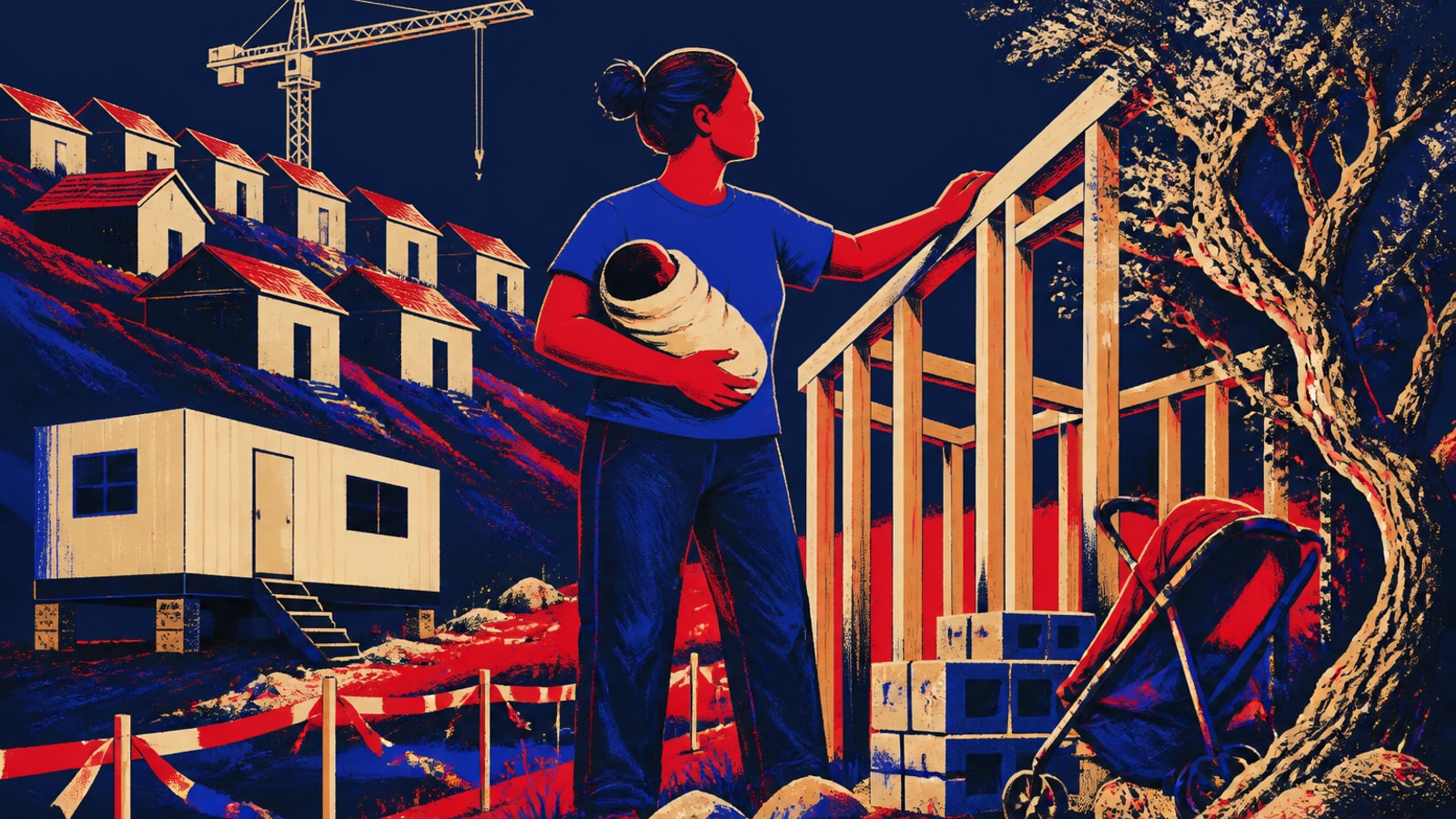
The natural growth argument holds that existing settlements need new housing and services for families formed by births inside them. The Foundation for Middle East Peace described that usage in 2021 as growth from births, as distinct from migration into settlements from Israel or abroad. The argument’s premise matches the official accounting at national scale: Israel’s Central Bureau of Statistics recorded about 177,000 births against about 21,000 arriving immigrants in the 11.75 months to 22 April 2026. Israel’s own records also measure what a birth count does not: a 2005 review commissioned by the Prime Minister’s Office counted 105 unauthorized outposts, each defined as standing apart from any existing settlement, and the Supreme Court ordered outposts on private Palestinian land removed, in Migron in 2011 and in Amona in 2014.
Key Findings
- 177,000 births against 21,000 immigrants. Israel’s Central Bureau of Statistics recorded about 177,000 infants born, about 48,000 deaths and about 21,000 immigrants arriving in the 11.75 months to 22 April 2026, in preliminary national estimates (Central Bureau of Statistics, 2026).
- Births outweighed migration about fivefold in Jerusalem. Jerusalem added about 20,500 people by natural increase during 2023, against 4,000 by the international migration balance, while its total population rose by 13,400 (Central Bureau of Statistics, 2024).
- 105 outposts, each apart from an existing settlement. Israel’s own commissioned review, published by a party to the events, counted 105 unauthorized outposts in March 2005, defined as “at least a few hundred meters distant” from an existing settlement, and stated that the figure “probably does not reflect the true number” (Prime Minister’s Office of Israel, 2005).
- Settlements defined by area, not by population. The 1995 Interim Agreement defines “the Settlements” as “the settlements in Area C” and lists settlements among the issues reserved for permanent status negotiations (Israel and the PLO, 1995).
- 5 to 0 on private land in 1979. Israel’s Supreme Court unanimously invalidated a requisition order for the Elon Moreh settlement as to the petitioners’ private land on 22 October 1979, and it later ordered the Migron outpost evacuated on 2 August 2011 (Israeli Supreme Court, 1979; Israeli Supreme Court, 2011, 2014).
What does the natural growth argument claim settlements need?
The argument claims that settlements need new homes for growth from births, the component Israel’s Central Bureau of Statistics publishes separately from migration. In the 11.75 months to 22 April 2026, the Bureau’s preliminary national estimates recorded about 177,000 infants born, against about 21,000 immigrants arriving (Central Bureau of Statistics, 2026).
Demographers divide population change into natural increase, which is births minus deaths, and net migration. The natural growth argument places settlement construction on the first side of that line. The Foundation for Middle East Peace, a Washington-based nonprofit that monitors settlement policy, described the term’s usual meaning in 2021 as growth from births, contrasted with immigration from Israel or from abroad. That is a monitoring organization’s description of usage, not an official definition. The claim it summarises is that children born in a settlement grow up, form households and need housing, schools and roads where they already live.
The Bureau’s accounting shows how the split works nationally. Against the 177,000 births it recorded about 48,000 deaths, so natural increase was roughly 129,000, a subtraction made from the Bureau’s two rounded components. Immigration added about 21,000 and family reunification about 5,000, while the balance of Israelis staying abroad was 45,000 negative. The Bureau reports total growth of 146,000, or 1.4%, of which 110,000 was the Israeli population and about 36,000 foreigners, and it states that the total does not equal the difference between the components.
The prior year’s release shows the same shape: about 174,000 births, about 50,000 deaths and about 28,000 immigrants between Independence Day 2024 and Independence Day 2025, for total growth of 135,000 (Central Bureau of Statistics, 2025). Both releases are preliminary and rest on the 2022 census. From 2023 the estimates include foreigners, so the series is not continuous with earlier years.
These are national figures. They supply the vocabulary the argument borrows, births against migration, and name the official body that measures it. Whether settlements specifically grow on the births side is a narrower question.
Who makes the natural growth argument, and is its premise sound?
Israeli governments and settlement advocates have voiced the argument in debates over construction freezes, as Israel Policy Forum’s 2025 explainer describes, and its premise holds where fertility is high. Israel’s Central Bureau of Statistics recorded about 20,500 people added to Jerusalem by natural increase during 2023, against 4,000 added by the international migration balance (Central Bureau of Statistics, 2024).
Israel Policy Forum, a US-based policy organization, and the Foundation for Middle East Peace in its 2021 description both place the argument in freeze debates. In those debates, building inside existing settlements was distinguished from founding new ones. None of the official records cited here dates the phrase’s first use.
The demographic premise is directionally right for high-fertility Jewish populations. Jerusalem, where the Bureau estimates that about 29.2% of residents were ultra-Orthodox at the end of 2023, a modelled estimate built on a 2022 base, added about five people by births for every one added by international migration. Natural increase was the dominant component the release shows.
The base rate comes next. Jerusalem’s total increase in 2023 was 13,400. The two components the release itemises sum to 24,500, so about 11,100 people left on balance through movements the release does not break out. That figure is a subtraction from the Bureau’s published numbers, not a Bureau figure. Births can dominate a population’s natural increase while its total growth still depends on who moves in and who moves out.
Settlement populations show the same higher natural increase. Yinon Cohen of Columbia University calculated, on his university web page, an average annual natural-growth rate of 3.57% for the Israeli population of the Judea and Samaria district in 2009 to 2011. He set that against 1.48% for Israeli Jews overall in 2010 to 2012. The calculation is not peer-reviewed and covers years more than a decade old, so it describes that period rather than the present.
The record therefore supports the premise that births are a large driver of settlement growth. The open question is scope: whether a share of growth that comes from births can account for the whole of construction, and on which land that construction stands.
Where does the births-versus-migration count for settlements come from?
Every births-versus-migration split for settlements rests on the Central Bureau of Statistics, which reports the Judea and Samaria Area as a statistical district. Hirsch-Hoefler and Ben Shitrit (2020) trace how the Bureau’s yearbook folded settlers into Israel’s total from 1970, through a footnote listing them as “Israeli residents in the Administrated Territories.”
The Bureau’s 2023 release on Israelis of Ethiopian origin notes that its district figures for the Judea and Samaria Area relate to Israeli localities only (Central Bureau of Statistics, 2023). The same release supplies the fertility baseline any settlement rate is compared with: 2.90 children expected per woman in the Jews and Others population in 2022, against 2.68 for women of Ethiopian origin.
Hirsch-Hoefler and Ben Shitrit, writing in a think-tank report that is not peer-reviewed, describe a steady trend they call the “normalization of settlements” in the yearbook. That framing is theirs. The dated steps they record run as follows.
| Year | Change in the Bureau’s yearbook | Source |
|---|---|---|
| 1968 | East Jerusalem moved into the general count for Israel proper | Hirsch-Hoefler and Ben Shitrit, 2020 |
| 1970 | A footnote folded settlers into Israel’s total | Hirsch-Hoefler and Ben Shitrit, 2020 |
| 1983 | Settlement localities counted in Israel’s total number of localities | Hirsch-Hoefler and Ben Shitrit, 2020 |
| 1997 | The separate territories chapter removed | Hirsch-Hoefler and Ben Shitrit, 2020 |
The same authors record two boundary choices that change any settlement total. The Bureau excludes unrecognized outposts. It places a locality straddling the Green Line, such as Shani Livne, in Israel’s South District, while Peace Now and B’Tselem count it as a settlement. A births share computed from the district series therefore covers recognized Israeli localities in the district, on the Bureau’s boundaries.
A figure stating that about 60% of annual settlement growth comes from births and about 40% from migration was published by the Foundation for Middle East Peace in 2021. The organization attributed it to Israeli official statistics. It is that organization’s reading of the data, not a share printed in the Bureau releases cited here. On that reading births are the majority of settlement growth, and migration is the remaining two-fifths.
Why does ultra-Orthodox fertility weigh so heavily in the argument?
About 59,700 of Jerusalem’s 86,700 Hebrew-education primary pupils, roughly 69%, studied under ultra-Orthodox supervision in the 2022/23 school year, on the Central Bureau of Statistics’ count (Central Bureau of Statistics, 2024). Where a population’s children are this concentrated in one community, that community’s fertility carries most of its natural increase.
The 69% is a division of the Bureau’s two published counts. The rest of the 86,700 were split between about 14,900 pupils under State-Religious supervision and about 12,000 in the State system, all approximate figures as the release prints them.
Family formation starts earlier in Jerusalem. The Bureau recorded an average age at first birth of 24.9 for Jerusalem mothers in 2022, against 27.8 nationally. A national baseline of 2.90 children per woman for Jews and Others in 2022 (Central Bureau of Statistics, 2023) sits below the rates of the most observant communities, as the peer-reviewed evidence below sets out.
Barbara Okun’s peer-reviewed analysis of the 2009 Israel Social Survey found that the odds of a Jewish woman or man in Israel having at least three children rise with religious observance (Okun, 2017). Okun accounts for that gradient through three measured factors: the importance of religious community, attitudes toward religion as a social and political institution, and family-building norms. The analysis is cross-sectional, so it records associations between religiosity and fertility, not causes.
The gradient matters for settlements because some of the largest are ultra-Orthodox towns. Israel Policy Forum stated in 2025 that nearly half of settlement growth came from two ultra-Orthodox cities, Modi’in Illit and Beitar Illit. That is the organization’s own statement of the share, not a Bureau figure.
Read together, these records locate the argument’s strongest demographic case. Births drive growth most heavily in the communities with the youngest first-time mothers and the highest observance, and those communities hold a large part of the settlement population. The same records say nothing about where the resulting homes are built, which the agreement, review and court records below address.
What did the 1995 interim agreement say about settlements?
The Interim Agreement that Israel and the PLO signed on 28 September 1995 defines the term in one clause, Article XII(5): “the Settlements” means, “in the West Bank the settlements in Area C.” Article XVII(1) then removes settlements from the Palestinian Council’s jurisdiction (Israel and the PLO, 1995).
Article XVII(1) lists everything carved out of the Council’s jurisdiction: “Jerusalem, settlements, specified military locations, Palestinian refugees, borders, foreign relations and Israelis.” Article XVII(4)(a) places authority over areas outside the Council’s territorial jurisdiction with Israel “through its military government.” Article XXXI(5) sets permanent status negotiations to begin “not later than May 4, 1996,” covering remaining issues including “Jerusalem, refugees, settlements, security arrangements, borders.” That date is what the text set.
Two clauses bind both parties while those negotiations are pending. Article XXXI(6) reads in full: “Nothing in this Agreement shall prejudice or preempt the outcome of the negotiations on the permanent status to be conducted pursuant to the DOP. Neither Party shall be deemed, by virtue of having entered into this Agreement, to have renounced or waived any of its existing rights, claims or positions.” Article XXXI(7) reads: “Neither side shall initiate or take any step that will change the status of the West Bank and the Gaza Strip pending the outcome of the permanent status negotiations.”
| Clause | What it says about settlements | Source |
|---|---|---|
| Article XII(5) | Defines them as the settlements in Area C | Israel and the PLO, 1995 |
| Article XVII(1) | Excludes them from the Council’s jurisdiction | Israel and the PLO, 1995 |
| Article XXXI(5) | Lists them among permanent status issues | Israel and the PLO, 1995 |
| Article XXXI(7) | Bars either side from changing the territories’ status | Israel and the PLO, 1995 |
The Agreement defines settlements by area, not by population. Area C itself is defined residually in Article XI(3) as “areas of the West Bank outside Areas A and B,” which are drawn by red lines and shading on a map, so the text contains no area share for Area C. None of the four clauses in the table mentions construction, housing or population growth. The English text cited is the one published by the Israeli Ministry of Foreign Affairs, a party to the Agreement. A fuller reading of the interim agreement’s jurisdiction clauses sets out the remaining articles.
How did new outposts relate to existing settlements, in Israel’s 2005 review?
Israel’s Prime Minister’s Office published in March 2005 the summary of an opinion by Talya Sason counting 105 unauthorized outposts. Each was defined as “not attached to an existing settlement, but rather at least a few hundred meters distant from it as the crow flies” (Prime Minister’s Office of Israel, 2005). This is Israel’s own commissioned review, published by a party to the events.
The definition separates the review’s subject from the natural growth argument’s subject. The argument concerns homes inside existing settlements. The review’s count covers sites set apart from them and excludes unauthorized building inside or adjoining recognized settlements. The 105 is a floor: Sason wrote that it “probably does not reflect the true number of outposts in the area,” and that the Civil Administration did not deliver all its data. A wider treatment of Israel’s own record on unauthorized outposts follows the review’s other findings.
The review dates 71 outposts before March 2001 and 24 afterwards, with 10 whose date the author had not found, so those two dated groups do not total 105. On land status, 26 stood on State land, 7 on survey land, 15 on Palestinian private property and 39 on mixed land that was “part State, part survey, part owned by Palestinians.” The remaining 18 stood on land whose status the author had not resolved, a figure derived by subtraction.
The review’s central finding concerned state bodies: “The problem is State and public authorities took part in breaking the law. They are the ones who financed construction without a resolution by the political echelon, in contrary to government resolutions.” It records, for example, that of 140 caravans placed in the territories in the 2003 acquisition, 90 went to unauthorized outposts. The test it applied was characteristic A of an outpost: “There was no government decision to establish it.”
On which land have Israel’s own courts barred settlement building?
Israel’s Supreme Court, sitting as High Court of Justice, ruled 5 to 0 on 22 October 1979 in HCJ 390/79 Dweikat, the Elon Moreh case. It declared a requisition order for a civilian settlement invalid as to the petitioners’ privately owned land, finding a political rather than military purpose dominant (Israeli Supreme Court, 1979).
The holding was narrower than a bar on settlement. Deputy President Landau wrote that taking private land for a civilian settlement “is potentially justified under Article 52 of the Hague Regulations,” when “military needs were those which in practice brought upon the decision.” Here, he found, “the process was inverted: the initiative came from the political echelons.” A second, independent ground held that a military administration cannot create “‘facts on the ground’” intended to outlast military rule. The annulment covered the petitioners’ roughly 125 dunams within an order of about 700, and Landau distinguished, rather than overruled, the 1978 Beit El case, which had upheld a requisition on the same Article 52 reasoning. Article 49(6) of the Fourth Geneva Convention was expressly left undecided.
The rule that settlements be built “only on State land” is not in the judgment. The Sason review reports it as a 1979 government resolution that followed the Elon Moreh ruling (Prime Minister’s Office of Israel, 2005).
The later line concerns outposts on registered private land. On 2 August 2011 the Court issued “a final order requiring the State to evacuate the Outpost of Migron,” with a deadline of 31 March 2012. The State itself did not dispute that the land was “under private Palestinian ownership” and that the outpost “is illegal.” On 25 December 2014 the Court ordered the Amona outpost removed within two years, and on 14 November 2016 it refused the government’s request for further delay (Israeli Supreme Court, 2011, 2014).
Each ruling turns on title to land, not on the origin of the people who would live there. The report of the Levy Commission on the legal status of building in Judea and Samaria was never officially published or adopted by the government; only an advocacy reprint circulates, so it stands as a stated position rather than a government record.
Methodology and limitations
The evidence comes from four source types. Official statistics are the Central Bureau of Statistics releases for Independence Day 2025 and 2026, Jerusalem Day 2024 and the Sigd festival 2023. All population estimates are preliminary and based on the 2022 census. The Jerusalem ultra-Orthodox share is a modelled estimate on a 2022 base, and foreigners enter the national estimates from 2023, which breaks continuity with earlier years. Primary records are the 1995 Interim Agreement, in the English text published by the Israeli Ministry of Foreign Affairs, a party to it, and three Supreme Court cases. The Elon Moreh quotations come from the unofficial Cardozo translation, the Migron quotations from the Judicial Authority’s own translation, and the Amona holdings from the Law Library of Congress summary, since that judgment exists in Hebrew only. The Sason opinion is cited from its official English summary; the full opinion is in Hebrew.
Peer-reviewed research is Okun (2017), a cross-sectional survey analysis reporting associations. Hirsch-Hoefler and Ben Shitrit (2020) is a think-tank report, not peer-reviewed, and Yinon Cohen’s rates come from his university web page, also not peer-reviewed.
The Foundation for Middle East Peace and Israel Policy Forum are named as holders of a description and of figures, including the 60% births share and the Modi’in Illit and Beitar Illit share, which are those organizations’ own readings. Several figures are arithmetic on published components: Jerusalem’s 69% pupil share, national natural increase of about 129,000, Jerusalem’s balance of about 11,100 and the 18 unresolved outpost sites. Each is marked where it appears.
Conclusion
So what is the natural growth argument? It is a claim that settlement homes answer births, and the official accounting it borrows is real: about 177,000 births against about 21,000 immigrants nationally in the year to April 2026, and roughly five births-driven arrivals for every migrant in Jerusalem in 2023, on the Central Bureau of Statistics’ preliminary counts.
The fuller record draws a sharper portrait. Births dominate where observance is highest and mothers are youngest, with about 69% of Jerusalem’s Hebrew-education primary pupils in ultra-Orthodox schools. The signed 1995 Agreement defines settlements by area and defers them to permanent status talks. Israel’s own commissioned review, published by a party to the events, counted at least 105 outposts placed apart from any existing settlement, and the Supreme Court’s rulings from Elon Moreh to Amona turned on who held title to the land.
A birth registry can say how many children a community has. It cannot say whether the hilltop where their homes rise was State land, survey land or a Palestinian family’s registered plot. When a growing household and a land title point in different directions, which of the two records should govern a society’s argument about where building belongs?
Frequently Asked Questions
How is natural increase calculated from official figures?
Natural increase is births minus deaths. The Central Bureau of Statistics recorded about 174,000 births and about 50,000 deaths between Independence Day 2024 and Independence Day 2025, a natural increase of roughly 124,000 by subtraction (Central Bureau of Statistics, 2025). Migration is counted separately.
Does family reunification count as natural growth?
No. The Central Bureau of Statistics lists about 5,000 people who arrived through family reunification in the 11.75 months to 22 April 2026 as a separate component from births (Central Bureau of Statistics, 2026). It is an arrival, so it sits on the migration side of the ledger.
Do Israelis living abroad affect the growth figures?
Yes. The Central Bureau of Statistics recorded a negative balance of 45,000 Israelis staying abroad in the 11.75 months to 22 April 2026 (Central Bureau of Statistics, 2026). That outflow offsets part of the natural increase in the national total.
Was the 1979 “State land only” rule a court ruling?
No. The Sason review reports it as a 1979 government resolution, adopted after the Elon Moreh judgment, that settlements “shall be established only on State land” (Prime Minister’s Office of Israel, 2005). The phrase “State land” does not appear in the Elon Moreh judgment itself.
Does the Interim Agreement say what share of the West Bank is Area C?
No. The 1995 text defines Areas A and B by lines and shading on a map and Area C as the remainder, and the word “percent” appears only once in the main Agreement, in Article IX on appointments (Israel and the PLO, 1995). Any area share comes from a later measuring body.
How much did the review say one ministry spent on outposts?
The Sason review records NIS 71,870,000 spent on unauthorized outposts from 2000 to 2004 by the Ministry of Construction and Housing (Prime Minister’s Office of Israel, 2005). That is the ministry’s own reported total, and the summary states it does not settle with the ministry’s own working schemes, so it is a floor.
How large was Migron when the Court considered it?
The State itself reported about 45 families and about 250 residents in Migron as of February 2009, describing it as the largest outpost in Judea and Samaria (Israeli Supreme Court, 2011, 2014). The State also reported that Migron was established in May 2001 without any government resolution.
Sources
- Central Bureau of Statistics, 2023. The Population of Ethiopian Origin in Israel: Selected Data Published on the Occasion of the Sigd Festival 2023. Central Bureau of Statistics. https://www.cbs.gov.il/he/mediarelease/DocLib/2023/362/11_23_362e.pdf. Official record.
- Central Bureau of Statistics, 2024. Selected Data on the Occasion of Jerusalem Day, 2024. Central Bureau of Statistics. https://www.cbs.gov.il/he/mediarelease/DocLib/2024/165/11_24_165e.pdf. Official record.
- Central Bureau of Statistics, 2025. Israel’s Independence Day 2025. Central Bureau of Statistics. https://www.cbs.gov.il/He/mediarelease/DocLib/2025/134/11_25_134e.pdf. Official record.
- Central Bureau of Statistics, 2026. Israel’s Independence Day 2026. Central Bureau of Statistics. https://www.cbs.gov.il/he/mediarelease/DocLib/2026/117/11_26_117e.pdf. Official record.
- Cohen, Yinon, undated. Demographic Success of the West Bank Settlers. Columbia University personal web page. http://www.columbia.edu/~yc2444/pages/Demographic%20Success%20of%20the%20West%20Bank%20Settlers.html. Author’s web page, not peer-reviewed.
- Hirsch-Hoefler, Sivan, and Lihi Ben Shitrit, 2020. So, How Many Settlements Are There? Counting, Tracking, and Normalizing Jewish Settlements in the Israeli Central Bureau of Statistics (CBS) Yearbook, 1967 to the Present. POMEPS. https://pomeps.org/so-how-many-settlements-are-there-counting-tracking-and-normalizing-jewish-settlements-in-the-israeli-central-bureau-of-statistics-cbs-yearbook-1967-to-the-present. Think-tank report, not peer-reviewed.
- Israel and the PLO, 1995. The Israeli-Palestinian Interim Agreement on the West Bank and the Gaza Strip (Oslo II), with Annex I and Annex III. Text published by the Israeli Ministry of Foreign Affairs. https://www.gov.il/en/Departments/General/the-israeli-palestinian-interim-agreement. Official record.
- Israeli Supreme Court, 1979. HCJ 390/79 Dweikat v. Government of Israel (Elon Moreh), judgment of 22 October 1979. Unofficial English translation, Cardozo Israeli Supreme Court Project. https://versa.cardozo.yu.edu/sites/default/files/upload/opinions/Dweikat%20et%20al.%20v.%20State.pdf. Official record (court judgment).
- Israeli Supreme Court, 2011, 2014. HCJ 8887/06 al-Nabut v. Minister of Defense (Migron) and HCJ 9949/08 Hamad v. Minister of Defense (Amona). Supreme Court of Israel; Law Library of Congress summary of the 2016 Amona decision. https://supremedecisions.court.gov.il/Home/Download?path=EnglishVerdicts/06/870/088/n45&fileName=06088870.N45&type=4 and https://www.loc.gov/item/global-legal-monitor/2016-11-25/israel-supreme-court-rejects-government-request-to-further-delay-eviction-of-settlement-built-on-land-privately-owned-by-palestinians/. Official record (court judgments).
- Okun, Barbara S., 2017. Religiosity and Fertility: Jews in Israel. European Journal of Population 33(4), 475 to 507. DOI 10.1007/s10680-016-9409-x. Peer-reviewed.
- Prime Minister’s Office of Israel, 2005. Summary of the Opinion Concerning Unauthorized Outposts, prepared by Talya Sason. Published by the Ministry of Foreign Affairs. https://www.gov.il/en/pages/summary-of-opinion-concerning-unauthorized-outposts-talya-sason-adv. Official record (government-commissioned review).