
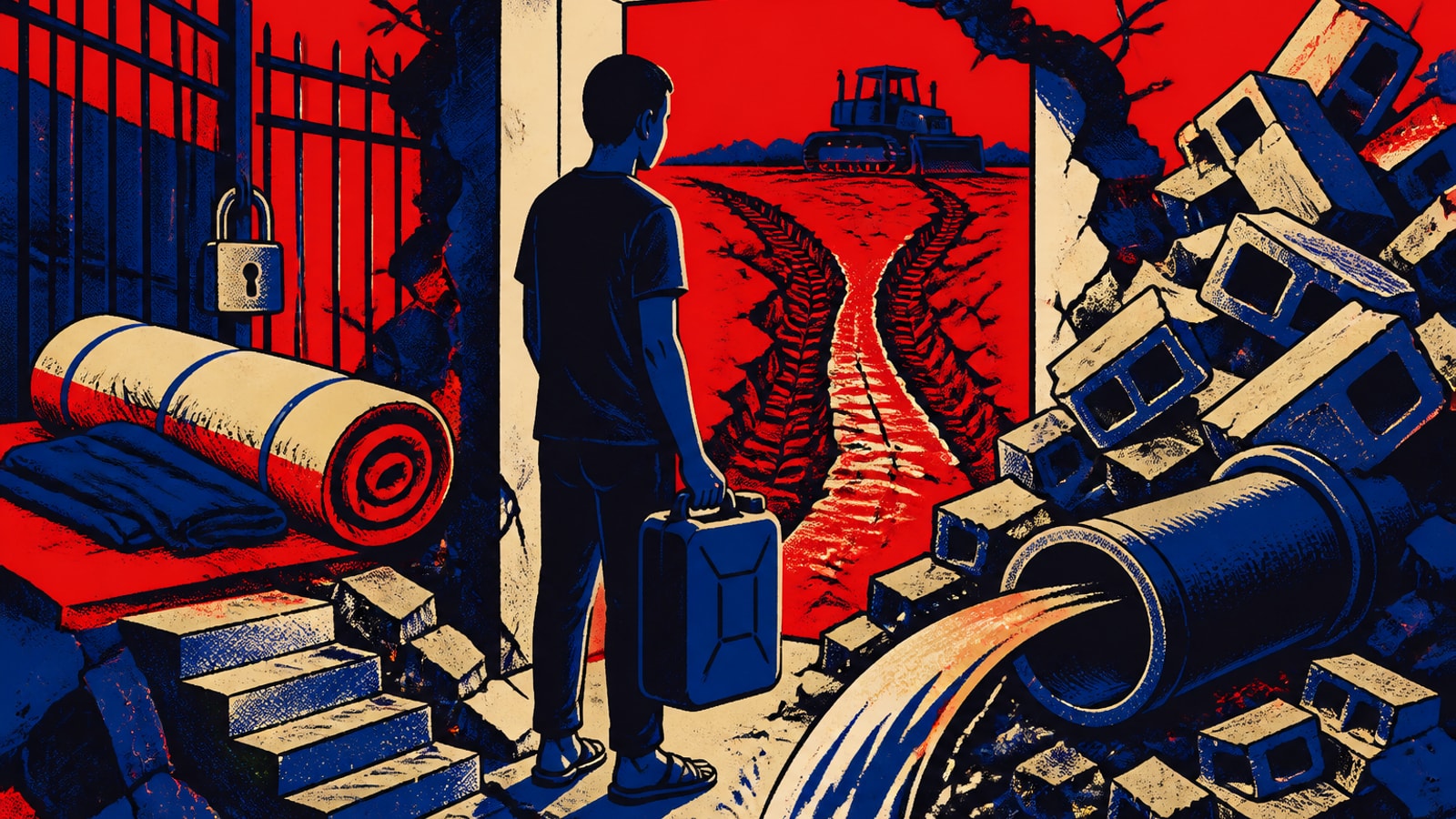
The largest toll recorded for a single Israeli raid is the 274 Palestinians killed and nearly 700 wounded during the June 2024 hostage-rescue operation in Nuseirat, central Gaza, a count published by the Gaza Ministry of Health on its own definitions and not separated into civilians and combatants. The records around raids also carry harms no casualty count holds: displacement out of refugee camps, water lines and roads cut by armoured bulldozers, schools closed for the duration of a curfew. Israel’s own military prosecution service reports 74 criminal investigations opened and more than 1,000 incidents referred for factual assessment as at 3 August 2024, a count that follows directly from the threshold it states it applies. A raid lasts hours; the records describing it are kept by parties counting different things, which is why the same operation can be read three ways.
Key Findings
- The Gaza Ministry of Health’s own count for the 8 June 2024 operation in Nuseirat is 274 Palestinians killed and nearly 700 wounded, including 64 children and 57 women, reported in June 2024 without a civilian and combatant split.
- The Israel Defense Forces Military Advocate General’s Corps reports, on its own count, 74 criminal investigations opened as at 3 August 2024, including 44 concerning the death of detainees held by the IDF, alongside more than 1,000 incidents referred to the General Staff’s Fact-Finding and Assessment Mechanism.
- The IDF Spokesperson stated on 29 February 2024 that Israeli forces had eliminated over 13,000 people it describes as terrorists in Gaza, and that about 3,400 had been apprehended in Judea and Samaria with the Israel Security Agency; the classification is the IDF’s own and no corresponding civilian count is published.
- The Guardian reported in August 2025, with +972 Magazine and Local Call, that an internal Israeli military database indicated a civilian death rate of 83% in the Gaza war, journalism reading a classified party record rather than a published official bulletin.
What do the records show raids do to civilians?
The UN Office for the Coordination of Humanitarian Affairs recorded 370 Palestinians killed by Israeli forces in the occupied West Bank between 7 October 2023 and 29 January 2024, including 94 children, a count kept on that office’s own definitions and covering search-and-arrest raids, demonstrations and checkpoint incidents together rather than raids alone.
That last point governs how the figure can be read. The office maintains a casualty database that records deaths and injuries separately and does not partition its totals by operation type, so a number describing a period of raids is not a number describing raids. The same holds in the other direction: injuries far outnumber deaths in that database, and an operation that kills nobody can still leave scores wounded.
The documented harms fall into four categories the records keep apart, and collapsing them is the most common error in reading this question. There is the immediate physical harm, killed and wounded. There is detention: the IDF Spokesperson stated on 29 February 2024, on the force’s own count, that about 3,400 people the IDF describes as terrorists had been apprehended by IDF forces together with the Israel Security Agency in Judea and Samaria during the war, including 1,500 it identifies as Hamas members, a count and a characterisation that are the party’s own. There is displacement, when a camp or a block is emptied. And there is the service disruption that outlasts the operation, covered further below.
Each of those four is measured by a different body, on a different definition, over a different window. No single published series carries all four for the same set of operations, which is why an answer built from one source will always be describing a slice. The documentary record on civilian harm has the same structure: several partial ledgers, no consolidated one.
Is it often said that raids have grown deadlier?
Amnesty International’s 2024 reporting on the occupied West Bank counts 507 Palestinians killed there during 2023, including at least 81 children, which it describes as the deadliest year for Palestinians in the territory since the UN Office for the Coordination of Humanitarian Affairs began recording casualties in 2005.
It is often said that Israeli raids have become sharply deadlier for Palestinian civilians. On the records that exist, the direction is not in dispute: the counts rose, and they rose steeply within 2023 itself. Of the 507 Amnesty counts for the year, 299 fall in the 86 days from 7 October to 31 December, which is 59% of the annual total in 24% of the year.
Two things frame that. The first is the age of the record. The continuous casualty series runs from 2005, so a claim that a year is the deadliest is a claim about a 19-year window, not about the whole period since 1967, for which no comparable series exists. The second is the unit. These are counts of Palestinians killed by Israeli forces from all causes recorded, which the compiling bodies do not separate into raid deaths, deaths at demonstrations, deaths at checkpoints and deaths in settler-related incidents. A rise in the total is consistent with a rise in raid lethality and also with a change in the mix.
Amnesty International is an advocacy organisation counting on its own definitions and stating its own findings, and its West Bank totals are drawn from the UN office’s records rather than measured independently. Israel publishes no corresponding civilian count for the West Bank. The IDF Spokesperson’s 29 February 2024 briefing gives apprehensions and describes those killed by the classification the IDF applies, so on the party’s own record the civilian share of West Bank casualties is not stated at all.
Which single raids produced the largest recorded tolls?
The Gaza Ministry of Health’s count for the 8 June 2024 hostage-rescue operation in Nuseirat is 274 Palestinians killed, according to the ministry.
The ministry also reported nearly 700 wounded, including 64 children and 57 women, in its June 2024 count.
It is the largest toll published for a single Israeli raid, and it is a party’s own count on its own definitions, with no civilian and combatant split.
Operation-level figures behave differently from campaign totals, and the difference matters for the question as asked. A campaign total in the tens of thousands is an aggregate across two years, hundreds of strikes and a ground manoeuvre. A raid figure is bounded: one place, one day, one operation, and every element of the count is in principle checkable against a hospital register.
Amnesty International’s 2024 investigation into four Israeli strikes in Rafah reports at least 95 civilians killed, including 42 children, with many more injured. That is the organisation’s own count from a set of strikes it selected for investigation, so it is a sample of incidents, not an estimate of a population, and it cannot be scaled to a rate. The organisation states its finding as evidence of unlawful attacks, a legal characterisation it holds and Israel rejects.
Against the incident record sits the party’s stated method. The IDF states that it warns civilians by telephone calls, text messages and leaflets, performs a non-lethal roof knock before striking a building, aborts strikes when civilians are present, and published a numbered evacuation-area map so residents could follow instructions by area. It publishes no count of warnings issued, roof knocks performed or strikes aborted, so the measures are documented as directives while their frequency is not documented at all. The IDF also states that Hamas sites military infrastructure, headquarters, launchers and weapons storage in residential buildings, hospitals, mosques and schools, and that Hamas broadcast messages telling residents to ignore its evacuation warnings.
How many people do raids displace from their homes?
Amnesty International reported in June 2025 that Israeli military operations in Jenin and Tulkarem destroyed homes and infrastructure, displaced tens of thousands of Palestinians, and restricted movement through checkpoints and roadblocks. The organisation states that count as its own finding, in an order of magnitude rather than a figure.
The reason it stays an order of magnitude is that the denominator is not current. The Palestinian Central Bureau of Statistics conducted its last census in 2017, counting 4,780,978 residents of the West Bank and Gaza, of whom 2,881,687 were in the West Bank, and East Jerusalem could not be directly enumerated even then. Every locality and camp population published since is a projection off that base. A displacement share for a named refugee camp therefore divides a monitoring organisation’s field estimate by a statistical projection, and neither number is a count.
West Bank raid displacement is a distinct phenomenon from Gaza displacement, and the two are often merged. In Gaza the driver on the record is evacuation orders and area-wide operations rather than camp-level raids: the Palestinian Central Bureau of Statistics reports that roughly 2.2 million people were living in the Strip on the eve of the war and nearly two million of them were displaced, with roughly 100,000 having left the Strip. The same bureau puts Gaza at about 2.13 million at the end of 2025, a decline of approximately 254,000 people, which it states is a decrease of 10.6% against pre-aggression population estimates. That is a demographic net change the bureau attributes to war-related deaths, missing persons, reduced births and forced out-migration together, and it is not a casualty figure.
In the West Bank the displacement recorded around raids is smaller in absolute terms and different in kind: households leaving a camp during an operation, some returning, some finding a demolished or uninhabitable home. No official series counts it. Israel publishes no figure for civilians displaced by its West Bank operations, and the Palestinian statistical authority publishes population projections rather than displacement counts, so the tens of thousands stands as a monitoring organisation’s estimate with no official counterpart to set beside it.
What happens to water, schools and roads after a raid?
The UN Office for the Coordination of Humanitarian Affairs reports that West Bank raids have damaged roads and water networks through armoured bulldozer use, cut water supply for thousands of residents, closed schools and disrupted access to health care during curfews. Those are that office’s field descriptions, and it publishes no consolidated total for networks damaged.
That absence is the shape of the whole evidentiary field here. Neither party publishes a count of water mains severed, metres of road destroyed or school days lost in raids. The Explosive Weapons Monitor documents harm from explosive weapons use in populated areas as a general pattern and is not a counter of Israeli raid damage. So the service-disruption harm, which is the part that outlasts the operation and reaches households that were never near the fighting, is the least quantified part of the answer.
What is published on the utilities side comes from the party operating them. The Coordinator of Government Activities in the Territories states that, as at its July 2026 report, more than 70,000 cubic metres of water per day were being facilitated into Gaza through external water lines and desalination facilities, excluding local wells, and that approximately 18,000 tons of medical supplies and medicines had entered since the ceasefire began on 10 October 2025. The IDF states that a new water line will serve around 600,000 residents, a projection of who will be served rather than a count of who has been. Every one of those figures is a party’s own reported total, and COGAT’s tonnages rest on self-declaration by humanitarian organisations and private providers rather than weighing at the crossings.
Supply figures and damage figures answer different questions, and neither substitutes for the other. A stated daily volume entering the Strip does not describe what reaches a household whose local network was cut, and a field report of a cut network does not quantify how many households lost supply for how long. Both sides of that ledger are published by interested parties, and the part in between, the measured service outcome for residents, is not published by anyone.
What does Israel’s own record state about raid conduct?
The Israel Defense Forces Military Advocate General’s Corps reports 74 criminal investigations opened as at 3 August 2024 in connection with the war in Gaza: 44 concerning the death of detainees held by the IDF, 8 alleged detainee mistreatment, 13 alleged pillaging or stealing, 6 alleged illegal use of force, and 3 alleged destruction of civilian property without military necessity.
The count travels with the standard that produced it, and reading one without the other produces a ratio that means nothing. In the Corps’ own words, in armed conflict “death or injury to a civilian or harm to civilian objects, while tragic and regrettable, in most cases do not by themselves indicate a reasonable suspicion of criminal conduct, as they can be explained as reasonable aftermath of lawful operational activity.” On that threshold, the Corps reports more than 1,000 incidents identified as requiring factual assessment and referred to the General Staff’s Fact-Finding and Assessment Mechanism, a permanent body created during the 2014 Gaza conflict on a recommendation of the Turkel Commission. The 74 are investigations opened, not findings, indictments or convictions.
The doctrine sits above the machinery. The IDF’s published ethical code states the value of Purity of Arms in these terms: a soldier “will not use their weapon or power to harm uninvolved civilians and prisoners and will do everything in their power to prevent harm to their lives, bodies, dignity and property.” The code also requires that a soldier “will ensure they are only giving out legal orders, and do not follow illegal orders.” On independence, the Corps states that “the MAG is subject only to the law on professional matters and operates with full independence,” with decisions subject to civilian oversight and challengeable before Israel’s Attorney General and the Supreme Court.
Doctrine records the standard the party sets itself and is not evidence about conduct in any particular operation. The investigation counts are the party’s own counts of its own processes, published by a participant and not independently audited. Together they are the only Israeli record on the page that is specific to conduct, and both are quantified in referrals and openings rather than in outcomes.
What does the US government’s own report record?
The US Congressional Research Service reports that Congress appropriated $8.7 billion in combined Foreign Military Financing and missile defense funding for Israel in FY2024, under a framework the 2016 Memorandum of Understanding sets at $38 billion across FY2019 to FY2028 subject to appropriation. The same government publishes the only annual human-rights record on these operations issued by a state that is not a party to them.
That record is the Country Reports on Human Rights Practices, submitted to Congress each year and covering Israel, the West Bank and Gaza. It is an official record by type, and it works differently from a statistical series: where it carries casualty and displacement figures for the West Bank and Gaza, it attributes them to the bodies that compiled them rather than measuring them itself. A figure a source relays belongs to the body that measured it, so the State Department series is authoritative for what the US government has recorded and placed on the record, and is not an independent count of raid casualties. No such independent official count exists from any third state.
The appropriations record is where that government’s position is quantified. On 20 April 2024 the House passed H.R. 8034, the Israel Security Supplemental Appropriations Act, 2024, by 366 to 58, with Republicans 193 to 21 and Democrats 173 to 37; the Senate agreed to the broader H.R. 815 national security supplemental by 79 to 18 on 23 April 2024. In September 2021 the House passed the $1 billion Iron Dome supplemental, H.R. 5323, by 420 to 9. Those are recorded votes, checkable line by line at congress.gov.
Set side by side, the two official records of one government describe different things and neither contradicts the other. The human-rights series documents what has been reported to and by the Department, sourced onward to the monitors who compiled it. The votes and appropriations document what the legislature decided, by margin and date. What the record does not contain is a US measurement of civilian harm in a given raid.
Why do the civilian and combatant counts stay unresolved?
The Palestinian Central Bureau of Statistics reports 70,942 deaths in Gaza by the end of December 2025, a figure it attributes to the Palestinian Ministry of Health rather than measuring itself. That registry total is a count of deaths reported to it and does not separate civilians from combatants in its headline figure, which is the single fact that keeps the civilian share contested.
Three other numbers circulate in that gap, and each is a different kind of evidence.
| Figure | What it is | Source type |
|---|---|---|
| 83% civilian death rate | Indicated by an internal Israeli military database | Journalism reading a classified party record (The Guardian, with +972 Magazine and Local Call, August 2025) |
| Over 13,000 described as terrorists killed in Gaza | The IDF’s own count and its own classification, as at 29 February 2024 | Party’s own reported count (IDF Spokesperson briefing) |
| At most 41,000 civilians | A ceiling derived by subtracting estimated natural deaths and Israel’s fighter estimate from the ministry total | Research-institute arithmetic on both parties’ inputs (Jerusalem Center for Security and Foreign Affairs, 2025) |
The 83% figure is the one most often repeated as though it were an official statistic. It is not: The Guardian, +972 Magazine and Local Call reported in August 2025 that a classified Israeli military database indicated that rate, which makes it journalism reading an internal record of a party to the conflict, published by neither party. The Jerusalem Center’s own page states that “neither the Hamas claim of 67,000 total Gazan deaths nor the Israel estimate of 21,000 Hamas fighters killed has been independently confirmed, and the Hamas claim has been challenged,” so its 41,000 is presented as a stated ceiling rather than a count. The IDF’s 13,000 is a floor by its own wording and rests on the IDF’s own classification of who was a combatant.
No published series measures the civilian share of Gaza’s dead. That absence is not an artefact of anyone’s reticence; it follows from the fact that the registry which records deaths does not record status, and the body which classifies status does not publish a civilian count. The same asymmetry shapes how published counts are relayed in US coverage.
Methodology and limitations
This report assembles published records on one question and states what each measures. It uses three source types, labelled at each use: official and primary records (the US Congressional Research Service report RL33222, the US Department of State Country Reports on Human Rights Practices, recorded votes at congress.gov, and the Palestinian Central Bureau of Statistics census and year-end briefs); a party’s own published counts (the Israel Defense Forces Military Advocate General’s Corps, the IDF Spokesperson’s 29 February 2024 briefing, the IDF’s published ethical code and stated precautions, COGAT’s humanitarian reporting, and the Gaza Ministry of Health’s casualty counts); and named journalism reading records neither party published (The Guardian, with +972 Magazine and Local Call, August 2025).
Positions held by monitoring and advocacy organisations, including Amnesty International, and field records kept by the UN Office for the Coordination of Humanitarian Affairs, are named and dated where they are the circulating claim, as those bodies’ own counts on their own definitions. They are not treated as measured shares or official rates, and their legal characterisations are the characterisations of the bodies that issued them.
Four limits bound what can be said. No published series separates raid casualties from other casualties in the West Bank; the compiling office’s totals cover raids, demonstrations and checkpoint incidents together. No count of raid-damaged water networks, roads or lost school days appears as an established total in any party’s statistics. The last full Palestinian census was taken in 2017, so every locality and camp population since is a projection, which is why displacement figures appear as orders of magnitude. And the Gaza casualty registry does not record combatant status, so no published figure states the civilian share; the three numbers that circulate in that gap are an internal party database read by journalists, a party’s own classification, and a research institute’s arithmetic on both parties’ inputs.
Figures from parties to the conflict are attributed as such throughout and are not independently verified. Where a source relays a figure measured by another body, the figure is credited to the body that measured it.
Conclusion
A raid is over in a day, and the question the reader arrives with is what it leaves behind. On the published records, the answer arrives in four separate ledgers that never close into one. The Gaza Ministry of Health counted 274 killed and nearly 700 wounded in a single June 2024 operation in Nuseirat, without stating who among them was a combatant. Amnesty International counts 507 Palestinians killed in the West Bank across 2023, 299 of them in the year’s final 86 days, on a series that only reaches back to 2005 and never isolates raids from demonstrations or checkpoints. Displacement out of the camps is published as tens of thousands against a population base last enumerated in 2017. Water networks cut and schools closed are described in field reports and counted nowhere.
Israel’s own record is quantified at the other end of the process. The Military Advocate General’s Corps reports 74 criminal investigations opened and more than 1,000 incidents referred for factual assessment, under a stated standard holding that civilian death or injury in armed conflict in most cases does not by itself indicate reasonable suspicion of criminal conduct. Its published code requires that a soldier not use weapon or power to harm uninvolved civilians. Its stated precautions, the warnings, the roof knock, the aborted strike, carry no published frequency at all. So the party that classifies combatants publishes no civilian count, the registry that counts the dead records no status, and the 83% civilian rate that circulates most widely comes from journalists reading a database neither party released.
Each of those records was built for a purpose, and none was built to answer the question a reader types. A raid is bounded where a campaign is not, one place, one day, one operation, so it is the case in which a complete account should be easiest to assemble, and it is assembled nowhere. When every body holding a ledger measures the slice its own mandate asks for, does the missing total reflect a limit on what can be counted, or the fact that no body in the record was ever charged with counting it?
Frequently Asked Questions
Which body has kept the longest continuous casualty record for the occupied territories?
The UN Office for the Coordination of Humanitarian Affairs has maintained a casualty database for the West Bank and Gaza since 2005, on its own definitions. Any statement that a given year is the deadliest on record is therefore a statement about a window opening in 2005, not about the period since 1967, for which no comparable continuous series exists.
What is Israel’s Fact-Finding and Assessment Mechanism?
It is a General Staff body that conducts factual assessments of alleged misconduct before any decision on criminal investigation. The Military Advocate General’s Corps states it was created during the 2014 Gaza conflict on a recommendation of the Turkel Commission and now operates as a permanent body, and reports referring more than 1,000 incidents to it in connection with the Gaza war as at 3 August 2024.
Why do published population figures for the West Bank and Gaza rest on projections?
Because the Palestinian Central Bureau of Statistics has conducted only three censuses, in 1997, 2007 and 2017, and the 2017 round is the most recent measured base, counting 4,780,978 residents. East Jerusalem could not be directly enumerated even then, so administrative estimates were used there. Every later total in the UN and World Bank series is projected off that census.
What does Israel’s military ethical code say about civilians?
The IDF’s published code states, under the value of Purity of Arms, that a soldier “will not use their weapon or power to harm uninvolved civilians and prisoners and will do everything in their power to prevent harm to their lives, bodies, dignity and property.” It also requires that a soldier ensure they give only legal orders and do not follow illegal ones. The code records a stated requirement and is not evidence about conduct in any particular operation.
Does the US Department of State produce its own casualty count?
No. Its Country Reports on Human Rights Practices covering Israel, the West Bank and Gaza is an official annual record submitted to Congress, and where it carries casualty and displacement figures it attributes them to the bodies that compiled them. A relayed figure belongs to the body that measured it, so the series documents what the US government has recorded rather than an independent measurement.
What does Israel publish about water entering Gaza?
The Coordinator of Government Activities in the Territories states that, as at its July 2026 report, more than 70,000 cubic metres of water per day were being facilitated through external water lines and desalination facilities, excluding local wells, and that approximately 18,000 tons of medical supplies and medicines had entered since the ceasefire began on 10 October 2025. Both are that unit’s own counts, and its tonnages rest on self-declaration rather than weighing at the crossings.
Sources
- Coordinator of Government Activities in the Territories (COGAT), 2026. Humanitarian Situation Report During the Ceasefire. gaza-aid-data.gov.il. Party’s own record (Israeli Ministry of Defense unit).
- Gaza Ministry of Health, 2024. Casualty count for the 8 June 2024 operation in Nuseirat, central Gaza, as reported in June 2024. Party’s own count.
- Israel Defense Forces, 2024. Press briefing by IDF Spokesperson, Rear Admiral Daniel Hagari, February 29th, 2024. idf.il. Party’s own record.
- Israel Defense Forces. The Spirit of the IDF: the ethical code and its values. idf.il/en/mini-sites/spirit-of-the-idf/. Party’s own published doctrine.
- Israel Defense Forces. Stated precautions in Gaza and the human-shields position. idf.il/en/mini-sites/hamas/hamas-use-of-human-shields-in-gaza/. Party’s own stated position.
- Israel Defense Forces, Military Advocate General’s Corps, 2024. Addressing Alleged Misconduct in the Context of the War in Gaza. Published 24 February 2024, updated 3 August 2024. idf.il. Party’s own reported counts.
- Jerusalem Center for Security and Foreign Affairs, 2025. The Death of Genocide. jcfa.org/the-death-of-genocide/. Research-institute analysis.
- Palestinian Central Bureau of Statistics, 2018. Population, Housing and Establishments Census 2017 (final results). Ramallah. pcbs.gov.ps. Official record (national census).
- Palestinian Central Bureau of Statistics, 2025. A Brief on the Status of the Palestinian People at the End of 2025. pcbs.gov.ps. Official record (national statistical office).
- The Guardian, 2025. Revealed: Israeli military’s own data indicates civilian death rate of 83% in Gaza war. theguardian.com, 21 August 2025, reported with +972 Magazine and Local Call. Named press analysis of a classified party record.
- US Congress, 2021 to 2024. Recorded votes on Israel security assistance: House Roll Call 275 (23 September 2021), House Roll Call 152 (20 April 2024), Senate Record Vote 154 (23 April 2024). congress.gov. Official record (recorded votes).
- US Congressional Research Service. U.S. Foreign Aid to Israel: Overview and Developments, report RL33222. congress.gov. Official record (nonpartisan report to Congress).
- US Department of State. 2023 Country Reports on Human Rights Practices: Israel, West Bank and Gaza. state.gov. Official record.