
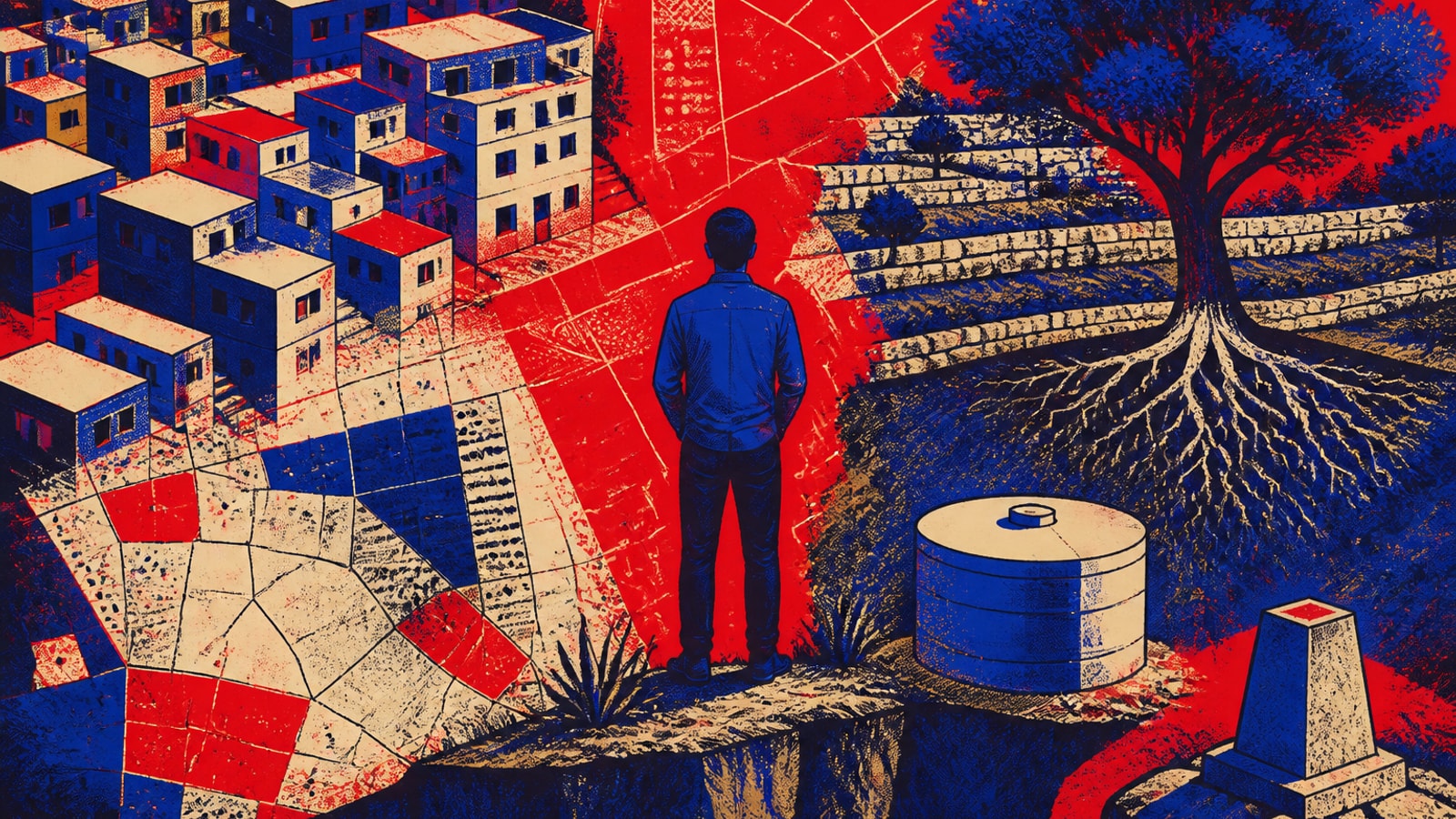
The Palestinian Central Bureau of Statistics recorded 878 persons per square kilometre for the State of Palestine in 2021, and 5,853 per square kilometre in the Gaza Strip. On the other part of the same ground, Israel’s Central Bureau of Statistics recorded a population of about 10.148 million in September 2025. The land between the Jordan River and the Mediterranean is small, roughly 27,000 square kilometres, and both national statistical agencies record growing populations inside it. Where the totals themselves are disputed, the disagreement is about which residents belong in which universe, and named researchers on each side have published their own competing figures.
Key Findings
- The Palestinian Central Bureau of Statistics reported 878 persons per square kilometre for the State of Palestine in 2021, 557 per square kilometre in the West Bank, 5,853 in the Gaza Strip, and 9,683 in the Gaza district alone.
- Israel’s Central Bureau of Statistics reported a population of about 10.148 million in September 2025, comprising roughly 7.758 million Jews and others and 2.130 million Arabs, 78.5% and 21.5% of the 9.888 million in those two groups, growing about 1.0% over the year.
- The Palestinian Academic Society for the Study of International Affairs estimated in 2022 that 7.1 million Palestinians lived inside historic Palestine, 49.9% of the population there, out of 14.3 million Palestinians worldwide by mid-2022.
- Zimmerman, Seid and Wise (2006), in a Begin-Sadat Center think-tank report, recalculated the Arab population of the West Bank and Gaza at 2.49 million for mid-2004 against the 3.83 million then reported by the Palestinian Central Bureau of Statistics, a gap of 1.34 million; the Palestinian authority’s 2017 census enumerated 4,780,978 residents.
- Fertility has fallen sharply on the Palestinian side and stayed high on the Israeli side: the World Bank’s World Development Indicators record 6.81 births per woman for the West Bank and Gaza in 1990, while Israel’s Central Bureau of Statistics reported a total fertility rate of 2.89 for Israel in 2022.
How densely do Palestinians live in the West Bank and Gaza?
The Palestinian Central Bureau of Statistics recorded 878 persons per square kilometre for the State of Palestine in its own area-and-density table for 2021. That national average conceals a wide internal range, and the Gaza figures sit far above it.
In the same 2021 table the agency reported 557 persons per square kilometre in the West Bank against 5,853 in the Gaza Strip, with the Jerusalem district at 1,365, North Gaza at 6,958 and the Gaza district at 9,683. UN-Habitat’s 2019 country profile described Palestine as “one of the highly dense countries in the world,” putting the average at 735 persons per square kilometre and Gaza above 4,500.
The figures move by publisher and by year, and the divergences are small but real. The Palestinian Academic Society for the Study of International Affairs, a Palestinian research body, reported the same 878 for 2021 and 557 for the West Bank in its 2022 fact sheet, with 5,855 for Gaza rather than 5,853. WAFA, the Palestinian Authority’s news agency, reported in 2022, on its own account, 899 persons per square kilometre for the State of Palestine, 569 in the West Bank and 6,019 in Gaza.
The population base underneath all of these is the Palestinian Central Bureau of Statistics census of 2017, which enumerated 4,780,978 residents of the West Bank and Gaza, 2,881,687 in the West Bank and 1,899,291 in Gaza. Every later total in the Palestinian, World Bank or UN series is a projection off that measured base rather than a count.
Gaza’s side of the ratio has since moved. The Palestinian Central Bureau of Statistics reported at the end of 2025 that Gaza stood at about 2.13 million against a pre-war baseline of roughly 2.2 million on 6 October 2023, a decline of about 10.6% relative to its pre-war estimates, with roughly 100,000 people having left the Strip. Those are the agency’s own estimates rather than an enumeration, and the agency presents them as a demographic net decline.
Is the land actually as small as it sounds?
It is. The Palestinian Academic Society for the Study of International Affairs estimated in its 2022 fact sheet that 7.1 million Palestinians lived inside historic Palestine, 49.9% of the total population there, out of 14.3 million Palestinians worldwide by mid-2022. The smallness of the territory is the shared term, not a feature of one side’s claim.
The land between the Jordan River and the Mediterranean covers roughly 27,000 square kilometres in total, an area smaller than Belgium and the Netherlands combined. Inside it, two statistical agencies publish two large totals. Israel’s Central Bureau of Statistics reported about 10.148 million residents in September 2025. The Palestinian Central Bureau of Statistics reported Gaza at about 2.13 million at the end of 2025, and the World Bank’s World Development Indicators put the combined West Bank and Gaza economy at about 5.29 million for 2024 and 5.41 million for 2025, projected off the 2017 census.
The two agencies’ universes overlap, which is why the totals cannot be added. Israel’s 2.130 million Arab residents, counted by its own Bureau in September 2025, are also Palestinians in the sense the 2022 Palestinian fact sheet uses, and Israel’s Bureau counts East Jerusalem residents and West Bank settlers inside Israel’s total while international monitors count them separately.
At the global level the two populations are also of comparable order. Sergio DellaPergola, in his World Jewish Population 2024 chapter in the American Jewish Year Book, put the world core Jewish population at 15,736,800 as of 1 January 2024, of which 7,153,000 lived in Israel, and reported that over 85% of the total lives in Israel and the United States. The Palestinian fact sheet’s 14.3 million worldwide, with 7.1 million inside historic Palestine, describes a population of similar size with a similar concentration in the same place. Both are estimates by named bodies using their own definitions of membership, and neither is an enumeration of a global population.
What does Israel’s own statistical record show about its population?
Israel’s Central Bureau of Statistics reported a population of about 10.148 million in September 2025, comprising roughly 7.758 million Jews and others and 2.130 million Arabs, after growth of about 1.0% over the preceding year.
Those two groups total 9.888 million, of which the counts are 78.5% and 21.5%; the balance of the national total is foreign residents, whom the Bureau counts in the total but in neither group.
The Bureau’s Independence Day release of 2025 puts that total against the founding figure: 806,000 residents in 1948, more than twelve times smaller than the present population, which the release gives as 10.094 million on a preliminary basis up to date for the end of May 2025. Over the same span more than 3.5 million immigrants arrived, of whom about 1.66 million (47.6%) arrived from 1990 onward, alongside about 154,000 immigrating citizens since 1970. In the eleven and a half months to that release, the Bureau counted about 174,000 births, about 28,000 immigrants and about 50,000 deaths, with a negative balance of 56,000 Israelis staying abroad.
The composition of that immigration is documented in the same official series. William Berthomière (1995), in the Revue Européenne des Migrations Internationales, recorded that more than 500,000 migrants arrived in Israel from the former Soviet Union from 1989, a wave large enough that Factor and Habib (1993) modelled service costs against a population rise of about 10% between 1990 and 1993. The Bureau’s 2023 release on the population of Ethiopian origin counted 168,800 such residents at the end of 2022, about 55% of them born in Ethiopia, with 1,680 immigrants arriving from Ethiopia in 2022.
The founding text states the purpose that this record measures. The Declaration of the Establishment of the State of Israel, published in Official Gazette Number 1 on 14 May 1948, declares “THE ESTABLISHMENT OF A JEWISH STATE IN ERETZ-ISRAEL, TO BE KNOWN AS THE STATE OF ISRAEL,” pledges that the state “will ensure complete equality of social and political rights to all its citizens irrespective of religion, race or sex,” and appeals to “the Arab inhabitants of the State of Israel to preserve peace and participate in the upbuilding of the State on the basis of full and equal citizenship.” The Bureau’s 2025 release records that about 45% of the world’s Jewish population lived in Israel at the end of 2023 and that about 80% of Jews in Israel were born there.
How many Palestinians are refugees or descendants of refugees?
The Palestinian Academic Society for the Study of International Affairs, reproducing the registration counts of the UN Relief and Works Agency in its 2014 fact sheet, put the number of registered Palestine refugees at close to 5 million, of whom about 1.5 million lived in refugee camps across the West Bank, Gaza, Jordan, Syria and Lebanon.
Registration is an administrative status held by descendants as well as by the originally displaced, which is why the registered figure is larger than any count of surviving 1948 refugees and why it extends across four host territories rather than one. It is a registry total maintained by the registering agency on its own eligibility rules, not a census of a resident population.
Within Gaza the refugee share is the majority. WAFA, the Palestinian Authority’s news agency, reported in 2022, on its own count, that 66% of Gaza’s population were refugees. Set beside the Palestinian statistical authority’s 5,853 persons per square kilometre for the Strip in 2021, that is the combination the question turns on: a dense population, most of it registered as displaced from elsewhere in the same territory.
Whether refugee status tracks measurable disadvantage is a narrower question with a peer-reviewed answer that cuts against the intuition. Sulayman Al-Qudsi (2000), in International Migration, compared refugee and non-refugee Palestinians in the West Bank and Gaza on education, labour-market attainment and family demography, and found refugees somewhat better educated than non-refugees while showing only slightly higher fertility. The publisher gates the full text and withholds the abstract, so the finding is carried at the level of the comparison the paper states.
The base figure underneath the refugee question is the scale of the 1948 displacement itself. Benny Morris (2004), in the second edition of The Birth of the Palestinian Refugee Problem Revisited, published by Cambridge University Press from Israeli military and state archives, carries roughly 700,000 as his own archival estimate of the number who left their homes and became refugees during the war. What that number is called, and why it happened, is where the archival literature divides.
What do historians actually dispute about the 1948 displacement?
Benny Morris (2004) and Ilan Pappé (2006) work from overlapping archival material and reach different conclusions about intent. Morris estimates roughly 700,000 displaced and attributes the exodus to multiple causes varying by locality and phase; Pappé argues the same events constituted a planned ethnic cleansing.
Morris’s account, drawn from Israeli military and state archives, names military attack and fear of attack, expulsions in certain sectors, and flight, with the mix differing by place and by stage of the war. He rejects a single master expulsion plan and equally rejects the claim that departures were voluntary. That double rejection is the load-bearing part of his conclusion, and it is why his book is cited by both sides of the argument.
Pappé’s 2006 book from Oneworld Publications states its conclusion in its title, The Ethnic Cleansing of Palestine, and argues that the displacement was planned rather than emergent. He writes as an author who states a moral position, and the book is the strongest scholarly statement of the characterisation.
The two positions are not reconciled in the literature, and the disagreement is about intent and causation rather than about the order of magnitude. Both authors work at roughly the same scale of displacement; they differ on whether the archival record documents a directed programme or a set of locally driven outcomes within a war. The Anti-Defamation League, an advocacy organisation, publishes a standing page rejecting the ethnic-cleansing characterisation, which is that organisation’s stated position rather than an archival finding.
For the question of present-day need, the consequence of the dispute is narrow. The refugee registration total, the density figures and the population counts do not depend on which reading of 1948 prevails: the registry counts the same people either way. Where the reading matters is in what the displacement is called, and that is precisely what the archival literature has not settled.
Why do the population numbers themselves get disputed?
Zimmerman, Seid and Wise (2006), in a Begin-Sadat Center for Strategic Studies report, recalculated the Arab population of the West Bank and Gaza at 2.49 million for mid-2004 against the 3.83 million then reported by the Palestinian Central Bureau of Statistics, a gap of 1.34 million they characterised as a roughly 50% overstatement.
Their itemisation attributes the gap to 325,000 residents living abroad, 210,000 East Jerusalem Arabs also counted in Israel’s own survey, a 113,000 unexplained jump over prior Israeli records, 238,000 in unmet birth forecasts, 70,000 in retroactively altered birth data, and a 310,000 error in immigration against emigration. The report is not peer-reviewed, was led by a business consultant, a historian and a physicist, and carries an explicit policy thesis, that Israel’s demographic time bomb is overstated. Yakov Faitelson (2009) restated it in Middle East Quarterly, adding that the 1997 census included 325,253 Arab emigrants and that the 2007 census double-counted about 208,000 East Jerusalem residents, while noting that the Palestinian Authority criticised the same 2007 census for undercounting East Jerusalem, so the objection runs in both directions.
Sergio DellaPergola of the Hebrew University of Jerusalem, in the paired 2005 Jerusalem Issue Brief with Bennett Zimmerman, built his Palestinian estimate from Israeli rather than Palestinian data and still reached about 3.4 million for the West Bank and Gaza, close to the official figures under dispute, putting the Jewish share at roughly 54% of about 10.3 million and treating the fertility differential rather than the head-count as the decisive long-run factor. Ian Lustick (2013), in a peer-reviewed audit in The Middle East Journal, traced how the claim of 1 million to 1.5 million nonexistent Palestinians was assembled, concluded that it rests on “complex but systematic manipulation of data,” and documented that it was tied to proposals to annex 60% or more of the West Bank.
The Israeli side of the ledger has its own definitional history. Sivan Hirsch-Hoefler and Lihi Ben Shitrit (2020) document that the Central Bureau of Statistics Yearbook moved East Jerusalem into the general population count for Israel proper in the 1968 edition, folded settlers into Israel’s total by a 1970 footnote, counted settlement localities among Israeli localities by 1983, and removed the separate territories chapter in 1997, a trend they call the normalisation of settlements. The Bureau’s own 2024 Jerusalem Day release reports that the city passed one million residents at the end of 2023 and that 39.5% of them were Arabs, all inside Israel’s total. Both agencies publish coherent numbers; they publish them for different universes, which is the mechanism behind the disputed population totals.
| Count for the West Bank and Gaza | Figure | Source and type |
|---|---|---|
| 1997 census, enumerated | 2,895,683 | Palestinian Central Bureau of Statistics, official record |
| Recalculated total for mid-2004 | 2.49 million | Zimmerman, Seid and Wise, 2006, think-tank report, not peer-reviewed |
| Estimate for 2005 built from Israeli data | about 3.4 million | DellaPergola, in Zimmerman and DellaPergola, 2005, policy brief |
| 2017 census, enumerated | 4,780,978 | Palestinian Central Bureau of Statistics, official record |
| 2024 series total | 5.29 million | World Bank World Development Indicators, 2024, projection off the 2017 census |
Why is density rising for both populations at once?
Israel’s Central Bureau of Statistics reported a total fertility rate of 2.89 children per woman for 2022, alongside 181,193 live births and population growth of 2.2%. The Palestinian rate has fallen a long way from its own earlier level and remains above it.
The Palestinian decline is documented in official inputs. The World Bank’s World Development Indicators record 6.81 births per woman for the West Bank and Gaza in 1990. Sumour and colleagues (2007), in an arXiv preprint reporting Palestinian Central Bureau of Statistics figures, carry 6.77 for 1992, 6.06 for 1994 and 5.93 for 1999, with an official projection near 3.06 for 2025. Marwan Khawaja (2000), in Population Studies, found the fertility transition well underway in the West Bank since about 1985 with a lull during the first Intifada, and no clear sign of a transition in Gaza on data through 1992, attributing the measured rise he examined chiefly to changes in marital structure and to higher marital fertility among younger women.
Inside Israel the group rates have converged. The Central Bureau of Statistics reports in its official series that the Jewish and Muslim rates now sit within about a tenth of a child of each other, with the Christian and Druze rates below replacement: 1.61 for Christian women in 2024 and 1.85 for Druze women in 2022, down from a Druze peak of 7.92 in 1964. L. Daniel Staetsky (2019), in Population Studies, decomposed the Israeli Muslim stall, recording a fall from nearly 10 children per woman in the mid-1960s to about 4.5 in the mid-1980s and then a plateau near 4.5 for roughly two decades, which he attributes to abrupt discontinuations in the declines of both the proportion married and marital fertility.
Why the Jewish rate stays high is a live scholarly disagreement. Barbara Okun (2016), in Population Studies, finds that secular, native-born Jewish women hold above-replacement fertility despite high socio-economic status, and attributes it to a constellation of state and family support, strong familism, and relatively egalitarian gender relations, with nationalism one factor among several. Shenhav-Goldberg, Brym and Lenton-Brym (2019), in the Canadian Review of Sociology, read the same anomaly as driven by religious and nationalist sentiment heightened by a perceived demographic threat, together with the world’s most extensive publicly funded in vitro fertilisation system. Philippe Fargues (2000), in Population and Development Review, had already argued that fertility on both sides tracks national conflict and pronatal sentiment rather than a smooth modernisation curve, and that it was framed as national strength by Palestinians and Israelis alike. Whichever reading holds, the narrowing gap between the two birth rates means the numerator of the density ratio keeps rising while the denominator does not.
How much of the West Bank do Palestinians administer today?
Sergio DellaPergola’s World Jewish Population chapter for 2019 records that at the beginning of that year 418,900 Jews lived in the West Bank, according to Israeli demographic data.
Out of Israel’s 6,665,600 core Jews, DellaPergola also records 221,800 living in East Jerusalem neighbourhoods incorporated after 1967, 23,200 on the Golan Heights, and 6,001,700 inside Israel’s pre-1967 borders.
That decomposition exists because the two conventions for counting the same ground differ. Israel’s Central Bureau of Statistics reports these residents inside Israel’s national total, as Hirsch-Hoefler and Ben Shitrit (2020) document across the Yearbook editions from 1968 onward. B’Tselem, an Israeli human-rights organisation with an advocacy mission, publishes its West Bank settlement count and its count for the annexed East Jerusalem neighbourhoods as separate series, the counterpart convention used by international monitors. The two conventions produce different totals from the same residents.
The Bureau also excludes localities that other Israeli bodies count. Hirsch-Hoefler and Ben Shitrit (2020) record that unrecognised outposts fall outside the Bureau’s settlement figures, with Peace Now, an Israeli organisation, documenting about 121 of them in 2019, and that a Green Line straddling locality such as Shani Livne is placed by the Bureau in Israel’s South District while Peace Now and B’Tselem count it as a settlement. Israel’s own commissioned reviews and Supreme Court rulings on unauthorized outposts are the official and judicial record on that category.
Inside Jerusalem the same counting choice is visible in a single municipal figure. The Bureau’s 2024 Jerusalem Day release records that the city surpassed one million residents at the end of 2023, 60.5% of them Jews and others and 39.5% Arabs, growing by 13,400 during the year, with the East Jerusalem neighbourhoods annexed after 1967 counted as part of that one municipal population.
No figure for the share of West Bank land under Palestinian administration appears here as an established total: the sources in this report measure population and territory of residence rather than administrative jurisdiction over land area, and the density figures above are computed by the Palestinian statistical authority over the full area of the West Bank and Gaza rather than over the portion administered from Ramallah.
Does conflict coverage measurably change attitudes toward Jews?
Harber, Bulska, Malloy and Vila (2026), writing in American Psychologist, report that their Conspiracies Mediated Model of New Antisemitism accounted for over 55% of the variance in anti-Israel attitudes, with conspiracy beliefs implicating Israel and Zionists carrying the association.
The finding held across three preregistered studies with 373, 243 and 493 participants, according to Harber, Bulska, Malloy and Vila.
In those studies, conspiracy beliefs about Jews unrelated to Israel did not mediate the association, and a general conspiratorial mindset did not explain the results. The authors also report that Democrats, compared with Republicans, expressed less antisemitism but stronger anti-Israel attitudes and greater endorsement of anti-Israel and anti-Zionist conspiracy beliefs. The findings are correlational and the figures come from the published abstract.
Exposure alone does not appear to carry the effect. Huesmann, Dubow, Boxer, Souweidane and Ginges (2012), in the Journal of Research on Adolescence, surveyed 89 Jewish American and 180 Arab American high-school students on media exposure to the Israeli-Palestinian conflict and on implicit and explicit ethnic stereotypes. Total media exposure did not directly predict stereotypes; the association ran through identification with the groups as portrayed in the media, and ethnic identity correlated with implicit out-group stereotyping at r = -0.70. Both groups held more negative stereotypes about the out-group than the in-group.
Ozer, Obaidi and Bergh (2025), in the International Journal of Intercultural Relations, primed British samples of 354 and 490 participants with war-in-Gaza material and measured hostility toward Jews and other ethnic groups. They report two distinct pathways: political orientation was positively associated with anti-Jewish hostility and antisemitism through social dominance orientation, a classical right-wing route, while conservative political orientation was negatively associated with antisemitism through out-group identity fusion with the Palestinian people, an identity-based route that conflates attitudes toward Israel with prejudice toward Jews. The authors state the associations as correlational, and the experiments measure primed attitudes in two British samples rather than population prevalence.
Methodology
This report answers a question about the relationship between two populations and one territory using each side’s own official statistical record plus peer-reviewed demographic and psychological research.
The source types are labelled where they are used. Official and primary records include the Palestinian Central Bureau of Statistics 2017 census and its area-and-density table for 2021, the Israel Central Bureau of Statistics releases for Rosh Hashana 5786 (2025), Independence Day 2025, Jerusalem Day 2024, Israel in Figures 2023, the Druze and Christian population releases, and the population of Ethiopian origin release for 2023, the World Bank’s World Development Indicators for 2024, and the Declaration of the Establishment of the State of Israel of 14 May 1948. Peer-reviewed research supplies the fertility, refugee-comparison and attitudinal findings. Two sources are party reporting and are attributed as such: WAFA is the Palestinian Authority’s news agency and its density and refugee-share figures are its own counts, and the Palestinian Academic Society for the Study of International Affairs is a Palestinian research body reporting its own estimates and reproducing UN Relief and Works Agency registration totals. UN-Habitat’s 2019 country profile is a UN programme report. Zimmerman, Seid and Wise (2006) and Faitelson (2009) are think-tank publications that are not peer-reviewed and that carry a stated policy thesis; Lustick (2013) is the peer-reviewed audit of that thesis.
Several limits bear on the figures. Every Palestinian population total after 2017 is a projection off the 2017 census rather than a count, East Jerusalem was not directly enumerated in that census and was estimated administratively, and Palestinian figures before 1997 have no census basis. The Palestinian authority’s end-2025 Gaza estimate is an estimate rather than an enumeration, and its own absolute-change figure does not reconcile with its stated endpoints, so only the percentage and the endpoints are used. Israel’s Central Bureau of Statistics counts East Jerusalem residents and West Bank settlers inside Israel’s total, a scope choice distinct from the convention international monitors use, and its Independence Day figures are preliminary. Where a density figure is quoted, its area denominator is the publishing agency’s own; the approximate 27,000 square kilometre total for the land between the Jordan River and the Mediterranean is a geographic approximation used for scale only and is not drawn from either statistical agency.
Where the literature disagrees, both positions are named: Morris (2004) against Pappé (2006) on the causation of the 1948 displacement, Okun (2016) against Shenhav-Goldberg, Brym and Lenton-Brym (2019) on the drivers of Israeli fertility, and Zimmerman, Seid and Wise (2006) against DellaPergola (2005) and Lustick (2013) on the Palestinian head-count. Abstract-sourced entries, including Harber and colleagues (2026) and Al-Qudsi (2000), carry only the detail their abstracts or stated comparisons supply. The findings in the final section are correlational and are reported with the samples and caveats their authors state.
Conclusion
So is this a tiny sliver of land, and does the second population have a comparable stake in it? The land is small, on that the premise is right, and the records show that the smallness is the shared term of the problem rather than one side’s claim about it. The Palestinian statistical authority measures 878 persons per square kilometre across the State of Palestine and 5,853 in the Gaza Strip, and Israel’s Central Bureau of Statistics measures 10.148 million residents on the other part of the same roughly 27,000 square kilometres.
The rest of the record is a set of two-sided facts. Two populations of comparable order, 7.1 million Palestinians inside historic Palestine by the 2022 Palestinian estimate and 7.758 million Jews and others in Israel by the Bureau’s September 2025 count, sit on the same ground. Both are populations assembled partly by movement: more than 3.5 million immigrants to Israel since 1948, more than 500,000 from the former Soviet Union alone from 1989, against close to 5 million registered Palestine refugees and 66% of Gaza’s residents recorded by the Palestinian Authority’s own agency as refugees. Both statistical agencies count residents the other counts too, and the disputes over the totals, from the 1.34 million gap Zimmerman, Seid and Wise published in 2006 to the Yearbook conventions Hirsch-Hoefler and Ben Shitrit traced in 2020, run in both directions. And on both sides the ratio is tightening from births, not only from land: 2.89 children per woman in Israel in 2022, and a Palestinian rate that has fallen from 6.81 in 1990 yet remains above it.
What follows from that is the part the numbers sharpen without settling. When one population’s attachment to this ground is treated as intelligible and the other’s as puzzling, the puzzlement itself becomes a frame, and framing is measurable: Ozer, Obaidi and Bergh found in 2025 that priming British participants with war material moved hostility toward Jews along two separate pathways, and Harber and colleagues found in 2026 that conspiracy beliefs implicating Israel and Zionists carried over 55% of the variance in anti-Israel attitudes. Two peoples, one small territory, and a public argument in which each side’s need is routinely explained away as something other than need. Is that habit of explaining away one of the inputs that feeds the attitudes those studies measured? The density tables cannot say. They can only say that both sets of figures were produced by counting the same ground twice.
Frequently Asked Questions
When was the last actual census in the Palestinian territories?
The Palestinian Central Bureau of Statistics conducted its census with a reference date of 1 December 2017, the third round after 1997 and 2007, enumerating 4,780,978 residents. Every Palestinian, World Bank or UN figure for a later year is a projection off that base rather than a count, and East Jerusalem was estimated administratively rather than directly enumerated.
How does Israel’s statistical bureau define “Jews and others” and “Arabs”?
The Central Bureau of Statistics defines “Others” as non-Arab Christians, other religions and those registered as not classified by religion, grouped with Jews, and defines “Arabs” as Moslems, Arab Christians and Druze. On that definition its 2025 Rosh Hashana release reported 7.758 million Jews and others and 2.130 million Arabs, 78.5% and 21.5% of the 9.888 million in those two groups.
Which international series should be used for the Palestinian population?
The UN Population Division’s World Population Prospects 2024 covers the State of Palestine and the World Bank’s World Development Indicators cover the West Bank and Gaza; the two denote the same territory under different names. The World Bank series gives about 5.29 million for 2024 and about 5.41 million for 2025, and Gaza is not published as a separate area in either series.
Why do Israeli group fertility rates matter to the density figures?
Because the composition of Israeli fertility has changed. The Central Bureau of Statistics reports that the Jewish and Muslim rates have converged to within about a tenth of a child, while Christian and Druze rates are below replacement, at 1.61 for Christian women in 2024 and 1.85 for Druze women in 2022. Group-level convergence, not one group’s rate, drives the national figure of 2.89 for 2022.
Which scholars disagree about why Israeli fertility is unusually high?
Barbara Okun (2016), in Population Studies, attributes the above-replacement fertility of secular, native-born Jewish women to a constellation of state and family support, strong familism and relatively egalitarian gender relations. Shenhav-Goldberg, Brym and Lenton-Brym (2019), in the Canadian Review of Sociology, attribute it primarily to religious and nationalist sentiment plus state-funded in vitro fertilisation. The two readings of the same anomaly are unreconciled.
Are Palestinian refugees economically worse off than non-refugees?
Not on the measure Sulayman Al-Qudsi published in International Migration in 2000, which found refugees in the West Bank and Gaza somewhat better educated than non-refugees while showing only slightly higher fertility. The publisher gates the full text, so the finding is carried at the level of the refugee-versus-non-refugee comparison the paper states rather than as quoted figures.
Why can the Israeli and Palestinian population totals not simply be added?
Because their universes overlap. Israel’s Central Bureau of Statistics counts East Jerusalem residents and West Bank settlers inside Israel’s total, while B’Tselem and other monitors count the West Bank and annexed East Jerusalem as separate series, and Israel’s 2.130 million Arab residents also fall within the 7.1 million Palestinians the 2022 Palestinian fact sheet places inside historic Palestine.
Sources
- Al-Qudsi, S. S., 2000. Profiles of Refugee and Non-Refugee Palestinians from the West Bank and Gaza. International Migration, 38(4), pp. 79 to 107. DOI 10.1111/1468-2435.00121. Peer-reviewed.
- Berthomière, W., 1995. The migration of Jews from the former Soviet Union: a new challenge for Israel? Revue Européenne des Migrations Internationales, 11(3), pp. 19 to 41. PMID 12347243. Peer-reviewed.
- DellaPergola, S., 2019. World Jewish Population, 2019. American Jewish Year Book 2019, vol. 119, Springer. Berman Jewish DataBank reprint. Academic reference.
- DellaPergola, S., 2025. World Jewish Population, 2024. American Jewish Year Book 2024, Springer. Academic reference.
- Factor, H. and Habib, J., 1993. A model of the impact of immigration on health and social service expenditures for the elderly. Public Finance, 48(Supplement), pp. 147 to 177. PMID 12233616. Peer-reviewed.
- Faitelson, Y., 2009. The Politics of Palestinian Demography. Middle East Quarterly, 16(2), pp. 51 to 59. Think-tank periodical, not peer-reviewed.
- Fargues, P., 2000. Protracted National Conflict and Fertility Change: Palestinians and Israelis in the Twentieth Century. Population and Development Review, 26(3), pp. 441 to 482. DOI 10.1111/j.1728-4457.2000.00441.x. Peer-reviewed.
- Harber, K., Bulska, D., Malloy, T. and Vila, J., 2026. Antisemitism, Conspiracy Beliefs, and Anti-Israel Attitudes. American Psychologist. DOI 10.1037/amp0001635. Peer-reviewed, abstract-sourced.
- Hirsch-Hoefler, S. and Ben Shitrit, L., 2020. So, how many settlements are there? Counting, tracking, and normalizing Jewish settlements in the Israeli Central Bureau of Statistics Yearbook, 1967 to the present. POMEPS. Organizational report, not peer-reviewed.
- Huesmann, L. R., Dubow, E., Boxer, P., Souweidane, V. and Ginges, J., 2012. Foreign Wars and Domestic Prejudice. Journal of Research on Adolescence, 22(3). DOI 10.1111/j.1532-7795.2012.00785.x. Peer-reviewed.
- Israel Central Bureau of Statistics, 2023. The Population of Ethiopian Origin in Israel. Media Release 362/2023. cbs.gov.il. Official record.
- Israel Central Bureau of Statistics, 2024. Israel in Figures 2023: Selected Data From the Statistical Abstract of Israel. cbs.gov.il. Official record.
- Israel Central Bureau of Statistics, 2024. Selected Data on the Occasion of Jerusalem Day, 2024. Media Release 165/2024. cbs.gov.il. Official record.
- Israel Central Bureau of Statistics, 2024. The Druze Population of Israel on the Occasion of the Nabi Shu’ayb Festival 2024. Media Release 124/2024. cbs.gov.il. Official record.
- Israel Central Bureau of Statistics, 2024. Total Fertility Rate by Population Group; Israel in Figures 2024. cbs.gov.il. Official record.
- Israel Central Bureau of Statistics, 2025. Christmas 2025, Christians in Israel. Media Release 413/2025. cbs.gov.il. Official record.
- Israel Central Bureau of Statistics, 2025. Israel’s Independence Day 2025. Media Release 134/2025. cbs.gov.il. Official record.
- Israel Central Bureau of Statistics, 2025. Population of Israel on the Eve of Rosh Hashana 5786. Media Release 304/2025. cbs.gov.il. Official record.
- Khawaja, M., 2000. The recent rise in Palestinian fertility: permanent or transient? Population Studies, 54(3), pp. 331 to 346. DOI 10.1080/713779091. Peer-reviewed.
- Lustick, I. S., 2013. What Counts is the Counting: Statistical Manipulation as a Solution to Israel’s “Demographic Problem.” The Middle East Journal, 67(2), pp. 185 to 205. DOI 10.3751/67.2.12. Peer-reviewed.
- Morris, B., 2004. The Birth of the Palestinian Refugee Problem Revisited, 2nd edition. Cambridge University Press. ISBN 978-0521009676. Scholarly book, archival history.
- Okun, B. S., 2016. An investigation of the unexpectedly high fertility of secular, native-born Jews in Israel. Population Studies, 70(2), pp. 239 to 257. DOI 10.1080/00324728.2016.1195913. Peer-reviewed.
- Ozer, S., Obaidi, M. and Bergh, R., 2025. The Impact of Globalized Conflicts: Examining Attitudes Toward Jews Among Britons in the Political Context of the War in Gaza. International Journal of Intercultural Relations, 107. DOI 10.1016/j.ijintrel.2025.102184. Peer-reviewed, abstract-sourced.
- Palestinian Academic Society for the Study of International Affairs, 2014. Population fact sheet. passia.org. Palestinian research body, reproducing UN Relief and Works Agency registration counts.
- Palestinian Academic Society for the Study of International Affairs, 2022. Population fact sheet. passia.org. Palestinian research body, own estimates.
- Palestinian Central Bureau of Statistics, 2018. Population, Housing and Establishments Census 2017, final results. Ramallah. pcbs.gov.ps. Official record.
- Palestinian Central Bureau of Statistics, 2021. Area, Population, and Population Density in Palestine by Governorate. pcbs.gov.ps. Official record.
- Palestinian Central Bureau of Statistics, 2025. A Brief on the Status of the Palestinian People at the End of 2025. pcbs.gov.ps. Official record.
- Pappé, I., 2006. The Ethnic Cleansing of Palestine. Oneworld Publications. Scholarly book, author states a moral position.
- Provisional Government of Israel, 1948. Declaration of the Establishment of the State of Israel. Official Gazette Number 1, Tel Aviv, 14 May 1948. Knesset English text. Primary record.
- Shenhav-Goldberg, R., Brym, R. and Lenton-Brym, T., 2019. Family Welfare Effort, Total Fertility, and In Vitro Fertilization: Explaining the Israeli Anomaly. Canadian Review of Sociology, 56(3), pp. 421 to 438. DOI 10.1111/cars.12255. Peer-reviewed.
- Staetsky, L. D., 2019. Stalling Fertility Decline of Israeli Muslims and the Demographic Transition Theory. Population Studies, 73(3), pp. 317 to 333. DOI 10.1080/00324728.2019.1622765. Peer-reviewed.
- Sumour, M. A., El-Astal, A. H., Shabat, M. M. and Radwan, M. A., 2007. Simulation of Demographic Change in Palestinian Territories. arXiv:0705.4427. Preprint, reporting Palestinian Central Bureau of Statistics fertility inputs.
- UN Department of Economic and Social Affairs, Population Division, 2024. World Population Prospects 2024. population.un.org/wpp. Official record, dataset.
- UN-Habitat, 2019. Profile for the State of Palestine. unhabitat.org. UN programme report.
- WAFA, 2022. Reporting on Palestinian population and density. english.wafa.ps. Palestinian Authority news agency, a party’s own reporting.
- World Bank, 2024. World Development Indicators, Israel and West Bank and Gaza. data.worldbank.org. Official compiled statistical series.
- Zimmerman, B. and DellaPergola, S., 2005. What is the True Demographic Picture in the West Bank and Gaza? A Presentation and a Critique. Jerusalem Issue Brief, 4(19), Jerusalem Center for Public Affairs. Organizational policy brief.
- Zimmerman, B., Seid, R. and Wise, M. L., 2006. The Million Person Gap: The Arab Population in the West Bank and Gaza. Mideast Security and Policy Studies, Begin-Sadat Center for Strategic Studies, Bar-Ilan University. Think-tank report, not peer-reviewed.