
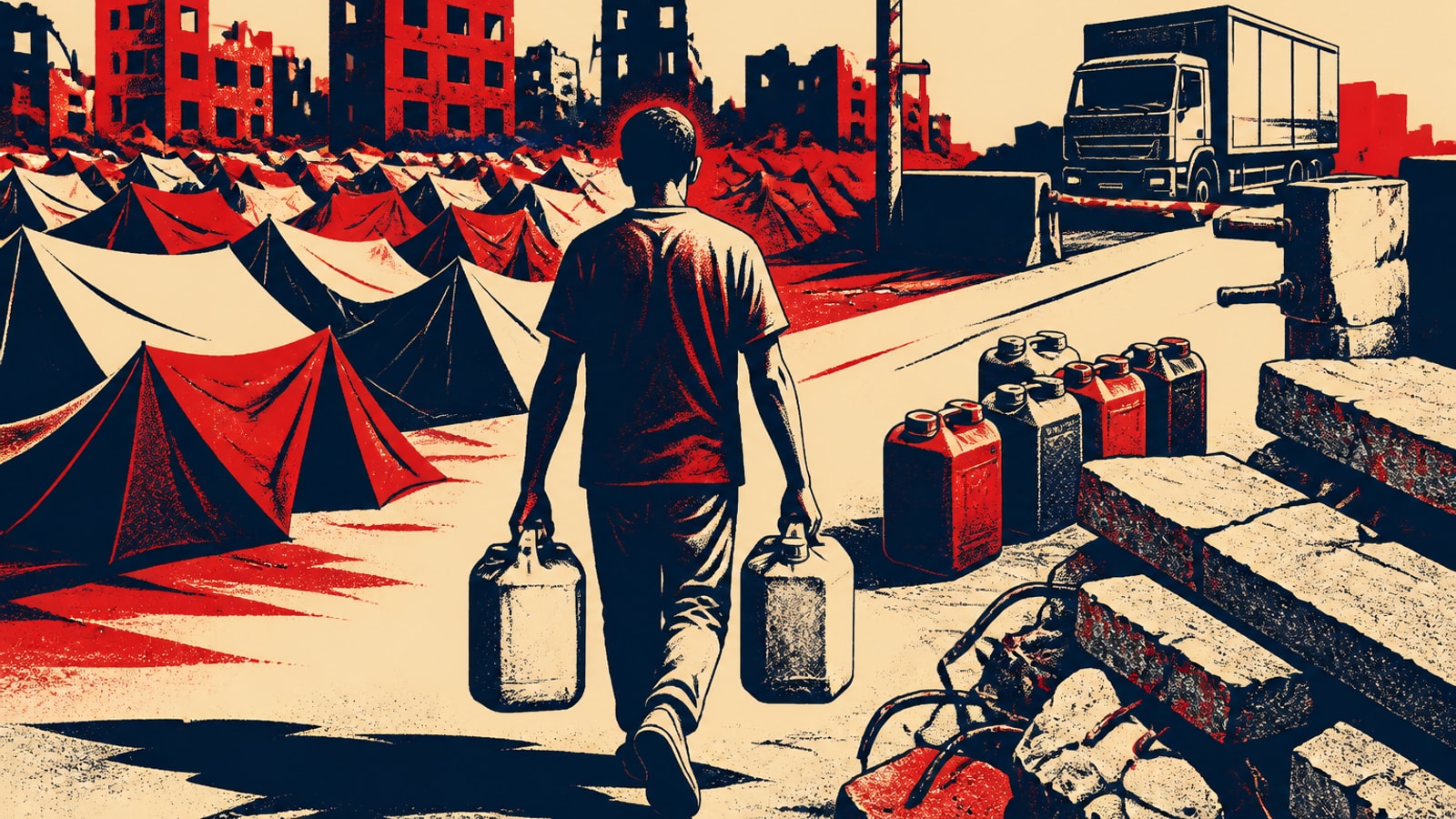
UNICEF reported in July 2026 that “most of the population, 1.9 out of 2.1 million people, [have been] displaced,” attributing the figure in its own footnote to “a UN estimate in 2025” and adding that many of them were displaced “several times.” Months into a ceasefire announced on 10 October 2025, the published counts do not describe a settled territory: the Gaza Ministry of Health recorded 881 fatalities in the period after the announcement through 20 May 2026, and the Gaza Strip Rapid Damage and Needs Assessment, published jointly by the World Bank, the European Union and the United Nations, put recovery and reconstruction needs at US$71.4 billion in its 2026 edition. Anyone asking what Gaza looks like now is asking a question that six different kinds of body answer with six different measurements, each narrower than the phrase itself.
Key Findings
- 1.9 million of about 2.1 million people have been displaced, in a figure UNICEF relays in July 2026 and attributes in its own footnote to “a UN estimate in 2025,” describing people displaced “many of them several times.” It is a cumulative count of people ever displaced, not a count of people currently displaced, and UNICEF names no measuring body for it.
- The shelter figures for the displaced could not be traced to their primary. The displacement-site counts circulate through a UN humanitarian relay of a coordination cluster’s reporting, which this report could not retrieve directly, so they are described in the body with that limitation stated and are not carried as a finding here.
- Nearly 90% of water and sanitation infrastructure has been damaged or destroyed, in a sentence UNICEF publishes with no source, no date and no stated denominator, so what the share is a share OF cannot be established from the document. The 82% water-insecurity figure it carries alongside was measured by the WASH Cluster on 342 assessed households, not by UNICEF and not on the population.
- No body publishes a cumulative post-ceasefire fatality total for Gaza on a single stated method. The Gaza Ministry of Health registry, the UN humanitarian office’s relay of it and the event-coded conflict datasets each close on different dates and count different units, and the event-coded projects publish monthly situation notes rather than a running total for the period.
- Recovery and reconstruction needs stand at US$71.4 billion, against US$35.2 billion in recorded physical damage and US$22.7 billion in economic losses, according to the Gaza Strip Rapid Damage and Needs Assessment, published jointly by the World Bank, the European Union and the United Nations,, 2026.
What do the latest counts record in Gaza today?
UNICEF reported in July 2026 that 1.9 million of the Gaza Strip’s approximately 2.1 million people have been displaced.
It relays that as a 2025 UN estimate and attributes it to no named body. The figure covers people displaced at any point and many of them repeatedly, describing people living somewhere other than their home, is the number that carries most of what the phrase “the situation in Gaza” is reaching for, and it is the figure a named body publishes with a date attached.
The casualty registry sits alongside it. The Palestinian Ministry of Health, whose figures the UN Office for the Coordination of Humanitarian Affairs relays in its situation reporting, recorded 72,619 people killed and 172,484 injured in the Gaza Strip between 7 October 2023 and 6 May 2026. That is a health ministry’s own registry, compiled by an authority that is a party to the conflict, and it is reported here as that authority’s own count rather than as an independently verified total. The same office’s humanitarian situation reports of 25 May 2026 and 16 July 2026 record continued airstrikes, shelling and gunfire, and water quality that remains unsafe.
The three descriptions do not measure the same thing. Displacement is a count of people, taken against a population base. The casualty registry is a cumulative count of deaths reported through health facilities across thirty-one months. The situation reports are qualitative observation of conditions in a given fortnight. A reader who wants one number for Gaza is asking for something no body publishes, because no body measures a territory in aggregate; each measures the slice its mandate covers.
What the counts share is direction and date. Every named figure in this report post-dates the October 2025 ceasefire announcement or extends through it, and none of them describes a population that has returned home, a health system that has resumed normal function, or a housing stock that has been rebuilt. The rest of this report takes the components in turn, naming who measured each one and what the measurement covers. The distinctions between the bodies that count Gaza’s civilians are set out at greater length in the Institute’s report on what each body counts.
Is the ceasefire holding, and what has been recorded since?
The Gaza Ministry of Health recorded 881 fatalities and 2,621 injuries between the 10 October 2025 ceasefire announcement and 20 May 2026, its own registry count as a party to the conflict. It is commonly said that a ceasefire framework is in place while violence continues, and on the counts that different bodies publish for the same period, that is what the record holds.
Two other counts of the post-announcement period exist and neither matches the first. The UN Office for the Coordination of Humanitarian Affairs, citing local health authorities, reported at least 1,000 Palestinians killed since the announcement, a figure stated as a floor. No event-coded conflict dataset publishes a cumulative total for the same period; the projects that cover Gaza issue monthly situation notes instead, so there is no third figure to set beside these two.
So the concession the question invites is straightforward. A ceasefire framework was announced, and the recorded counts of death and injury did not stop at the announcement. All three named sources agree on that direction; they disagree on magnitude by a margin of about a third between the lowest and the highest, which is the subject of a later section here.
What has changed is the composition of the reporting. Before October 2025, the UN humanitarian office’s situation reports described sustained major military operations. The 25 May 2026 and 16 July 2026 reports describe continued airstrikes, shelling and gunfire alongside a partial resumption of commercial and humanitarian supply, and they describe shelter conditions as dire. The Council on Foreign Relations, in its 2026 conflict tracking, describes Israel as having withdrawn to a predetermined line while retaining control of the majority of the territory.
The Israeli Ministry of Foreign Affairs, in its position statement last updated 17 September 2025, sets out the objectives Israel states for its deployment, and reports as of 14 September 2025 that 207 hostages had returned or been recovered, 148 alive and 59 deceased, with 48 remaining in captivity. Those are Israel’s own figures, published by a party to the conflict, and they predate the ceasefire announcement by under a month.
Where are Gaza’s displaced residents living now?
Roughly 1.7 million people are reported to be sheltering in displacement sites, with nearly 88% of them in temporary shelters.
That figure reaches this report through the UN humanitarian office’s relay of a site-management coordination cluster, and the cluster’s own reporting could not be retrieved to check it, so it is stated here with that limitation rather than carried as a finding. The share is of the displacement-site population, not of Gaza’s residents overall, the publisher writes it as “nearly” 88% rather than as an exact total, and its relay gives the same population as both about 1.7 million people and 354,480 households, which are different units.
The two figures are not two measurements of one quantity and no publisher reconciles them. The 1.9 million is cumulative, covering people displaced at any point since the war began and many of them more than once, and it is a 2025 estimate carried into a 2026 document. The 1.7 million counts people in displacement sites at a stated date. Subtracting one from the other would produce a residual neither body publishes and neither method supports, so this report does not perform that subtraction.
The temporary-shelter share is the load-bearing detail because it distinguishes displacement from housing. A temporary shelter, in the cluster’s usage, covers tents, tarpaulin structures and comparable makeshift arrangements, as distinct from a repaired or intact building. On that measure, the great majority of the site population is in structures not built to last a season, more than a year and a half after the largest wave of displacement and months after the ceasefire announcement.
The UN humanitarian office’s 2026 situation reports describe those conditions as dire, and record the constraints on improving them: restricted entry of shelter materials, damage to the housing stock, and the scale of the return that would be required. What the published record does not contain is a count of how many displaced people have returned to a permanent home since October 2025. No named body publishes that figure, and its absence is why displacement in Gaza is still reported as a stock rather than as a flow.
How much of the water and sanitation system still works?
Nearly 90% of Gaza’s water and sanitation infrastructure has been damaged or destroyed, in UNICEF’s July 2026 wording.
UNICEF attaches no source, no date and no denominator to that sentence, so the asset class it counts, whether wells, networks, desalination plants or latrines, and the pre-war baseline it measures against are both unstated. That is a share of the infrastructure, not of the population, and it is the measured figure behind the widely repeated statement that water access has improved in places while remaining unsafe.
The population-side figures UNICEF relays run alongside it, and they were measured by the WASH Cluster rather than by UNICEF. 82% of ASSESSED HOUSEHOLDS were classified water insecure on the WISE-12 scale over a 30-day recall window, in a phone survey of 342 households conducted between 2 and 15 March 2026 whose authors state that its findings “cannot be considered representative of the population in Gaza.” Up to 70% cannot access 6 litres of water per person per day, a threshold below the 15 litres commonly used as an emergency minimum in humanitarian planning. The three shares have three different denominators, and they are not additive: infrastructure, families, and individuals are separate bases.
The health consequence appears in the UN humanitarian office’s 2026 situation reports, which record water quality still unsafe and diarrhoea and hepatitis A spreading. Those are reported observations from health surveillance rather than a measured incidence rate, and no named body publishes a case count for either condition in the post-ceasefire period.
COGAT, the Israeli Ministry of Defense unit that coordinates entry into the Strip, states in its July 2026 report that more than 70,000 cubic metres of water per day are facilitated into Gaza through external water lines and desalination facilities, excluding local wells. That is Israel’s own operational count, published by a party to the events, and it measures supply facilitated rather than water reaching households or meeting a quality standard. Set against a population of roughly 2.1 million, 70,000 cubic metres would be about 33 litres per resident per day at the point of entry, which is the arithmetic the figure supports and not a statement about consumption. The two measurements, supply facilitated and access achieved, are the two ends of a distribution system that UNICEF records as nearly nine-tenths damaged.
Are hospitals, fuel and aid supply functioning during the ceasefire?
COGAT recorded 1,778,363 metric tons of food entering the Gaza Strip between 10 October 2025 and 7 June 2026, its own count as a party to the events it describes, based on self-declaration by humanitarian organisations and private providers rather than weighing at the crossings. Over the same ceasefire period the UN Office for the Coordination of Humanitarian Affairs, in its 16 July 2026 situation report, recorded fuel shortages threatening hospitals, ambulances, water systems, bakeries and communications.
Both statements are on the record and neither displaces the other. COGAT’s July 2026 report sets its food tonnage at nearly three times the World Food Programme’s monthly requirement benchmark, a ratio in which only the numerator is COGAT’s own measurement. The same report records 18,000 tons of medical supplies and medicines entering since the ceasefire began, and a decline of approximately 72% in the Gaza food consumer price index between September 2025 and May 2026, against its September 2025 level. COGAT does not identify the source of the price data.
The Israel Defense Forces, on its own humanitarian aid page dated 19 August 2025, states that more than 1.9 million tons of aid had been delivered since the start of the war, including 7,800 tons by the aerial route. Those are floors as published, not exact totals, and they are the military’s own self-reported counts.
What the entry figures do not measure is distribution, and that is where the humanitarian reporting sits. Fuel constrains hospital generators, ambulance movement, water pumping and bakery operation simultaneously, so a shortage registers across every service at once regardless of how much food crossed a border in the same month. The UN humanitarian office also records medical evacuations out of Gaza as limited, without publishing a monthly evacuation count for the ceasefire period.
Neither side of this publishes the number that would reconcile it: no named body reports tonnage received at distribution points against tonnage entered at crossings. The gap between a supply figure and a service figure is the reason the two descriptions of Gaza’s aid situation can both be accurate and still not meet. The Institute has examined the legal framing around aid entry in a separate report on aid restrictions.
Who controls which parts of Gaza now?
Seth J. Frantzman wrote on 26 June 2026 that “as of early June 2026, around two million Gaza civilians continue to live under Hamas rule in around 40% of Gaza.”
He adds that “the rest of Gaza is controlled by the Israel Defence Forces,” the two parts separated by what Israel calls the Yellow Line. That is a signed opinion column, published by the Australia/Israel Jewish Affairs Council and republished the same day by the Foundation for Defense of Democracies, both of which are advocacy organisations. It carries no mapping exercise, no imagery analysis and no stated method, and the author hedges the share as “around” in each of the three places he gives it.
The same column quotes Israel’s prime minister saying “we are now in 60% of the territory of the Gaza Strip,” a party’s own stated share that no party publishes as a mapped delimitation. The Council on Foreign Relations, in its 2026 conflict tracking, describes Israel as having withdrawn to a predetermined line while retaining control of the majority of the territory, a qualitative characterisation consistent in direction with the FDD figure but not a measurement of it. The Israeli Ministry of Foreign Affairs, in its statement last updated 17 September 2025, sets out Israel’s stated objectives for the operation without stating a share of territory held.
These figures come from a single column and cannot be divided into one another. The column states no total population for the Strip and offers no share of residents, so setting its “around two million” against the roughly 2.1 million projected residents would produce a ratio neither it nor the statistical agencies publish, built from two bodies that measured different things. What the column does assert, in its own words, is that the population and the territory are distributed differently: most people under one authority, most land under another.
Control also determines what can be measured at all. The Palestinian Central Bureau of Statistics has conducted three censuses, in 1997, 2007 and 2017, the last of which counted 1,899,291 residents in the Gaza Strip on a reference date of 1 December 2017. Every population figure for Gaza published since is a projection off that measured base, adjusted for war-related mortality and out-migration, and no enumeration has been possible since the war began. The 2.1 million denominator that UNICEF’s displacement share rests on is therefore an estimate carried forward from a nine-year-old count, not a current head count, and the same is true of every population-based share in this report.
What would rebuilding cost, and who assessed it?
The Gaza Strip Rapid Damage and Needs Assessment, published jointly by the World Bank, the European Union and the United Nations, put recovery and reconstruction needs at US$71.4 billion in its 2026 edition. That figure is forward-looking: it estimates what rebuilding would require, not what has been lost.
The same assessment reports the losses separately, and the two accounts are distinct quantities that do not sum to the needs figure. It records US$35.2 billion in physical damage, meaning destroyed and damaged buildings, infrastructure and productive assets, and US$22.7 billion in economic losses, meaning foregone output, income and service delivery. Those two total US$57.9 billion, which is US$13.5 billion below the recovery estimate, because reconstruction costs include work that replaces nothing previously standing and prices at current rather than pre-war terms.
The assessment also carries its own casualty accounting, and it does not match the health ministry registry to the digit. It reports more than 71,000 Palestinian fatalities and over 171,000 injuries across the conflict period, against the ministry’s 72,619 and 172,484 through 6 May 2026. The two are within about two percent of each other, and the difference is a matter of cut-off date and of which reported deaths the assessment carried forward, not a dispute about magnitude.
For scale, US$71.4 billion is roughly thirteen and a half times the World Bank’s reported total population figure for the West Bank and Gaza as an economy in dollars of recorded output in a normal year, which is another way of saying reconstruction on this estimate is not a budgetary item that the territory’s own economy can generate. No named body has published a funding pledge total against the assessment’s figure, and the assessment itself is an estimate of requirement rather than a programme with committed financing.
Why do post-ceasefire casualty counts differ across sources?
The Gaza Ministry of Health recorded 881 deaths from the ceasefire announcement through 20 May 2026, and it is the only cumulative post-ceasefire total any body publishes on a stated method. The gap is not a dispute about whether people died; it is the arithmetic consequence of three bodies counting different units over different windows.
The Ministry of Health figure is a registry count. It records deaths reported through health facilities and morgues under the ministry’s own procedures, which means it captures deaths that reach a functioning facility and is compiled by an authority that is a party to the conflict. The UN humanitarian office’s separate relay of local health authorities gives at least 1,000 killed since the announcement, stated as a floor rather than a total, which is a third figure for approximately the same period.
An event-coded dataset is not a registry at all. It counts fatalities attributed to coded security events, assembled from reported incidents, and its unit is the event rather than the body, so it can include deaths from categories a health registry treats differently.
The reason this report carries no event-coded total beside the registry figure is that none is published. The event-coded projects that cover Gaza issue monthly situation notes rather than a cumulative total for the ceasefire period, and no cumulative 10 October 2025 to 30 April 2026 Gaza fatality figure appears in their published output. The absence is recorded here rather than filled: a number assembled by adding monthly notes together would be this report’s arithmetic, not any publisher’s count.
None of the three is an independent enumeration. No body has conducted a census-style mortality survey in Gaza during the ceasefire period, and the Gaza Strip Rapid Damage and Needs Assessment, published jointly by the World Bank, the European Union and the United Nations,’s own conflict-period totals are drawn from reported figures rather than from field enumeration. The Institute has examined how these differences travel into reporting in its report on what the published counts actually measure.
What has been measured about how this conflict travels online?
Elmas and colleagues, in a 2026 preprint, identified 11 coordinated groups involving 541 accounts driving conversation about this conflict on X.
Elmas and colleagues reached this finding by analysing 4,570,633 tweets from 1,521,433 users on X, collected between 1 September and 15 December 2023.
Of 191 highly amplified coordinated posts, the authors assessed 12 as misleading, concentrated in 3 of the 11 groups.
The authors describe those campaigns as relying on low-complexity tactics, retweet amplification and copy-paste diffusion, operating as a fragmented landscape without centralised control, with each group organised around a small set of amplified accounts that drew little engagement from accounts outside the group. They record amplification and make no finding of centralised or external financing.
Volume is measured separately. Chen and colleagues, in a 2024 preprint, assembled 412,258 Reddit submissions and 8,089,095 comments across 25 conflict-centric and 75 conflict-inclusive subreddits between August and November 2023, of which the subset on Zionism and antisemitism topics accounted for 126,107 submissions and 2,516,114 comments. Those counts measure how much was said on a topic, not what share of it was hostile.
Guerra, Lepre and Karakuş, in a 2024 preprint scoring over 450,000 posts and comments from four subreddits between 7 October 2023 and 3 January 2024, found daily post volume rising to around 10,000 at the conflict’s onset, holding above an 8,000 seven-day moving average through November, and levelling to about 6,000 in December. Peaks in their lexicon-based extremity score coincided with offline conflict events, an association the authors report without a causal claim.
The relevant measurement for the Institute’s own subject is Sear and Johnson, 2023, a preprint from George Washington University’s Dynamic Online Networks Lab mapping hate-and-extremism communities across 26 platforms. It records antisemitic hate rising sharply and almost immediately in the minutes following the attack of 7 October 2023, before Israel had responded, with Islamophobia rising to a much lesser extent. All four findings here carry preprint status and the sampling bounds their authors state.
Methodology
This report answers a status question by assembling published figures from named bodies, each labelled by source type and dated. It draws on four kinds of evidence.
Official and primary records: the Palestinian Central Bureau of Statistics 2017 census, which counted 1,899,291 residents in the Gaza Strip on 1 December 2017, and its 2025 year-end brief on the Palestinian population. Every current Gaza population figure in circulation, including the 2.1 million denominator UNICEF’s displacement share rests on, is a projection carried forward from the 2017 measured base, because no enumeration has been possible since.
A party’s own reported counts, labelled as such throughout: COGAT’s July 2026 ceasefire report and the Israel Defense Forces’ humanitarian aid page of 19 August 2025 on the Israeli side, and the Palestinian Ministry of Health registry on the Palestinian side. None of these is independently verified. COGAT’s tonnages rest on self-declaration by supplying organisations rather than weighing at crossings, and the Ministry of Health registry records deaths that reach a reporting facility.
Assessments and datasets: the Gaza Strip Rapid Damage and Needs Assessment, published jointly by the World Bank, the European Union and the United Nations in 2026, for damage, losses and needs; UNICEF’s 2026 reporting for displacement and water; the Site Management Cluster’s 2026 emergency response reporting for shelter; and the Site Management Cluster’s 2026 shelter reporting. The June 2026 territorial-control figures are quoted from a signed opinion column carried by two advocacy organisations, not from a research assessment or an official delimitation, and the Council on Foreign Relations characterisation cited alongside it is qualitative.
Peer-reviewed and preprint research: the four online-discourse studies in the final section are preprints, and their figures are sample-bounded to the corpora and windows their authors specify. All associations they report between online activity and offline events are correlational, as their authors state.
Three limitations bear on every figure. First, no independent enumeration of casualties, population or displacement has been conducted in Gaza during the reporting period, so every count is a registry, a projection or a coded dataset. Second, the counts use incompatible units and closing dates, which is why the three post-ceasefire fatality figures diverge. Third, shares in this report have different bases, and each is stated with its own: 88% is of the displacement-site population, 90% is of water and sanitation infrastructure, 82% is of families, and 40% is of land area.
Conclusion
So what does Gaza look like now, on the record rather than in adjective? 1.9 million of about 2.1 million people displaced at some point, on a 2025 UN estimate UNICEF relays without naming its source. Of the 1.7 million in displacement sites, 88% under temporary shelter. Nearly 90% of the water and sanitation infrastructure damaged or destroyed, 82% of families water insecure. A rebuilding bill of US$71.4 billion against US$35.2 billion in recorded physical damage. And a ceasefire announced on 10 October 2025 under which the Gaza Ministry of Health still logged 881 deaths through 20 May 2026, the only cumulative total for that period any body publishes on a stated method.
Two accounts of supply run in parallel and neither cancels the other: COGAT recording 1,778,363 metric tons of food entering across eight months on its own reported count, and the UN humanitarian office recording fuel shortages that reach hospitals, ambulances, pumps and bakeries at the same time. Both are dated, both are attributed, and the number that would reconcile them, tonnage received against tonnage entered, is published by nobody.
That is the shape of the answer, and it is also the shape of the problem. A territory this heavily measured and this thinly enumerated produces figures that diverge for reasons of method alone, and a divergence of that size is exactly the raw material a conspiracy narrative works with. Sear and Johnson recorded antisemitic hate rising within minutes of 7 October 2023, before any military response existed to react to. Elmas and colleagues found 541 accounts working the same discourse in coordinated groups. When the ground truth about Gaza arrives in the feed as competing totals with no visible reason for the gap, does the gap itself become one of the inputs, the space where a claim about who is hiding what gets its footing? The counts in this report are all checkable. Whether being checkable is enough is the question sitting underneath them.
Frequently Asked Questions
When was the last census conducted in Gaza?
The Palestinian Central Bureau of Statistics conducted its third and most recent census on a reference date of 1 December 2017, counting 4,780,978 residents across the West Bank and Gaza, of whom 1,899,291 were in the Gaza Strip. The 1997, 2007 and 2017 rounds are the only censuses the authority has conducted, and every later total for the territory is a projection off the 2017 base.
What population figure does the Palestinian statistical authority publish for the end of 2025?
The Palestinian Central Bureau of Statistics reported Gaza at about 2.13 million at the end of 2025, a decline of approximately 254,000 people, which it states is a decrease of 10.6% against pre-aggression population estimates. The same brief separately reports that roughly 2.2 million people were living in Gaza on the eve of the war and that nearly two million of them were displaced. The brief attributes the change to war-related deaths, missing persons, reduced births and forced out-migration, and it is a demographic net decline rather than a casualty count.
Why do international population series not publish a Gaza-only figure?
The World Bank’s World Development Indicators report the West Bank and Gaza as a single combined economy, with Gaza not published separately, and the UN World Population Prospects series covers the State of Palestine as one area for the same reason. The World Bank’s own note records Palestinian values before 1997 as modelled and totals after 2017 as projections off the census rather than counts.
How many hostages does Israel report as returned or held?
The Israeli Ministry of Foreign Affairs stated as of 14 September 2025 that 207 hostages had returned or been recovered, 148 alive and 59 deceased, with 48 remaining in captivity, living and deceased. Those are Israel’s own reported counts, published by a party to the conflict, and they are point-in-time figures from September 2025.
What has Israel’s own military reported about investigations into alleged misconduct?
The Israel Defense Forces Military Advocate General’s Corps reported, as at 3 August 2024, that 74 criminal investigations had been opened, including 44 concerning the death of detainees held by the IDF, and that over 1,000 incidents had been referred to the General Staff’s Fact-Finding and Assessment Mechanism. The Corps states its own threshold: in armed conflict, “death or injury to a civilian or harm to civilian objects, while tragic and regrettable, in most cases do not by themselves indicate a reasonable suspicion of criminal conduct.” The counts are of investigations opened, not of findings, indictments or convictions.
What does the Israeli military’s ethical code state about civilians?
The Israel Defense Forces’ published code states, under the value it calls Purity of Arms, that a soldier “will not use their weapon or power to harm uninvolved civilians and prisoners and will do everything in their power to prevent harm to their lives, bodies, dignity and property.” The code is a statement of the standard the force sets for itself and is evidence of that stated standard, not evidence about conduct in any particular incident.
What aid figures did Israel publish earlier in the war?
The Israel Ministry of Foreign Affairs reported, cumulative to 16 December 2023, over 70,000 tons of aid entering Gaza including over 6,500 tons of medical supplies, over 750 patients exiting for care overseas, and approximately 9,500 foreign nationals and dual citizens evacuated with Israeli assistance. These are the Ministry’s own counts as a party to the conflict, each published as a floor or approximation.
Sources
- Chen, Y., He, X., Burghardt, K., Zhang, J., Lerman, K., 2024. IsamasRed: A Public Dataset Tracking Reddit Discussions on the Israel-Hamas Conflict. arXiv:2401.08202. Preprint.
- COGAT (The Coordinator of Government Activities in the Territories), 2026. Humanitarian Situation Report During the Ceasefire. Israeli Ministry of Defense unit. gaza-aid-data.gov.il. Official record, party’s own self-reported counts.
- Council on Foreign Relations, 2026. Global Conflict Tracker: Israeli-Palestinian Conflict. cfr.org. Research organization.
- Elmas, T., Silva, M., Pote, N., Dey, S., Chang, H., Ye, Y., Luceri, L., Buntain, C., Ferrara, E., Flammini, A., Menczer, F., 2026. Israel-Hamas War on X: A Case Study of Coordinated Campaigns and Information Integrity. arXiv:2604.10566. Preprint.
- Frantzman, Seth J., 2026. Decision or Stagnation in Gaza? Australia/Israel Review, Australia/Israel Jewish Affairs Council, 26 June 2026, republished at fdd.org. Signed opinion column, advocacy organisation.
- Guerra, M., Lepre, B., Karakuş, B., 2024. Quantifying Extreme Opinions on Reddit Amidst the 2023 Israeli-Palestinian Conflict. arXiv:2412.10913. Preprint.
- Israel Defense Forces, 2025. Clearing Up the Misconceptions: Everything You Need to Know About the Humanitarian Aid Situation in Gaza. idf.il, dated 19 August 2025. Official record, party’s own self-reported counts.
- Israel Defense Forces, Military Advocate General’s Corps, 2024. Addressing Alleged Misconduct in the Context of the War in Gaza. idf.il, updated 3 August 2024. Official record, party’s own counts.
- Israel Defense Forces. The Spirit of the IDF: the ethical code and its values. idf.il. Official record, published doctrine.
- Israeli Ministry of Foreign Affairs, Permanent Mission of Israel to the Multilateral Organizations in France, 2025. Israel’s Objectives and Current Operation. embassies.gov.il, updated 17 September 2025. Official record, party’s own self-reported counts.
- Israel Ministry of Foreign Affairs, 2023. Israel-Hamas Conflict 2023: Humanitarian Efforts. gov.il. Official record, party’s own self-reported counts.
- Palestinian Central Bureau of Statistics, 2018. Population, Housing and Establishments Census 2017 (final results). Ramallah. pcbs.gov.ps. Official record, national census.
- Palestinian Central Bureau of Statistics, 2025. A Brief on the Status of the Palestinian People at the End of 2025. Ramallah. pcbs.gov.ps. Official record.
- Palestinian Ministry of Health, 2026. Cumulative casualty registry for the Gaza Strip, 7 October 2023 to 6 May 2026, and post-ceasefire registry to 20 May 2026. Party’s own registry count, relayed in United Nations humanitarian situation reporting.
- Sear, R., Johnson, N. F., 2023. Unprecedented Reach and Rich Online Journeys Drive Hate and Extremism Globally. arXiv:2311.08258. Preprint.
- Site Management Cluster, 2026. Displacement-site reporting for the occupied Palestinian territory, reaching this report through a UN humanitarian relay. Humanitarian coordination body; the primary could not be retrieved for verification.
- UNICEF State of Palestine, 2026. Humanitarian Situation Update: Analysis of the Response to the Needs of Children at Mid-year 2026, 17 July 2026. Agency situation update and funding appeal; the figures cited from it are relayed from other bodies, and the household water figures originate with the WASH Cluster, Light Touch Monitoring, Gaza, March 2026.
- World Bank, European Union and United Nations, 2026. Gaza Strip Rapid Damage and Needs Assessment, April 2026, covering October 2023 to October 2025. Joint damage and needs assessment.
- World Bank, 2024. World Development Indicators, West Bank and Gaza. data.worldbank.org. Official compiled statistical series.