
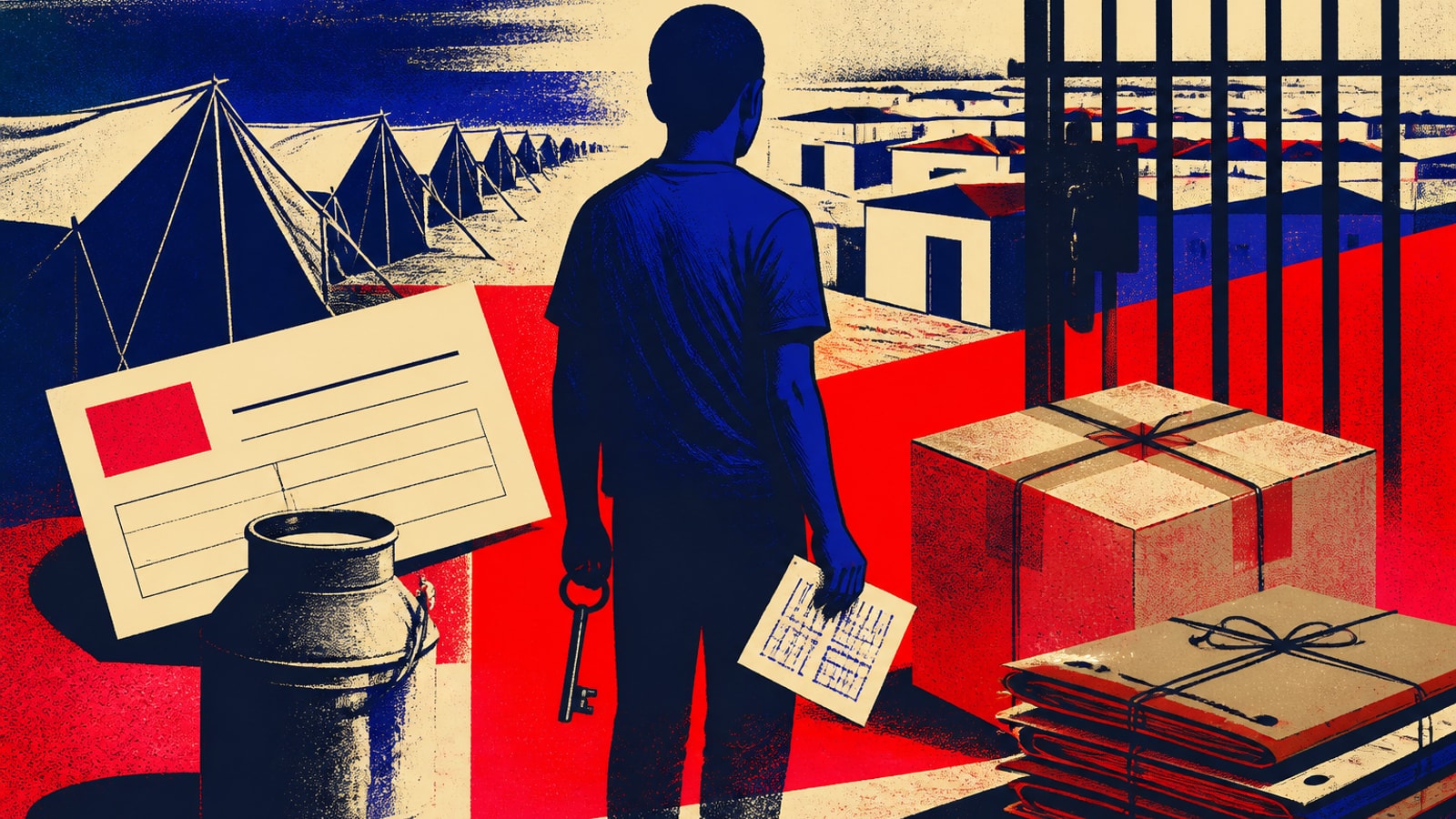
On the face of Israel’s own statutes, the two populations are governed by different rules: the Law of Return, enacted in 1950, gives every Jew the right to immigrate and, through the Citizenship Law of 1952, to acquire citizenship, while the roughly 700,000 Palestinians whom Benny Morris’s archival history (Cambridge University Press, 2004) records as displaced during the 1948 war, and their descendants, hold no equivalent statutory route to residence. What that means in practice depends on which population is being counted, and the published totals differ by nearly 3 million because each body counts under a different rule. Inside Israel the picture is different again: some of the people displaced in 1948 never crossed a border, and hold Israeli citizenship while their former property remains vested in a state custodian under a 1950 law.
Key Findings
- Israel’s Law of Return (1950) states that every Jew has the right to come to the country as an oleh, an immigrant; the Citizenship Law (1952) granted citizenship by residence only to those Palestinian Arabs who could document continuous presence from the state’s establishment. Both are enacted texts published by the Knesset.
- Benny Morris’s archival history of the 1948 war (2004) puts the displaced at roughly 700,000 and attributes the exodus to causes that varied by locality and phase, rejecting both a single master expulsion plan and the claim that departures were voluntary.
- The peer-reviewed Israel Law Review article 1948 Refugees records that about 400 Palestinian towns and villages were destroyed in the course of the military operations, resulting in the expulsion and flight of about 80% of the residents of the Palestinian regions on which the State of Israel was established.
- Israel’s High Court of Justice upheld the Citizenship and Entry into Israel Law, which restricts status for West Bank and Gaza spouses of Israeli citizens, by 6 votes to 5 in 2006 (HCJ 7052/03) and again in 2012 (HCJ 466/07); the order lapsed in July 2021 and the Knesset re-enacted it in March 2022.
Which laws decide who may return and who may not?
Three Israeli statutes, all enacted between 1950 and 1952, set the terms. The Law of Return (1950) gives every Jew the right to immigrate; the Citizenship Law (1952) granted citizenship by residence only to Palestinian Arabs who could document presence in Israel from the state’s establishment; and the Absentees’ Property Law (1950) vested property left by those absent in a state custodian.
Section 1 of the Law of Return, in the Knesset’s published English text, reads: “Every Jew has the right to come to this country as an oleh.” The Citizenship Law of 1952 supplies the corresponding route to nationality, so that a Jew who immigrates under the Law of Return becomes a citizen on arrival. The same 1952 law provides a separate residence-based route for those who were not Jewish immigrants, and it is that route the 1948 displacement closed off: it required registration as a resident and presence in the country across a defined continuous period, a condition that a person who had left in 1948 and had not returned could not satisfy.
The Absentees’ Property Law of 1950 addressed what those who left had owned. It defined an absentee by location during a dated window running from 29 November 1947, and vested the property of anyone meeting that definition in a Custodian of Absentee Property. The classification attached to the property through the owner’s whereabouts, not through any finding about the owner’s conduct.
Two later instruments sit on top of this base. Basic Law: Israel as the Nation-State of the Jewish People, adopted in 2018, states at clause 1(c) that “The realization of the right to national self-determination in the State of Israel is exclusive to the Jewish People,” and at clause 5 that the State “shall be open to Jewish immigration, and the ingathering of the exiles.” The Citizenship and Entry into Israel Law, first enacted as a temporary order in 2003, governs family reunification and is treated in its own section below. The full set of Israeli statutes cited in this debate is broader, but these are the instruments that decide return and status.
Is it often said refugees are denied residency and nationality?
It is often said that Israel denies Palestinian refugees the residency and nationality it grants Jews. On the archival record the directional point holds: Benny Morris’s history of the 1948 war (2004) puts the displaced at roughly 700,000, and no Israeli statute enacted since has opened a route back to residence for them or for their descendants.
The claim has two named holders. Human Rights Watch, in its April 2021 report A Threshold Crossed, states that Israeli authorities have denied millions of Palestinians residency and nationality, and identifies more than 700,000 people who fled or were expelled in 1948, together with their descendants, as excluded by the Citizenship Law of 1952. Amnesty International, in its February 2022 report on Israel and the Occupied Palestinian Territory, states that Palestinians displaced in 1947 to 1949 and in 1967, and their descendants, remain denied return, and characterises that denial as a flagrant violation of international law. Both are the determinations of monitoring organizations with advocacy missions, made on their own definitions and published under their own names.
What the statutes themselves condition on is narrower than the characterisation, and it is worth stating exactly. The 1952 law’s residence route turns on documented registration and continuous presence, a test of physical location across dated years rather than a test of ethnicity; the Law of Return’s test is the applicant’s status as a Jew. The asymmetry the claim describes is produced by the two instruments read together, and neither instrument states a bar on Palestinians by name.
On the scale of the displacement itself, the peer-reviewed Israel Law Review article 1948 Refugees records that about 400 Palestinian towns and villages were destroyed in the course of the Zionist and Israeli military operations, resulting in the expulsion and flight of about 80% of the residents of the Palestinian regions on which the State of Israel was established. That figure and Morris’s roughly 700,000 measure different quantities, a share of a regional population and an absolute count, and the two are not interchangeable. How the departures came about is a separate and live dispute among historians, addressed further below.
How many Palestinian refugees are there, and who counts them?
No census of Palestinian refugees exists. The published totals run from 5.6 million, the registration figure Amnesty International reported in 2022, to 8.36 million, the total BADIL published in 2021, a spread of about 2.8 million, and the gap is definitional rather than empirical: each body counts a different population under a different rule.
Two of those totals are relays of the same registry. Amnesty International’s 2022 report gives 5.6 million refugees registered with the United Nations Relief and Works Agency; Human Rights Watch’s 2021 report gives 5.7 million on the same registry basis. A registry counts people who have registered and remain on file, which is a different quantity from a count of people displaced, and it excludes anyone who never registered.
Two further totals are broader. BADIL, in a 2013 submission to the United Nations human rights system, reported at least 7.4 million displaced Palestinians, itemised as 5.8 million 1948 refugees, more than 1 million 1967 refugees and 519,000 internally displaced persons; its 2021 survey reported 8.36 million. Those are that organization’s own counts on its own definitions, and the internally displaced component is the clearest single reason the totals diverge, because it counts people who never crossed a border.
The one enumeration of the resident population in the territory is an official record and it counts something else again. The Palestinian Central Bureau of Statistics counted 4,780,978 residents in its 2017 census, 2,881,687 in the West Bank and 1,899,291 in Gaza, on a reference date of 1 December 2017. That is a de facto count of persons present, not a count of refugees, and East Jerusalem could not be directly enumerated, so administrative estimates were used there. It is also the most recent full census, which means every later total for the territory in the World Bank and United Nations series is a projection off that measured base rather than a count.
No published figure in this set is a census of refugees, and none of the four totals above is presented by its publisher as one.
What status do 1948 refugees who stayed inside Israel hold?
Roughly 400 Palestinian towns and villages were destroyed in the course of the 1948 military operations, per the peer-reviewed Israel Law Review article 1948 Refugees, and some of the people displaced from them never left the territory that became Israel. They acquired Israeli citizenship while their property remained classified as absentee property under the Absentees’ Property Law of 1950.
The category exists because the two statutes test different things. Citizenship under the 1952 law turned on registration and continuous presence in the country; the absentee classification under the 1950 law turned on where a person was located during the dated window the law specifies, including any part of Palestine outside Israeli control. A person who left one village for another inside the new state’s boundaries could satisfy the citizenship test and meet the absentee definition at the same time. The result is a status in which the citizen and the dispossessed owner are the same person, and it is a construction of Israeli statute rather than of any external determination.
BADIL, on its own definitions, counted 519,000 internally displaced Palestinians in its 2013 submission. That figure is the closest published estimate of the population this section describes, and no Israeli official series publishes a corresponding count, because the Israeli registers record citizenship and locality rather than displacement history.
What the Israeli official record does show is the size of the population within which these citizens sit. Israel’s Central Bureau of Statistics reported that in September 2025 the country’s population stood at about 10.148 million, comprising roughly 7.758 million Jews and others and 2.130 million Arabs, with the remaining roughly 260,000 counted as foreign residents.
The founding text addressed the same population directly. The Declaration of the Establishment of the State of Israel, read on 14 May 1948, appeals “to the Arab inhabitants of the State of Israel to preserve peace and participate in the upbuilding of the State on the basis of full and equal citizenship and due representation in all its provisional and permanent institutions.” Its equality clause exists in two official English translations that differ on one word: the Knesset publishes “all its citizens,” the Ministry of Foreign Affairs “all its inhabitants.”
How do family reunification rules affect refugees’ relatives?
Israel’s High Court of Justice upheld the Citizenship and Entry into Israel Law by 6 votes to 5 in 2006 (HCJ 7052/03, Adalah v. Minister of Interior) and again by the same margin in 2012 (HCJ 466/07). The law, first enacted as a temporary order in 2003, bars the Interior Ministry from granting status in Israel to spouses from the West Bank and Gaza, subject to age and other exceptions.
The order was renewed annually until it lapsed in July 2021, when the Knesset failed to extend it, and was re-enacted in March 2022. Its stated basis is security. In both High Court rulings the state defended the measure on that ground, and in both the majority held it within constitutional bounds while a minority of five justices would have struck it down. The closeness of the split is itself part of the domestic record: the measure has never commanded a settled majority on Israel’s highest court.
The population this touches is not the registered refugee population abroad, but a subset of it that lives immediately adjacent to Israeli citizens: relatives of Palestinian citizens and residents of Israel who hold West Bank or Gaza identity documents. Where an earlier generation’s displacement placed family members on opposite sides of the 1949 lines, the reunification rules govern whether the family can live in one place. This is the everyday administrative mechanism that sits underneath the legal question of return, and unlike return it is decided case by case in a ministry.
The United States Department of State’s Country Reports on Human Rights Practices for Israel, the West Bank and Gaza, an official record mandated by Congress under the Foreign Assistance Act of 1961, record in their 2022 and 2023 editions that Israeli authorities restricted family reunification for Palestinian spouses and that processing of residency and status applications was subject to delay. The reports describe practice; they publish no count of applications refused, and no Israeli ministry publishes one either.
What does the US government’s own report record about refugee status?
The Department of State publishes the Israel, West Bank and Gaza country reports annually, most recently covering calendar year 2023, and they contain no published count of Palestinian refugees denied residency or nationality. What they contain is a description of practice, produced by one government about another and submitted to Congress.
The reports are structured to separate jurisdictions, treating Israel in one chapter and the West Bank and Gaza in another, with the Palestinian Authority and Hamas addressed as separate authorities within the latter. That structure matters for the question, because the status of a Palestinian refugee differs by where the person is: a resident of the West Bank, a resident of Gaza, a citizen of Israel and a registered refugee in a third country each fall under a different administrative regime, and the country reports do not merge them.
Within those chapters the recorded material relevant to refugees concerns residency and status: restrictions on family reunification, the permit regime governing movement between the West Bank, Gaza and Israel, and delays in the processing of residency applications. The reports set out these as practices observed during the reporting year, sourced to the department’s own reporting and to material it identifies.
The absence of a number is the load-bearing fact here, and it is not confined to this source. Neither the Israeli Ministry of the Interior, nor the Central Bureau of Statistics, nor the State Department publishes a series recording how many people have been refused status on the ground that they or their forebears left in 1948. The registries that do publish totals count registration, not refusal. A reader looking for the quantity that would settle the question by arithmetic will not find it in any official series, and this report does not supply one in its place.
That leaves the official record doing what it can do: establishing what the statutes say, what the courts have held, and what practice one government has recorded of another.
Do refugees and non-refugees differ measurably in living standards?
On education and fertility, the measured gap between refugees and non-refugees is small. Al-Qudsi’s 2000 comparison in International Migration (peer-reviewed) found Palestinian refugees from the West Bank and Gaza somewhat better educated than non-refugees, with only slightly higher fertility, a pairing that runs against the expectation that refugee status tracks uniformly worse outcomes.
The study compares the two populations on education, labour-market attainment and family and demographic attributes. Its publisher withholds the abstract and gates the full text, so the finding is carried here at the level of the paper’s stated refugee-versus-non-refugee comparison rather than as quoted coefficients. It also measures outcomes in host settings, not the effect of any Israeli policy, and nothing in it establishes a cause for the difference it reports.
A second peer-reviewed data point concerns what registration means in service terms. Hababeh and colleagues (2018), reporting in a Lancet supplement from the Lancet Palestinian Health Alliance meeting, surveyed Palestine refugee mothers of young children attending UNRWA Well Baby Clinics across the West Bank, Gaza, Jordan, Lebanon and Syria between June and December 2015. They found modern contraceptive use substantial among that population, with the authors’ own emphasis falling on the method mix and on low uptake of long-acting reversible contraception. It is a meeting abstract rather than a full research article, so the reported detail is limited, and its sample is drawn from clinic attenders, not from the refugee population at large.
Read together, the two studies establish something narrower than the legal claim and something different in kind. Registration confers access to a service network that measurably reaches the people on it, and the measured differences between registered refugees and their non-refugee neighbours on education and fertility are modest. Neither result speaks to whether return or status is available, which is the question the statutes settle, and neither can be used to answer it. Living-standard measurement and legal-status measurement are separate phenomena, and collapsing them yields a claim that neither literature supports.
Where do scholars dispute the refugee definition and descent registration?
The definitional dispute turns on one rule: the registry that produces the widely cited totals registers the descendants of 1948 refugees, so the registered population grows across generations. The Anti-Defamation League’s backgrounder on Palestinian refugees, published by a monitoring organization with an advocacy mission, holds that this descent-based registration makes the Palestinian count unlike the treatment other refugee populations receive under the UN High Commissioner for Refugees.
The legal architecture behind that difference is set out in the Boston University School of Law faculty scholarship paper Myths and Realities of the Palestinian Refugee Problem, which examines how the separate agency regime established for Palestinian refugees relates to the general refugee definition and to the protection framework applied elsewhere. The paper’s account and the ADL backgrounder start from the same structural fact, that two different international regimes apply, and draw different conclusions from it. That both exist, dated and under names, is the answer to the question of whether the point is contested: it is, in print, by identifiable parties.
The historical dispute is separate and sharper. Benny Morris, in The Birth of the Palestinian Refugee Problem Revisited (Cambridge University Press, 2004), reconstructs the 1948 exodus from Israeli military and state archives and attributes it to multiple causes varying by locality and phase, including military attack, fear of attack, expulsions in certain sectors, and flight. He rejects both a single master expulsion plan and the claim that departures were voluntary. Ilan Pappé, in The Ethnic Cleansing of Palestine (Oneworld, 2006), argues that the displacement was a planned ethnic cleansing, and that book is the strongest scholarly statement of the characterisation. The two are the named poles of a live disagreement over intent, worked from overlapping archives, and neither has displaced the other in the literature.
Both disputes bear directly on the refugee question without settling it. How many people count as refugees depends on the registration rule; how their displacement is characterised depends on a reading of the 1948 archives that two historians of the period read in opposite directions.
Methodology and limitations
This report is assembled from four source types, each labelled where it is used. Enacted texts and official records: the Law of Return (1950), the Citizenship Law (1952), the Absentees’ Property Law (1950), the Citizenship and Entry into Israel Law (temporary order, 2003, re-enacted 2022) and Basic Law: Israel as the Nation-State of the Jewish People (2018), in the translations published by the Knesset, which labels its Basic Law translation unofficial; the Declaration of the Establishment of the State of Israel (1948); the rulings of Israel’s High Court of Justice in HCJ 7052/03 (2006), HCJ 466/07 (2012) and HCJ 5555/18 (2021); the Israel Central Bureau of Statistics population releases; the Palestinian Central Bureau of Statistics census of 2017; and the US Department of State country reports. Peer-reviewed research: Al-Qudsi (2000) and the Israel Law Review article 1948 Refugees. Scholarly books: Morris (2004) and Pappé (2006), interpretive history rather than measurement. Monitoring and advocacy organizations, named where their figure is the circulating claim and labelled as that body’s own count on its own definitions: Amnesty International (2022), Human Rights Watch (2021), BADIL (2013, 2021) and the Anti-Defamation League.
Limitations, stated as facts about the record. No published total of Palestinian refugees rests on a census; registry figures count registration and are not comparable with displacement estimates or with resident counts. The 2017 Palestinian census is the last full enumeration in the territory, so later totals in the World Bank and United Nations series are projections off it, and East Jerusalem was covered there by administrative estimate. Israel’s Central Bureau of Statistics counts East Jerusalem residents and West Bank settlers inside Israel’s total, a scope choice distinct from the convention international monitors use. Al-Qudsi (2000) is carried at the level of its stated refugee-versus-non-refugee comparison, because the publisher gates the full text; Hababeh and colleagues (2018) is a conference abstract in a journal supplement. No official series in Israel or the United States publishes a count of individuals refused residency or nationality on grounds of 1948 or 1967 displacement, and none is supplied here in its place.
Conclusion
So does Israel discriminate against Palestinian refugees? On the enacted texts, the two populations are governed by different rules, and the difference is written into statute rather than inferred: the Law of Return (1950) gives every Jew a right of immigration, the Citizenship Law (1952) conditioned the residence route on a continuity of presence that the roughly 700,000 people Morris records as displaced in 1948 could not satisfy, and the Absentees’ Property Law (1950) placed what they owned with a state custodian. The 2018 Basic Law states that the realization of national self-determination in Israel is exclusive to the Jewish People. Those are the instruments, and a reader can check every one of them.
What the same record refuses to yield is a number. The totals in circulation run from 5.6 million to 8.36 million because registries, displacement estimates and resident censuses count different populations under different rules, and no body publishes a count of people refused status. Israel’s own highest court has twice upheld the family reunification restriction, both times by 6 votes to 5, which places the domestic legal question one vote from the opposite outcome. Inside Israel there are citizens whose former property remains classified as absentee, a status produced by two statutes reading a single person in two ways. And the peer-reviewed comparisons of refugees with non-refugees find differences on education and fertility that are small, a finding that sits beside the legal question rather than answering it.
The two halves of that record answer different kinds of question. An enacted text can be read down to its clause and a court split recorded to the vote; the population those rules govern has no established size and no register of who has been refused. The public argument over return proceeds anyway, on totals that differ by millions because the bodies publishing them are not counting the same people. When a legal question this precise is contested over a population this uncounted, how much of the disagreement is about what the statutes say, and how much is about who is being counted?
Frequently Asked Questions
Which Israeli law grants Jews an automatic right to immigrate?
The Law of Return, enacted in 1950. Section 1, in the Knesset’s published English text, reads: “Every Jew has the right to come to this country as an oleh.” The Citizenship Law of 1952 supplies the corresponding route to nationality on arrival.
Why do published counts of Palestinian refugees differ by millions?
Because the counting rules differ. Amnesty International reported 5.6 million registered refugees in 2022 and Human Rights Watch 5.7 million in 2021, both relaying an agency registry; BADIL published at least 7.4 million in 2013 and 8.36 million in 2021 on a broader definition that includes internally displaced persons. None is a census.
Does Israel count East Jerusalem residents in its own population?
Yes. The Israel Central Bureau of Statistics reported that Jerusalem’s residents passed one million at the end of 2023, 60.5% Jews and others and 39.5% Arabs, counting the neighbourhoods annexed after 1967 inside the single municipal figure. International monitors count those residents separately.
What is a present absentee?
A person who holds Israeli citizenship while their property is classified as absentee property under the Absentees’ Property Law of 1950. The two statutes test different things, citizenship by registration and continuous presence, absentee status by location during a dated window from 29 November 1947, so both can apply to the same person.
Has Israel’s Supreme Court ruled on the 2018 Nation-State Law?
Yes. In HCJ 5555/18, decided on 8 July 2021 by an eleven-justice panel, the Court dismissed fifteen petitions and upheld the Basic Law, while holding that the Knesset as constituent authority has no power to deny the state’s core character as Jewish and democratic.
How large is the Arab population of Israel today?
About 2.130 million, per the Central Bureau of Statistics release of September 2025, alongside roughly 7.758 million Jews and others within a total of about 10.148 million residents that also includes some 260,000 foreign residents.
What did the last Palestinian census count?
The Palestinian Central Bureau of Statistics counted 4,780,978 residents on 1 December 2017, comprising 2,881,687 in the West Bank and 1,899,291 in Gaza. It enumerated persons present, not refugees, and used administrative estimates for East Jerusalem.
Sources
- Al-Qudsi, S., 2000. Profiles of Refugee and Non-Refugee Palestinians from the West Bank and Gaza. International Migration, 38(4). DOI 10.1111/1468-2435.00121. Peer-reviewed.
- Anti-Defamation League, no date. Palestinian Refugees (backgrounder). adl.org. Monitoring organization, advocacy mission.
- Boston University School of Law, no date. Myths and Realities of the Palestinian Refugee Problem. Faculty scholarship, scholarship.law.bu.edu. Academic scholarship.
- Central Bureau of Statistics (Israel), 2024. Selected Data on the Occasion of Jerusalem Day, 2024. Media Release 165/2024. cbs.gov.il. Official record.
- Central Bureau of Statistics (Israel), 2025. Population of Israel on the Eve of Rosh Hashana 5786. cbs.gov.il. Official record.
- Hababeh, M., and colleagues, 2018. Contraceptive use by Palestine refugee mothers of young children attending UNRWA clinics. The Lancet, 391(S2). DOI 10.1016/S0140-6736(18)30392-1. Conference abstract in a peer-reviewed supplement.
- Israel Law Review, no date. 1948 Refugees. Cambridge University Press. Peer-reviewed.
- Knesset, 1950. Law of Return, 5710-1950. Enacted text, main.knesset.gov.il. Official record.
- Knesset, 1950. Absentees’ Property Law, 5710-1950. Enacted text. Official record.
- Knesset, 1952. Citizenship Law, 5712-1952. Enacted text. Official record.
- Knesset, 2003 and 2022. Citizenship and Entry into Israel Law (Temporary Order). Enacted text. Official record.
- Knesset, 2018. Basic Law: Israel as the Nation-State of the Jewish People. Official English translation, main.knesset.gov.il. Official record.
- Morris, B., 2004. The Birth of the Palestinian Refugee Problem Revisited, 2nd edition. Cambridge University Press. ISBN 978-0521009676. Scholarly book.
- Palestinian Central Bureau of Statistics, 2018. Population, Housing and Establishments Census 2017: Final Results. Ramallah. pcbs.gov.ps. Official record.
- Pappé, I., 2006. The Ethnic Cleansing of Palestine. Oneworld Publications. Scholarly book.
- Provisional Government of Israel, 1948. Declaration of the Establishment of the State of Israel. Official Gazette No. 1, 14 May 1948. Official record.
- Supreme Court of Israel sitting as High Court of Justice, 2006. HCJ 7052/03, Adalah v. Minister of Interior. Court judgment.
- Supreme Court of Israel sitting as High Court of Justice, 2012. HCJ 466/07, Galon v. Attorney General. Court judgment.
- Supreme Court of Israel sitting as High Court of Justice, 2021. HCJ 5555/18, Hasson v. Knesset. Judgment of 8 July 2021. Court judgment.
- US Department of State, 2023 and 2024. Country Reports on Human Rights Practices: Israel, West Bank and Gaza (2022 and 2023 editions). state.gov. Official record.