
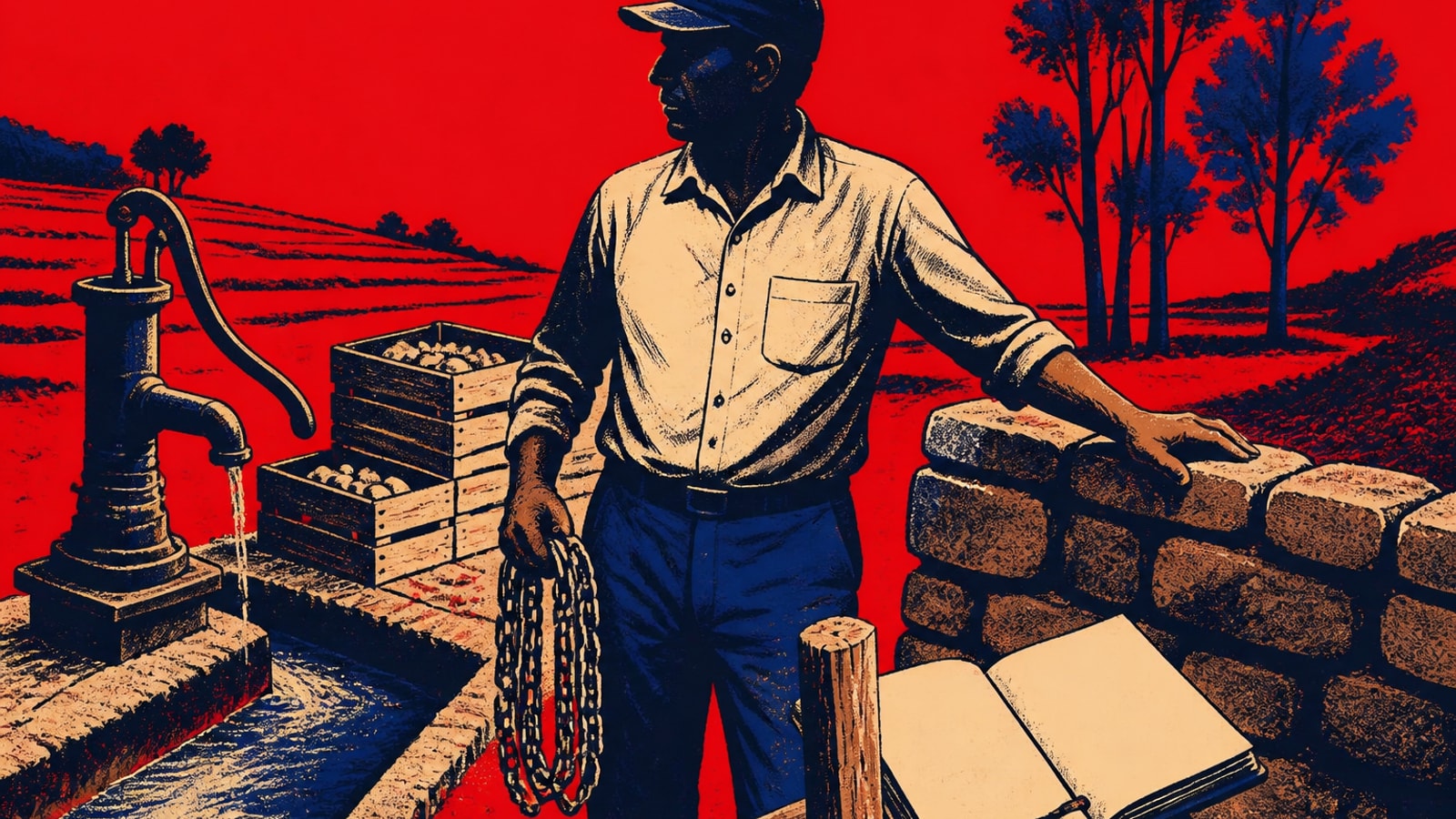
Contact between the first Zionist agricultural colonies and the Palestinian villages around them was routine, economic and litigious: some colonies hired five to ten times as many Palestinian as Jewish workers, the ratio reported in Lorena Neal’s 1995 Illinois Wesleyan University honors paper on the roots of the conflict from 1882 to 1914 (an undergraduate paper, not peer-reviewed), and Yuval Ben-Bassat (2009, peer-reviewed), working from the colonies’ own archives, finds that where colonies and villagers came to blows “the immediate causes were generally disputes over property boundaries and grazing.” The first reported major clash between settlers and peasants is dated to March 1886, four years after the first colonies were founded. The surviving record reads neither as two sealed worlds nor as one shared one, and the two poles of the scholarship, Benny Morris (2004) and Ilan Pappé (2006), work from overlapping archives and part company over what that record was building toward.
Key Findings
- Some early Zionist colonies employed five to ten times as many Palestinian as Jewish workers, per Lorena Neal’s 1995 Illinois Wesleyan University honors paper covering 1882 to 1914 (undergraduate, not peer-reviewed).
- Yuval Ben-Bassat (2009, peer-reviewed), working from the local archives of five of the six first-aliyah Judean colonies, reports that clashes with neighbouring Arab villagers “were not common, but they did occur from time to time,” and that “the immediate causes were generally disputes over property boundaries and grazing.”
- Benny Morris, in The Birth of the Palestinian Refugee Problem Revisited (2004, Cambridge University Press), records Palestinian tenant cultivators displaced when Ottoman-era estates were sold, and attributes the 1948 exodus of roughly 700,000 Palestinians to causes varying by locality and phase, rejecting both a master expulsion plan and voluntary departure.
- Ilan Pappé, in The Ethnic Cleansing of Palestine (2006), argues from overlapping archives that the 1948 displacement was planned, the named counter-pole to Morris.
- Israel’s Declaration of the Establishment of the State, 14 May 1948, appeals “to the Arab inhabitants of the State of Israel to preserve peace and participate in the upbuilding of the State,” 51 years after the First Zionist Congress its recitals date to 1897.
What did daily contact between settlers and villagers involve?
Wages and litigation: some of the first colonies hired five to ten times as many Palestinian as Jewish workers, the ratio reported in Neal’s honors paper on the period 1882 to 1914 (undergraduate work, not peer-reviewed), and the same colonies took their quarrels with the villages beside them to the Ottoman authorities and to court.
Those two facts describe the same relationship. Yuval Ben-Bassat’s study of the six Judean colonies southeast of Jaffa, published in the Journal of Palestine Studies in 2009, is built on the “understudied primary documents found in the local archives of five out of the six former first ‘aliyah Judean colonies,” among them “logbooks, personal letters, receipts, contracts, maps, and pictures.” The problems those colonies faced with their Arab neighbours, he writes, are usually described as arising from “disputes over natural resources such as water, land, and grazing rights.”
His own summary of the friction is more specific. Clashes with neighbouring villagers “were not common, but they did occur from time to time in several of the colonies (Gederah, Rehovot, and Qastina), culminating in injuries and even deaths,” and “the immediate causes were generally disputes over property boundaries and grazing.” He records the Rothschild administration asking the Ottoman authorities to prosecute Arabs who damaged colony property, and a trial Rehovot brought against the village of Zarnuqa after a clash “sparked by a dispute over grazing rights.”
Disputes of this kind arise between any two adjacent farming communities. What made them accumulate into something else was that one community was arriving, buying and expanding, and the boundary argued over was moving in one direction.
The character of individual relations is the part of this record least amenable to counting. Logbooks, letters and receipts record transactions and complaints, and no source reviewed here supplies a rate, a share or a tally for hostility or for goodwill in the settlement period.
Contact was therefore neither segregation nor partnership. It was proximity with an economic dependency running one way, wages, and a legal and physical dependency running the other, land and grazing, in a period when the ownership of both was changing.
Did land purchases displace the families farming the land?
It is often said that the Zionist purchases of the 1880s and 1890s, made from absentee Ottoman landlords, evicted the tenant farmers who worked the land. In documented cases that is what happened: Benny Morris, in The Birth of the Palestinian Refugee Problem Revisited (2004, Cambridge University Press), records Palestinian tenant cultivators displaced when estates changed hands, title passing from an owner who did not farm to a purchaser who did not inherit the tenancy.
The mechanism is the point. Under the Ottoman land regime, registered ownership and actual cultivation were frequently held by different people, and a sale settled the first without the second. A purchase that was, in the register, an ordinary transaction between two willing parties could remove a family that had farmed the plot for generations and held no registered claim to it. Ben-Bassat (2009) records that about a dozen absentee landlords, in many cases Christians from nearby Jaffa, sold the colonists much of the land settled in that region. He does not trace any given dispute to any given sale, so the link between a transfer of paper title and a boundary argued over in the field is a reading the record permits rather than one it measures.
Scale is where the circulating account is thinnest. The figure most often repeated for the pre-war period is that Zionist purchases had secured about 2% of Palestine’s area by 1914; in the material available here it appears in later summaries without an identifiable original publisher, and no auditable acreage series for that date is available from a named body, which is why the question of who owned the land of Palestine is answered from the registers rather than from a single percentage. Displacement in the purchase period is documented case by case; a total is not.
The 1948 war is a separate event and should not be folded into the purchase record. Morris (2004) puts the number of Palestinians who became refugees during that war at roughly 700,000, attributing the exodus to causes that varied by locality and phase, including military attack, fear of attack, expulsions in certain sectors, and flight. Sixty-six years separate the first colonies from that displacement, and the archival account of the 1948 removals is not a description of an 1890s land sale.
Did the colonies hire Palestinian labor or exclude it?
Both, in sequence: the first-wave colonies employed Palestinian labor heavily, five to ten times as many Palestinian as Jewish workers in some cases per Neal’s honors paper, and the same colonies later voted to stop leasing their land to Arabs, a decision Ben-Bassat (2009) records at Gederah, Rehovot and Rishon le-Zion.
Ben-Bassat sets out the economic side plainly. Economic connections with the Arab population, he writes, “predominantly revolved around the employment of low-wage day workers, especially during the high agricultural seasons, a situation which, according to some indications, created pockets of resentment among the Arab workers.” In the colonies it ran, the Rothschild administration “set the ratio between Jewish and Arab workers, fixed the workers’ wages” and “established the rules of conduct” toward them. Employment was managed, not incidental.
The turn away from it is dated in the same archives. Ben-Bassat quotes Baron Edmond de Rothschild’s wish, expressed in 1899, to see “the whole region [hevel] between Eqron and Rishon le-Zion cultivated by Jewish workers and blooming.” Within a few years, “several Judean colonies opposed for the first time the lease of Jewish-owned land to Arabs”: Gederah’s managing committee decided at a meeting in 1903 to stop leasing land to Arabs, and “similar decisions were approved by Rehovot and Rishon le-Zion around that time in an effort to limit Arab presence in the colonies and reduce theft and damage to property.”
Two things follow. The first is that any single characterisation of early Zionist practice toward Palestinian workers is date-dependent. That the colonies were economically intertwined with Palestinian villages is accurate for the first period; that they acted to limit an Arab presence on their land is accurate for the second. Both are on the record, and neither cancels the other.
The second is that the rationale the record states is not the wage bill. The reason Ben-Bassat gives for the leasing decisions is “the widespread theft and damage to property in the colonies claimed to have been committed by the Arab rural population,” a claim he attributes to the colonists rather than establishes.
What the record does not supply is a rate. No source reviewed here reports what share of colonies adopted such restrictions, how many Palestinian workers lost employment, or how far any substitution went.
When was the first recorded clash between settlers and peasants?
March 1886. That is the date Neal’s honors paper on 1882 to 1914 gives for the first reported major clash between Zionist settlers and Palestinian peasants (undergraduate work, not peer-reviewed), four years after the establishment of the first colonies in 1882.
The interval is the useful part of that date. Violent friction is not a Mandate-era development that arrived with mass immigration, the Balfour Declaration of 2 November 1917, or the political contest over a future state. It is present within the first four years of settlement, at the scale of a colony and a village, over the same subjects the colony archives record: land, grazing, boundaries and the season’s labor.
What the 1886 date does not establish is a pattern. A first reported clash fixes an onset, not a frequency. No source reviewed here publishes a count of incidents per year, a casualty series, or a comparison of clash rates between colonies for the pre-1914 period, and the phrase “first reported” carries its own limit, since it records the earliest event that entered a surviving account rather than the earliest event. Ben-Bassat (2009), working the colony archives directly, puts the frequency no more precisely than “not common, but they did occur from time to time.”
Set beside the boundary and grazing disputes Ben-Bassat finds in the colony archives, the date marks where the documentary trail crosses from complaint to confrontation. The subjects on both sides of that line are the same subjects.
What did early Zionist writers say about the existing population?
Fifty-one years separate the First Zionist Congress of 1897 from the first founding instrument in which the movement’s institutions addressed the Arab population directly in a governing text: Israel’s Declaration of the Establishment of the State, read 14 May 1948, which appeals “to the Arab inhabitants of the State of Israel to preserve peace and participate in the upbuilding of the State on the basis of full and equal citizenship and due representation.”
That 1897 date is not supplied here from outside. The Declaration’s own recitals carry it, along with the Balfour Declaration of 2 November 1917, the League of Nations Mandate, and the UN General Assembly resolution of 29 November 1947, which the text calls a recognition that “is irrevocable.” The founding instrument narrates its own lineage, and the reader can see which parties it names.
The founding-period programmatic literature surveyed in Tyler Weisman’s 2014 paper “Zionism, 1862 to 1897: Foundations of a Movement,” published in the proceedings of the National Conference on Undergraduate Research by the University of North Carolina Asheville (undergraduate work, not peer-reviewed), is, by that survey’s account, organised around Jewish conditions in Europe, the case for territorial concentration, and settlement in Palestine as the vehicle. Joana Ricarte, in a 2023 Palgrave Macmillan chapter, reads the same founding documents, the Bilu manifesto of 1882, Herzl’s pamphlet of 1896 and the Basle Declaration of 1897, and writes that they “either deliberately ignore the existence of several communities that lived in Palestine at that time or imply that their will over the land is not worth consideration.” That is one scholar’s reading of the texts and not a measurement of anything. Where those texts do not address the existing inhabitants as a political community with claims of its own, the absence is a fact about the documents, not evidence of an intention in either direction.
One detail of the 1948 text matters for anyone quoting it. The two official Israeli English translations differ on the word the equality clause turns on: the Knesset publishes the promise of “complete equality of social and political rights to all its citizens,” while the Ministry of Foreign Affairs publishes the same sentence with “all its inhabitants.” The Hebrew is the original and both English versions are translations of it, so a quotation should name which text it is taking.
What this section supports is narrow and dated: a founding literature about settlement, and a founding instrument, half a century later, that speaks to the population settlement had reached.
When did local friction become organized political opposition?
The shift is dated to the Mandate decades: the United Nations Secretariat’s own published overview of the history of Palestine dates anti-Zionist riots to 1920, 1921, 1929 and 1939, followed by an Arab revolt running from 1936 to 1939, an account compiled by an intergovernmental body from its own materials rather than an independent measurement.
Those dates mark a change of scale and of subject. The disputes in the colony archives are between a colony and a village over a boundary, a grazing right or a season’s labor. The Mandate-era episodes are territory-wide, directed at immigration and land acquisition as policies rather than at any particular purchase, and they take place inside a governing framework, the League of Nations Mandate that Israel’s founding text names among its own antecedents, in which those policies were administered by a third party.
No source reviewed here measures that transition, and the mechanism usually offered for it is an argument rather than a finding. A relationship in which one population is buying land, restricting who may work and lease it, and growing by immigration produces grievances that no local settlement can discharge, because the grievance is about the direction of the whole rather than the terms of any one transaction. The colony-level dispute had a remedy, in a committee, a court or an Ottoman official. The territorial dispute had none.
Two limits on this section. First, the dated sequence above is a list of episodes as one body compiled them, not a measured series: it carries no incident counts, no casualty figures and no method statement. Second, the causal step from settlement practice to organised opposition is not established by these dates. They record that both occurred, and in that order; they do not measure how much of the second the first accounts for, and no source reviewed here does.
What the sequence does settle is the timing of the answer people are usually after. The relationship did not begin in political conflict, and it did not stay out of it. Four years to a first reported clash, and roughly four decades to a revolt.
Where do historians disagree about early Zionist intent?
Benny Morris (2004) and Ilan Pappé (2006) work the same period from overlapping archives and reach different conclusions. Morris’s The Birth of the Palestinian Refugee Problem Revisited, published by Cambridge University Press in a second edition in 2004 and built on Israeli military and state archives, attributes the departure of roughly 700,000 Palestinians in 1948 to causes that varied by locality and phase, and rejects both a single master expulsion plan and the claim that the departures were voluntary.
Pappé’s The Ethnic Cleansing of Palestine (2006) argues the opposite reading of the same events: that the displacement was a planned ethnic cleansing. That book is the strongest scholarly statement of the characterisation, and it is where the term’s use in this debate is anchored rather than a summary of someone else’s finding.
The disagreement is not principally about what the archives contain. It is about what the pattern in them amounts to. Morris’s account is a mosaic of local decisions taken under military pressure, some of them expulsions, whose aggregate outcome was mass displacement; Pappé’s is an account of a design whose local instances execute it. The pre-1948 settlement record enters the dispute as evidence on that question: whether the purchases, the tenancy displacements and the leasing restrictions were by-products of a settlement project or the early operation of a transfer policy.
Neither position is a fringe one, and neither is settled by the material either author cites. The Anti-Defamation League, an advocacy organisation, publishes a standing page rejecting the ethnic-cleansing characterisation, which is that organisation’s own position on its own definitions rather than an archival finding.
What a reader can take from the historiography is a boundary. The facts in the earlier sections, the tenancy displacements, the 1886 clash, the 1903 leasing decisions, the founding literature’s silences, are common ground. The inference from those facts to intent is where the published scholarship divides, between two named historians whose work rests on substantially the same documents.
Methodology and limitations
This report answers a historical question from the sources that document the period, each labelled by type. It measures the record, not the contested characterisations of Zionist intent.
Source types drawn on, and what each supports. Primary and official records: the Declaration of the Establishment of the State of Israel, 14 May 1948, published by the Provisional Government of Israel in Official Gazette Number 1 and available in two divergent official English translations, cited for its own text and its own recited chronology; the Palestinian Central Bureau of Statistics census series, cited only for the absence of census-based Palestinian population figures before 1997. Archival scholarship: Ben-Bassat (2009, Journal of Palestine Studies), a peer-reviewed study built on the local archives of five of the six first-aliyah Judean colonies, cited for the colony-level disputes, employment and leasing decisions it documents; Morris (2004) and Pappé (2006), interpretive works rather than measurement, cited for their stated findings and for the dispute between them. Peer-reviewed measurement: Harber and colleagues (2026) and Allington and colleagues (2023), cited with their samples and caveats. Interpretive edited-volume scholarship: Ricarte (2023, Palgrave Macmillan), cited only for her reading of the founding documents. Undergraduate research: Neal (1995, Illinois Wesleyan University) and Weisman (2014, National Conference on Undergraduate Research proceedings), both labelled at first use as undergraduate work that is not peer-reviewed.
Limits on the quantitative record. The five-to-ten labor ratio is the only employment figure available for the first-wave colonies, it comes from an undergraduate paper citing earlier scholarship, and it has no counterpart for the later period. The March 1886 clash is an onset date from the same paper. Both figures rest on a scanned 1995 typescript whose text could not be machine-read in full for this revision, so they are carried as that paper’s reported figures rather than as figures verified line by line here. The often-repeated claim that Zionist purchases had secured about 2% of Palestine by 1914 could not be traced to an identifiable original publisher, and is reported here as a circulating figure. The late-nineteenth-century Arab population figure of just under half a million has the same problem, and the Palestinian statistical authority’s census series begins in 1997, so no census-based Palestinian figure exists for the settlement period at all.
Where the literature disagrees, the disagreement is named: Morris and Pappé are set against each other, with the archival basis each cites. The chronology of Mandate-era riots and the 1936 to 1939 revolt is a sequence compiled by the United Nations Secretariat, used for its dates and carrying no measurement. The Anti-Defamation League’s rejection of the ethnic-cleansing characterisation is that organisation’s own stated position.
Conclusion
So did the two populations of the 1880s and 1890s live side by side or apart? Neither. They lived interleaved and unequally: Palestinian workers in the colonies’ fields at a ratio some colonies put at five to ten to one, Palestinian villages on the other side of the boundary and grazing disputes Ben-Bassat traces through the colonies’ own logbooks, and Palestinian tenant families removed by sales they were not party to.
The record holds several things at once, and each has a date. Contact was economic before it was political, and the first reported major clash arrives in March 1886, four years after the first colonies. The colonies that depended most on Palestinian labor were the same colonies whose committees voted, by 1903, to stop leasing land to Arabs. The founding literature of 1862 to 1897 argues about settlement; the founding instrument of 1948 is the first governing text to address the Arab inhabitants directly, and it does so by appealing to them to take part. Local disputes with local remedies were followed, across four decades, by riots and a revolt aimed at immigration and land purchase as such.
What sits underneath the split between Morris and Pappé is a question about ordinary things. A well, a field edge, a grazing right and a day’s wage are the smallest units in this record, and they are also the units in which a great many people now argue about who belongs where. When a dispute that began over where one holding ends is retold, a century later, as a story about what a people intended, how much of the original record survives the retelling, and how much of what the reader carries away was already decided before the first document was opened?
Frequently Asked Questions
Who legally owned the land the first colonies bought?
Registered ownership and actual cultivation were frequently held by different people under the Ottoman regime, and Morris (2004) records estates sold by owners who did not farm them, the cultivating tenants holding no registered claim. Ben-Bassat (2009) records about a dozen absentee landlords, many of them Christians from nearby Jaffa, selling the colonists much of the land in the Judean region.
How many Palestinians lived in Palestine in the late nineteenth century?
No census-based figure exists. The Palestinian Central Bureau of Statistics has conducted three censuses, in 1997, 2007 and 2017, and earlier figures are modelled or back-estimated. The commonly repeated late-nineteenth-century figure of just under half a million appears in later summaries without an identifiable original publisher.
Did the colonies stop employing Palestinian workers?
The record shows restriction, not a measured end. Ben-Bassat (2009) documents Gederah, Rehovot and Rishon le-Zion deciding around 1903 to stop leasing colony land to Arabs, “in an effort to limit Arab presence in the colonies.” No source reviewed here reports how many colonies adopted such decisions or how many workers were affected.
Why do the two English texts of Israel’s Declaration differ?
The Hebrew text of 14 May 1948 is the original and both English versions are translations. The Knesset publishes the equality clause as covering “all its citizens,” the Ministry of Foreign Affairs as covering “all its inhabitants.” Both are Israeli government publications, so a quotation should name which text it takes.
Is the 1948 displacement the same event as the early land purchases?
No, and Morris (2004) treats them separately. He puts the number displaced during the 1948 war at roughly 700,000, sixty-six years after the first colonies, and attributes it to causes varying by locality and phase, including military attack, fear of attack, expulsions and flight.
Does criticism of Israel’s founding register as antisemitism in the research?
The measured findings are associations, not definitions. Harber and colleagues (2026, peer-reviewed) report that conspiracy beliefs implicating Israel and Zionists mediated the relationship between antisemitism and anti-Israel attitudes, while beliefs about Jews unrelated to Israel did not. Allington, Hirsh and Katz (2023, peer-reviewed) found the anti-Zionist link in a 1,790-person UK sample largely accounted for by its overlap with attitudes toward Jews as Jews.
Sources
- Allington, D., Hirsh, D., and Katz, L., 2023. Correlation between coronavirus conspiracism and antisemitism: a cross-sectional study in the United Kingdom. Scientific Reports. DOI 10.1038/s41598-023-41794-y. Peer-reviewed.
- Ben-Bassat, Y., 2009. Proto-Zionist-Arab Encounters in Late Nineteenth-Century Palestine: Socioregional Dimensions. Journal of Palestine Studies, volume 38, number 2, pages 42 to 63. DOI 10.1525/jps.2009.38.2.42. Peer-reviewed.
- Harber, K., Bulska, D., Malloy, T., and Vila, J., 2026. Antisemitism, conspiracy beliefs, and anti-Israel attitudes. American Psychologist. DOI 10.1037/amp0001635. Peer-reviewed.
- Morris, B., 2004. The Birth of the Palestinian Refugee Problem Revisited, 2nd edition. Cambridge University Press. ISBN 978-0521009676. Scholarly book, archival history.
- Neal, L. S., 1995. The Roots of the Israeli-Palestinian Conflict: 1882 to 1914. Honors Projects, History 27, Illinois Wesleyan University. https://digitalcommons.iwu.edu/history_honproj/27. Undergraduate research, not peer-reviewed.
- Palestinian Central Bureau of Statistics, 2018. Population, Housing and Establishments Census 2017: final results. Ramallah. pcbs.gov.ps. Official record.
- Pappé, I., 2006. The Ethnic Cleansing of Palestine. Oneworld Publications. Scholarly book.
- Provisional Government of Israel, 1948. Declaration of the Establishment of the State of Israel. Official Gazette Number 1, Tel Aviv, 14 May 1948. main.knesset.gov.il/en/about/pages/declaration.aspx. Primary and official record.
- Ricarte, J., 2023. Before the Peace Process: Historical Roots of a Dysfunctional Relationship. In The Impact of Protracted Peace Processes on Identities in Conflict, pages 97 to 116. Palgrave Macmillan, Cham. DOI 10.1007/978-3-031-16567-2_4. Scholarly chapter, interpretive.
- Weisman, T., 2014. Zionism, 1862 to 1897: Foundations of a Movement. Proceedings of the National Conference on Undergraduate Research, published by the University of North Carolina Asheville. https://libjournals.unca.edu/ncur/wp-content/uploads/2021/08/1106-Weisman-1.pdf. Undergraduate research, not peer-reviewed.