
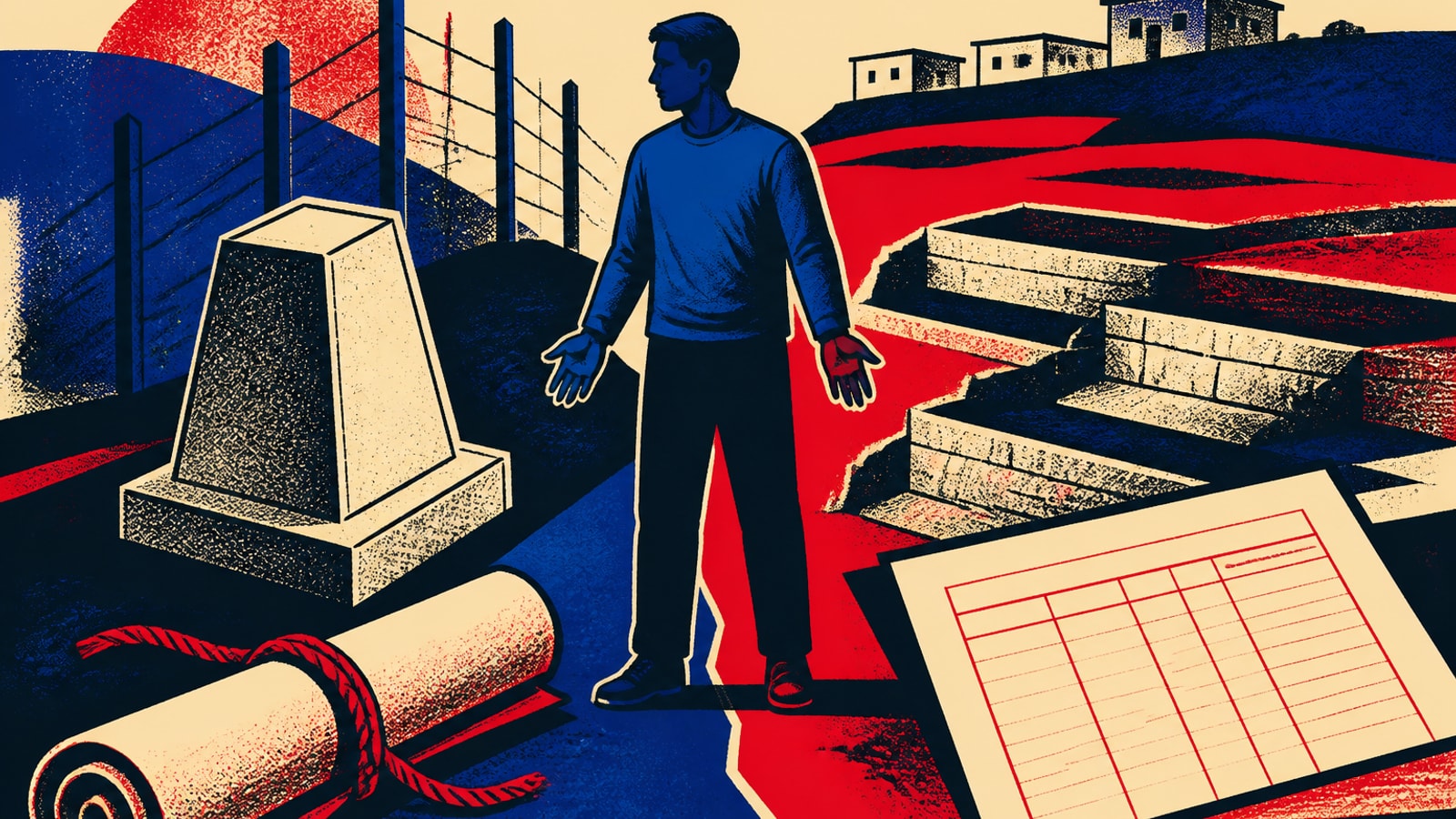
In the literature that applies it to Zionism, the phrase “colonial violence” names four categories of practice: land acquisition and settlement, displacement or transfer, armed force by militias and state forces, and structural domination. Violence, in ordinary use, names an act with a date and a place, which is why the phrase confuses readers who meet it: three of those four categories describe conditions rather than incidents, and none of the three treaties that define atrocity crimes contains an offence by that name. Two of the four carry official counts; the other two have no denominator in any source that uses them.
Key Findings
- Luke Anthony Lavin’s 2011 master’s thesis at the University of Utah defines colonialism as “the acquisition of control of a nation over a foreign territory, occupying it with settlers, and developing it economically while not extending the political, civic, and economic rights and benefits to the indigenous population,” a working definition the thesis states in its opening chapter without a citation of its own.
- Zero of the three instruments that define atrocity crimes contain an offence called colonialism: the 1948 Genocide Convention enumerates five acts plus a required intent, the 1973 Apartheid Convention enumerates six inhumane acts, and the 1998 Rome Statute enumerates four crimes: genocide, crimes against humanity, war crimes and the crime of aggression.
- Benny Morris (Cambridge University Press, 2004) puts the 1948 Palestinian displacement at roughly 700,000 people and finds no single master expulsion plan; Ilan Pappé (Oneworld, 2006) reads the same period as an executed plan.
- Basic Law: Israel as the Nation-State of the Jewish People (Knesset, 2018) states at clause 7 that “The State views the development of Jewish settlement as a national value”; Israel’s Supreme Court dismissed fifteen petitions against that law on 8 July 2021 while holding that the Knesset may not deny the state’s core democratic character.
- Sergio DellaPergola’s World Jewish Population chapter (2019) records 418,900 core Jews living in the West Bank at the beginning of 2019, one of the few elements of the taxonomy with a named author, a stated method and a number.
Which practices does the phrase colonial violence actually name?
Four. Luke Anthony Lavin’s 2011 University of Utah master’s thesis defines colonialism as “the acquisition of control of a nation over a foreign territory, occupying it with settlers, and developing it economically while not extending the political, civic, and economic rights and benefits to the indigenous population.” The phrase colonial violence names the coercion associated with each stage of that definition rather than any one act.
The first category is land acquisition and settlement, which Lavin’s definition treats as the definitional core: control of territory plus the arrival of settlers plus the withholding of political and civic rights from the resident population. Purchase, on this reading, sits inside the category rather than outside it, because the definition turns on the political exclusion that follows the transfer, not on whether the transfer was consensual.
The second is displacement or transfer, which in this literature covers both wartime flight and organised removal and is usually anchored to 1948.
The third is armed force by militias and state forces against civilians, the only one of the four that matches the ordinary meaning of the word violence.
The fourth is structural domination, meaning legal exclusion, territorial fragmentation and restricted sovereignty maintained over time. Settler Colonial Studies published an article in 2017 on Zionist hegemony and the settler-colonial conquest of Palestine that treats this fourth category as the framework’s organising claim rather than an addendum to the first three.
| Category | What it names | Where it is set out |
|---|---|---|
| Land acquisition and settlement | Territorial control plus settlement, without political rights for the resident population | Lavin, University of Utah master’s thesis, 2011 |
| Displacement or transfer | Removal of residents from land, wartime or organised | Morris, Cambridge University Press, 2004; Pappé, Oneworld, 2006 |
| Armed force | Force used by militias and state forces against civilians | Morris, Cambridge University Press, 2004 |
| Structural domination | Legal exclusion, fragmentation, restricted sovereignty, maintained over time | Settler Colonial Studies, 2017 |
Source: as listed per row. The four categories are analytic, not mutually exclusive, and no source assigns a share of practice to each.
Is the violence described as a structure rather than an event?
Yes, and that is the framework’s central claim rather than a nuance within it. Settler Colonial Studies published the reading in 2017, in an article treating Zionist hegemony and the conquest of Palestine as a continuing arrangement rather than a sequence of episodes. Zero of the texts that state this reading most directly report a count, a share or a rate.
Areej Sabbagh-Khoury’s study of the Zionist Left and land purchase in Mandate Palestine, reviewed by Sasha Marie Ward in The Journal of Interdisciplinary History (2024), locates the practice in what it calls colonization by purchase, before any state existed to direct it, and treats 1948 as an escalation from land accumulation into displacement. On that account the structural claim is chronological as well as conceptual: it holds that the pattern is legible across decades and does not require a single ordering authority at any point in them.
The reframe that matters for a reader weighing the phrase is one of evidence type. The structural reading is an analytic framework published in academic venues in the 2010s and 2020s, and the texts that carry it argue from documents, land records and political history rather than from a measured quantity. They report no incidence, no rate and no sample. That is not a defect in the scholarship, which does not present itself as measurement, but it does mean that a sentence beginning “colonial violence is ongoing” is a claim about how to characterise a pattern, and a sentence beginning “settler population in the West Bank stood at” is a claim about a count. The two travel together in ordinary use and answer to different standards.
The distinction also explains why the phrase resists a yes-or-no answer. A reader who asks whether colonial violence is occurring is asking whether a framework applies, and a framework applies or does not according to how its elements are defined, which is the subject of the section after next.
Does any treaty or court define colonial violence as an offence?
None of them. The 1948 Genocide Convention defines genocide by five enumerated acts plus a required intent to destroy a protected group in whole or in part. The 1973 Apartheid Convention defines the crime of apartheid by six enumerated inhumane acts committed to establish and maintain domination by one racial group over another.
The 1998 Rome Statute enumerates four crimes within the Court’s jurisdiction: genocide at Article 6, crimes against humanity at Article 7, war crimes at Article 8, and the crime of aggression at Article 8 bis. No offence called colonialism or colonial violence appears in any of the three.
This matters because the vocabulary that surrounds the phrase is borrowed from instruments that do define offences. Ethnic cleansing, dispossession and transfer are heard by readers as legal terms of art. Of the three, only forcible transfer of population maps onto an enumerated act, and it does so inside the apartheid and Rome Statute frameworks with their own elements and thresholds, not as a freestanding wrong. Ethnic cleansing is a descriptive term of scholarship and diplomacy rather than a treaty-defined crime.
No court has been asked to rule on an offence of colonial violence, because no instrument creates one. What courts have adjudicated are the enumerated crimes and, domestically, the constitutionality of specific statutes.
| Instrument | Year | What it enumerates | Offence named colonialism |
|---|---|---|---|
| Genocide Convention | 1948 | Five acts plus required intent | None |
| Apartheid Convention | 1973 | Six inhumane acts, plus domination purpose | None |
| Rome Statute | 1998 | War crimes and crimes against humanity | None |
Source: the treaty texts. The apartheid definition and its elements are examined in the Institute’s report on the apartheid definition under international law.
The consequence for reading the phrase is narrow and worth stating flatly. Colonial violence is an analytic category drawn from historical and sociological scholarship. It is not a charge in the sense that genocide, apartheid and forcible transfer are charges, and a text that uses it has not thereby alleged an enumerated crime.
Which part of the definition do the rejections actually contest?
Two elements, and neither is the occurrence of settlement. A 2024 Taylor & Francis article on the “exceptionalism” of the Israeli settler-colonial project, and the University of Washington’s Stroum Center for Jewish Studies in its published survey of the framework, both place the dispute on the same pair: whether a metropole directed the settlement, and whether the settlers were foreign to the territory.
The metropole objection runs on the definition’s own wording, which describes “control of a nation over a foreign territory.” Classical colonial cases carry a mother state that dispatches settlers and to which resources return. The Stroum Center sets out the objection that no such directing state exists in this case. The 2024 Middle East Critique article on exceptionalism addresses the same anomaly from inside the framework, asking why the case is treated as irregular by its own users.
The indigeneity objection contests the definition’s second half, that the arriving population is foreign to the territory and the resident population indigenous to it. The advocacy publications JNS and CAMERA on Campus, both writing from a stated pro-Israel position, press the same two points in shorter form.
Population records bear on the second objection without settling it. Israel’s Central Bureau of Statistics reported that of the 7.1 million Jews living in Israel at the beginning of 2024, 5.7 million were born in Israel and 1.4 million abroad, of whom about 1.0 million were born in Europe or the Americas and 275,000 in Africa. William Berthomière (1995) records more than 500,000 migrants arriving in Israel from the former Soviet Union from 1989.
Those are counts of birthplace across four generations, and neither side of the indigeneity dispute rests on birthplace alone: the argument is over ancestral claim and legal status, which no statistical bureau records.
Where do historians date the practice from, 1948 or earlier?
Roughly 700,000. Benny Morris’s The Birth of the Palestinian Refugee Problem Revisited (Cambridge University Press, 2004) puts the 1948 displacement at about that number, built from Israeli military and state archives, and finds no single master expulsion plan behind it. The dating dispute is not over whether mass displacement occurred but over when the practice began and whether it was directed.
Morris attributes the exodus to causes that varied by locality and by phase of the war: military attack, fear of attack, expulsions ordered in certain sectors, and flight. He rejects both the claim of one coordinating plan and the claim that departures were voluntary. Ilan Pappé’s The Ethnic Cleansing of Palestine (Oneworld, 2006) reads the same events as a planned removal carried out to design, and it is the named home of that characterisation rather than one restatement of it among others.
Sabbagh-Khoury’s study places the origin earlier still, in pre-state land purchase by the Zionist Left, and treats 1948 as the point at which accumulation escalated into displacement. That is a third position, not a variant of the first two: it dates the practice to the Mandate decades before 1948 and locates it in civilian institutions rather than in wartime command.
The three positions agree on more than the exchange usually shows. All three hold that displacement on the order of hundreds of thousands took place in 1948, and all three work substantially from the same archival base. What separates them is direction and onset, which is to say the two things the word colonial is doing when it is attached to the events: it asserts continuity across decades and it asserts design. Morris’s finding cuts against design without touching scale. Pappé asserts design. Sabbagh-Khoury asserts continuity.
A reader can hold Morris’s number and Pappé’s framing at once only by deciding which of the two archival readings is right, and the archives have not resolved it in the two decades since Morris’s second edition. The 1948 record itself, including the founding text and the votes around it, is examined in the Institute’s report on the 1948 expulsion question.
What do Israel’s own enacted texts say on these practices?
Basic Law: Israel as the Nation-State of the Jewish People (Knesset, 2018) states at clause 7, in the Knesset’s own English translation, which the Knesset labels unofficial, that “The State views the development of Jewish settlement as a national value, and shall act to encourage and promote its establishment and consolidation.” The same law states at clause 1(c) that “The realization of the right to national self-determination in the State of Israel is exclusive to the Jewish People.”
The founding text reads differently on rights. The Declaration of the Establishment of the State of Israel, published in Official Gazette Number 1 on 14 May 1948, pledges that the state “will ensure complete equality of social and political rights to all its citizens irrespective of religion, race or sex,” and appeals “to the Arab inhabitants of the State of Israel to preserve peace and participate in the upbuilding of the State on the basis of full and equal citizenship and due representation in all its provisional and permanent institutions.” The 2018 Basic Law contains no equality clause and no individual-rights clause. That is a fact about the text.
Israel’s own highest court has ruled on the law. In HCJ 5555/18 Hasson v. Knesset, decided 8 July 2021, an eleven-justice panel of the Supreme Court sitting as High Court of Justice dismissed fifteen petitions and upheld the Basic Law. The Court held at the same time that the Knesset as constituent authority is “not all powerful” and has no authority, even by Basic Law, to deny or facially contradict the core character of the state as Jewish and democratic, and it derived that limit from the Declaration of Independence, the Basic Laws, Knesset legislation and its own case law.
Both halves of that judgment are load-bearing. The law stands, and a domestic constitutional limit was articulated that the law was found not to cross. The statutes that carry this dispute, clause by clause, are set out in the Institute’s report on the Israeli laws called Jewish supremacist.
Which parts of the taxonomy carry a documented count?
418,900. Sergio DellaPergola’s World Jewish Population chapter (2019) records that many core Jews living in the West Bank at the beginning of 2019, alongside 221,800 in the East Jerusalem neighborhoods incorporated after 1967 and 23,200 on the Golan Heights. Settlement and population are counted. Structural domination and elimination are not.
How the counting is organised is itself contested, and the dispute is about categories rather than arithmetic. Sivan Hirsch-Hoefler and Lihi Ben Shitrit (2020) document that the Central Bureau of Statistics moved East Jerusalem into the general population count for Israel proper in its 1968 yearbook, folded settlers into Israel’s total under a 1970 footnote, counted settlement localities among Israeli localities by 1983, and removed the separate territories chapter in 1997. The monitoring organization B’Tselem publishes its West Bank and East Jerusalem figures as separate series, the opposite convention. Neither convention is an error; they answer different questions, and a total taken from one cannot be added to a total from the other.
The Palestinian side has a census. The Palestinian Central Bureau of Statistics counted 4,780,978 residents of the West Bank and Gaza on 1 December 2017, its third census round and the base from which the World Bank and United Nations series are projected forward. Israel’s Central Bureau of Statistics reported the country’s resident population at about 10.148 million in September 2025, comprising roughly 7.758 million Jews and others and 2.130 million Arabs, with the remainder foreign residents counted in the total but outside those two groups.
Set against that, the fourth category has no measure at all. No source in this literature publishes a rate of legal exclusion, a share of fragmented territory or an incidence of elimination, and none claims to. The category is argued, not counted, and a reader who wants a number for it will not find one.
Methodology
This report assembles the published definitions of a term and the records that bear on the practices it names. It measures how the phrase is defined and what is counted under it, not whether the characterisation it carries is correct.
Sources are drawn in the order the Institute’s hierarchy sets. Primary and official records: the Declaration of the Establishment of the State of Israel (Official Gazette Number 1, 14 May 1948); Basic Law: Israel as the Nation-State of the Jewish People (Knesset, 2018, English translation labelled unofficial by the Knesset); the Supreme Court judgment in HCJ 5555/18 Hasson v. Knesset (8 July 2021); the Palestinian Central Bureau of Statistics 2017 census; and Israel Central Bureau of Statistics media releases of 2025. Peer-reviewed research: Berthomière (1995); Ward’s 2024 review of Sabbagh-Khoury in The Journal of Interdisciplinary History; and the Taylor & Francis settler-colonial literature of 2017 and 2024. Scholarly books: Morris (Cambridge University Press, 2004) and Pappé (Oneworld, 2006). Academic reference: DellaPergola’s World Jewish Population chapters, which are the author’s own estimates rather than a government count. Unrefereed graduate work: Lavin’s 2011 University of Utah master’s thesis, which supplies the definition read in the first section.
Three limits apply to the figures used. DellaPergola’s territorial breakdown is a demographer’s estimate for the beginning of 2019 and is not an official statistic. Israel’s Central Bureau of Statistics counts East Jerusalem residents and West Bank settlers inside Israel’s national total, a scope choice different from the convention international monitors follow, so totals from the two conventions are not additive. Palestinian totals after 2017 are projections from the census base rather than enumerations.
One of the definitional sources is unrefereed graduate work. The definition of colonialism read here is stated flat in Lavin’s 2011 master’s thesis with no source attached to it, so it is carried as that thesis’s working definition and never as a standard or consensus formulation.
The 1948 displacement figure of roughly 700,000 is carried as Morris reports it from his archival base. Where Morris and Pappé disagree on whether that displacement was directed, both positions are named and dated, and the disagreement is reported as unresolved in the archival literature.
Conclusion
Violence, in ordinary use, names an act with a date and a place. The phrase examined here does not, and that is the answer to the question a reader arrives with: colonial violence, in the scholarship that applies it to Zionism, names a definitional package of four practices, of which only one, armed force against civilians, matches the ordinary meaning of the word.
The package divides cleanly along the line between what is counted and what is argued. Morris (2004) puts the 1948 displacement at roughly 700,000 from the Israeli archives. DellaPergola (2019) records 418,900 core Jews in the West Bank. The Palestinian Central Bureau of Statistics counted 4,780,978 residents in 2017. Israel’s own enacted texts state their terms without ambiguity: complete equality of social and political rights in the 1948 Declaration, Jewish settlement as a national value in clause 7 of the 2018 Basic Law, upheld by an eleven-justice Supreme Court panel on 8 July 2021 subject to a limit the Court set. Against that, structural domination and elimination carry no rate, no share and no denominator anywhere in the sources that name them, and no offence bearing the phrase appears in the 1948, 1973 or 1998 instruments. The dispute over whether the framework applies turns, in the texts that reject it, on two elements only: the absent metropole and the indigeneity question.
That leaves a phrase doing two jobs at once, one of them checkable and one of them not, and it travels through public argument as a single unit. Society will decide how much weight one term can bear when its uncountable half borrows the authority of its counted half. Is a vocabulary built to describe a structure also one of the channels through which older claims about Jewish collective character find a hearing?
Frequently Asked Questions
Which treaty defines apartheid, and how does that differ from the colonial framing?
The 1973 Apartheid Convention defines the crime by six enumerated inhumane acts committed for the purpose of establishing and maintaining domination by one racial group over another. It is a legal test with elements a tribunal can apply, whereas colonial violence is an analytic category with no enumerated acts and no instrument behind it.
Why do historians disagree about whether the 1948 displacement was directed?
Both Benny Morris (Cambridge University Press, 2004) and Ilan Pappé (Oneworld, 2006) work substantially from the same archival base and reach opposite readings of intent. Morris finds causes varying by locality and phase and no single master plan; Pappé reads the record as an executed design. The archives have not resolved it in the two decades since.
How many Palestinians does the Palestinian statistical authority count?
The Palestinian Central Bureau of Statistics counted 4,780,978 residents of the West Bank and Gaza in its census of 1 December 2017, comprising 2,881,687 in the West Bank and 1,899,291 in Gaza. Its brief on the status of the Palestinian people at the end of 2025 puts Gaza at about 2.13 million, an estimate rather than an enumeration.
Why do settler population figures differ between sources?
Because the counting conventions differ, not the arithmetic. Hirsch-Hoefler and Ben Shitrit (2020) document that Israel’s Central Bureau of Statistics has folded East Jerusalem and settler populations into Israel’s national total since 1968 and 1970 respectively, while monitoring organizations publish the West Bank and East Jerusalem as separate series. Totals from the two conventions cannot be added.
Which Jewish population figures are official statistics and which are author estimates?
Israel’s Central Bureau of Statistics figures, such as the roughly 10.148 million residents reported in September 2025, are official statistics of the national bureau. Sergio DellaPergola’s World Jewish Population chapters, including the 15,736,800 world total for 1 January 2024, are one demographer’s estimates published in an academic yearbook, hosted online by the bureau but not produced by it.
Where does the definition of colonialism in this report come from?
From a master’s thesis. Luke Anthony Lavin states it in the opening chapter of “The Zionist Cleansing of Palestine,” accepted for a Master of Arts at the University of Utah in August 2011, and attaches no source to it. It is unrefereed graduate work rather than peer-reviewed research, and this report cites it for a definition, never for a figure.
Sources
- Berthomière, W., 1995. The Migration of Jews from the Former Soviet Union: A New Challenge for Israel? Revue Européenne des Migrations Internationales, 11(3). PMID 12347243. Peer-reviewed.
- CAMERA on Campus. The False Comparison of Zionism and Colonialism. cameraoncampus.org. Advocacy publication.
- Central Bureau of Statistics, 2025. On the Occasion of Holocaust Day, 2025. Media release 124/2025, cbs.gov.il. Official record.
- Central Bureau of Statistics, 2025. Population of Israel on the Eve of Rosh Hashana 5786. Media release 304/2025, cbs.gov.il. Official record.
- DellaPergola, S., 2019. World Jewish Population, 2019. American Jewish Year Book 2019, vol. 119, Springer. Academic reference.
- DellaPergola, S., 2025. World Jewish Population, 2024. American Jewish Year Book 2024, Springer. Academic reference.
- Hirsch-Hoefler, S., and Ben Shitrit, L., 2020. So, How Many Settlements Are There? Counting, Tracking, and Normalizing Jewish Settlements in the Israeli Central Bureau of Statistics Yearbook, 1967 to the Present. POMEPS. Organizational report.
- Israeli Supreme Court sitting as High Court of Justice, 2021. HCJ 5555/18 Hasson v. Knesset, judgment of 8 July 2021. Official record (court judgment).
- JNS. The False Comparison of Zionism and Colonialism. jns.org. Advocacy publication.
- Knesset, 2018. Basic Law: Israel as the Nation-State of the Jewish People. Official English translation (labelled unofficial), main.knesset.gov.il. Official record (enacted legislation).
- Lavin, L. A., 2011. The Zionist Cleansing of Palestine. Master of Arts thesis, University of Utah, August 2011. ark:/87278/s6v12kh4. Unrefereed graduate thesis.
- Middle East Critique, 2024. Notes on the “Exceptionalism” of the Israeli Settler-Colonial Project. Taylor & Francis. DOI 10.1080/19436149.2024.2342733. Peer-reviewed.
- Morris, B., 2004. The Birth of the Palestinian Refugee Problem Revisited, 2nd edition. Cambridge University Press. ISBN 978-0521009676. Scholarly book.
- Palestinian Central Bureau of Statistics, 2018. Population, Housing and Establishments Census 2017, final results. Ramallah. pcbs.gov.ps. Official record (census).
- Palestinian Central Bureau of Statistics, 2025. A Brief on the Status of the Palestinian People at the End of 2025. Ramallah. pcbs.gov.ps. Official record.
- Pappé, I., 2006. The Ethnic Cleansing of Palestine. Oneworld Publications. Scholarly book.
- Provisional Government of Israel, 1948. Declaration of the Establishment of the State of Israel. Official Gazette Number 1, 14 May 1948. Official record (founding instrument).
- Settler Colonial Studies, 2017. Zionist Hegemony, the Settler Colonial Conquest of Palestine and the Problem with Conflict. Taylor & Francis. DOI 10.1080/2201473X.2017.1321171. Peer-reviewed.
- University of Washington, Stroum Center for Jewish Studies. Is Israel a Settler Colonial State? jewishstudies.washington.edu. University centre publication, undated on the page.
- Ward, S. M., 2024. Colonizing Palestine: The Zionist Left and the Making of the Palestinian Nakba by Areej Sabbagh-Khoury. The Journal of Interdisciplinary History, 55(2), pp. 308 to 311. MIT Press. DOI 10.1162/jinh_r_02057. Peer-reviewed (book review).